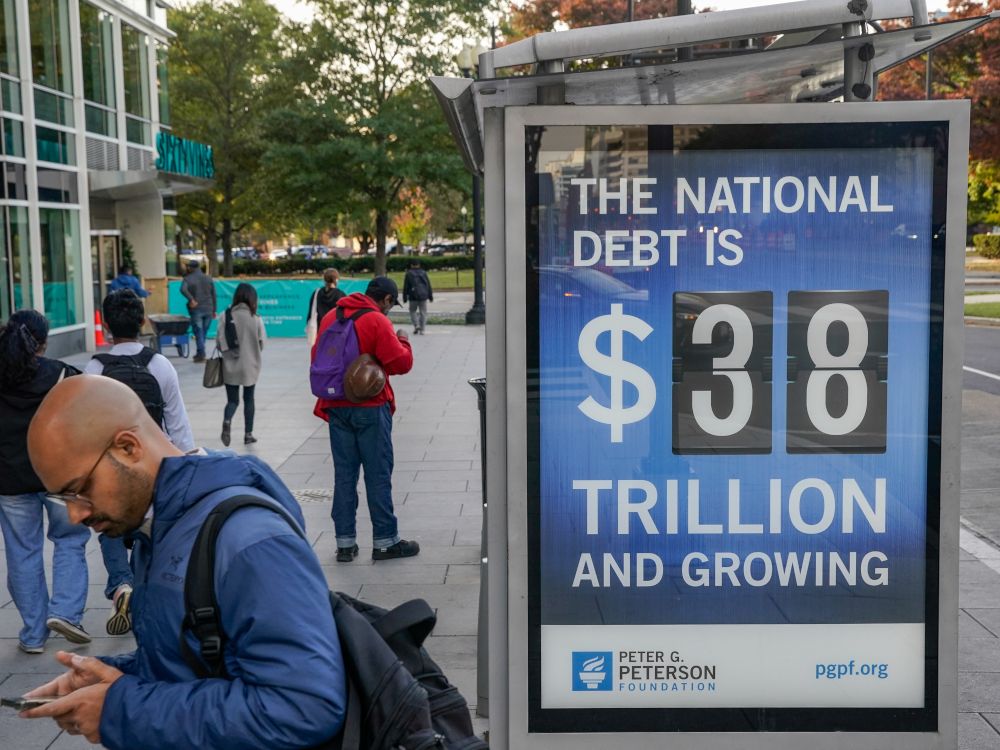
In the shadow of heated debates over tariffs, immigration policies, and international relations under the Trump administration, a quieter but potentially devastating issue looms large: the escalating U.S. federal debt. According to a recent report from the Congressional Budget Office (CBO), the nonpartisan agency responsible for forecasting federal finances, the United States is on track for widening budget deficits that could push the economy toward a crisis in the coming decades. The CBO's "The Budget and Economic Outlook: 2026 to 2036," released earlier this month, projects a budget deficit reaching 5.8 percent of gross domestic product (GDP) in 2026, climbing to 6.7 percent by 2036.
Interest payments on the existing federal debt are already a significant burden, expected to consume 2.6 percent of GDP this year alone. Federal debt held by the public—excluding intragovernmental holdings—is forecasted to rise from 101 percent of GDP in the current year to 120 percent by 2036, surpassing the previous postwar peak of 106 percent recorded in 1946. In absolute terms, the total federal debt stands at $38.7 trillion as of now, a figure that underscores the scale of the fiscal challenge facing lawmakers in Washington.
This trajectory has been building for decades, as both Republican and Democratic administrations have presided over spending that consistently outpaces revenue. Republicans have repeatedly promised spending cuts, while Democrats have advocated for higher taxes, yet neither party has succeeded in balancing the federal budget. J.D. Tuccille, writing in an opinion piece for the National Post, described the situation as the U.S. government running "headlong into a debt crisis," highlighting how these imbalances have led to a "massive accumulation of debt that, left unaddressed, will likely crash the economy within decades."
The CBO's projections, while concerning, are based on certain legal assumptions, including full funding for entitlement programs like Social Security and Medicare. To provide a more realistic perspective, the agency occasionally releases alternative scenarios that deviate from these optimistic baselines. In a 2023 analysis, the CBO examined what might happen if discretionary spending and revenues reverted to their 30-year historical averages as a percentage of GDP between 2023 and 2053. Under that scenario, "federal debt held by the public in 2053 would exceed 250 percent of GDP," a level so extreme that it would necessitate a complete reevaluation of the CBO's economic models.
Independent researchers have echoed these warnings with even starker predictions. A 2023 study by Mark J. Warshawsky, John Mantus, and Gaobo Pang of the American Enterprise Institute (AEI) forecasted that the debt-to-GDP ratio could hit 135 percent by 2032 and soar to 268 percent by 2052. The AEI analysts cautioned that this would trigger "a notable deterioration in consumer welfare … as interest rates, health-care spending and deficits increase in a vicious cycle and households increase savings to partially maintain rates of investment in the economy even as federal debt crowds it out."
The risks extend beyond domestic borders, potentially destabilizing global markets. The Committee for a Responsible Federal Budget (CRFB), in a 2022 report, warned that "high and rising debt could even spur a fiscal crisis. In this case, loss of market confidence could quickly drive up interest rates or inflation expectations, devaluing existing bonds and causing severe global financial disruptions." Such a crisis could ripple through international trade, investment, and financial systems, affecting allies and adversaries alike.
Economists Jagadeesh Gokhale and Kent Smetters of the Penn Wharton Budget Model have pinpointed a critical timeline for intervention. In their 2023 assessment, they estimated that U.S. officials have no more than 20 years—until around 2043—to implement corrective measures through tax increases or spending cuts before the government risks defaulting on its obligations, either explicitly or through implicit means like debt monetization that fuels significant inflation. This "best case" assumes market participants remain confident in future fiscal reforms; if skepticism grows faster, "debt dynamics would make the time window for corrective action even shorter."
Gokhale and Smetters further argued that a maximum sustainable debt-to-GDP ratio hovers around 200 percent, with a more realistic threshold closer to 175 percent. Beyond that, "credibility would disappear as people around the world grimly accepted that the U.S. government had become unable to meet its obligations," paving the way for the fiscal turmoil anticipated by groups like the AEI and CRFB.
The recent surge in debt can be traced in part to the extraordinary fiscal responses during the COVID-19 pandemic. As the economy ground to a halt under lockdowns, the federal government borrowed heavily to provide stimulus checks, enhanced unemployment benefits, and support for businesses, ballooning the debt by trillions. This profligacy, combined with years of structural deficits, has left policymakers with limited room to maneuver amid ongoing challenges like inflation and geopolitical tensions.
Debate rages over potential solutions, with stark differences in approach between political factions. Proponents of higher taxes argue it could generate needed revenue without slashing services, but critics point to historical patterns suggesting otherwise. Economist W. Kurt Hauser observed over 30 years ago that "no matter what the tax rates have been, in postwar America tax revenues have remained at about 19.5 percent of GDP," a trend that Federal Reserve Bank of St. Louis data indicates has persisted. This so-called Hauser's Law implies that individuals and businesses adapt to tax hikes by altering behavior, effectively capping federal receipts.
The CBO itself has quantified the economic drag of taxation, estimating that "the economic cost of a dollar of tax revenue ranges from 20 cents to 60 cents over and above the revenue raised." Raising taxes, therefore, not only fails to close the gap but burdens growth. On the spending side, Republican Sen. Chuck Grassley noted in 2011 that "Congress now spends $1.68 for every dollar it collects through taxes," a disparity that has only widened in the intervening years.
With revenue collection appearing constrained, experts increasingly emphasize the need for spending restraint. The federal government exerts more direct control over outflows than inflows, making cuts a more feasible path to sustainability. However, entitlement programs, which account for a growing share of the budget, remain politically sacrosanct, complicating reforms. As Tuccille put it, the U.S. has gone bankrupt "gradually and then suddenly," much like the character in Ernest Hemingway's "The Sun Also Rises."
Looking ahead, the implications of inaction are profound. Rising interest payments could crowd out funding for defense, infrastructure, and social programs, while higher debt levels might deter foreign investment and weaken the dollar's status as the world's reserve currency. Lawmakers in Congress face mounting pressure to address the issue, especially as midterm elections approach and fiscal hawks on both sides call for accountability.
Yet, with divided government and partisan gridlock, meaningful change remains elusive. The CBO's baseline assumes continued borrowing without disruption, but alternative forecasts paint a picture of potential catastrophe. As Americans grapple with these fiscal realities, the question is whether Washington can summon the political will to avert a crisis that analysts say is barreling toward the nation.
For now, the debt clock ticks onward, a stark reminder of the consequences of deferred decisions. Economists and budget watchdogs urge immediate action, warning that the longer the delay, the more painful the eventual reckoning will be for households, businesses, and the global economy.