WASHINGTON — On January 6, 2021, as a mob of supporters of then-President Donald Trump stormed the U.S. Capitol, a young congressional aide found herself thrust into chaos on just her fourth day on the job. The aide, who worked for newly elected Democratic Rep. Mondaire Jones of New York, described the day in a recent essay published in The Atlantic, recounting the fear, uncertainty, and unexpected camaraderie that defined the ordeal inside a House office building.
The events of that afternoon disrupted the congressional certification of the 2020 presidential election results, which Joe Biden had won. According to the aide's account, she arrived at work before 8 a.m. that day, earlier than usual since the House was not scheduled to convene until the afternoon. Driving through Washington, D.C., she noticed hundreds of people wearing MAGA hats and flying 'Stop the Steal' flags, a reference to unsubstantiated claims of election fraud pushed by Trump and his allies. 'They’d traveled far, I thought. But the rally felt less threatening than futile,' she wrote.
Rep. Jones, a freshman Democrat whose district encompassed parts of Westchester and Rockland counties in New York, had assembled a diverse staff, many of whom were queer, Jewish, Black, or a combination, the aide noted. Their presence, she said, symbolized a rejection of the Trump era. That morning, the office was abuzz with optimism over the recent Senate runoff victories in Georgia by Democrats Jon Ossoff and Raphael Warnock, which handed their party control of the upper chamber for the first time in nearly a decade.
By 1 p.m., Jones headed to the House floor to participate in the certification vote. Soon after, the Capitol's emergency-alert system issued a cryptic order to shelter in place due to 'police activity.' Staffers initially suspected it might relate to a reported suspicious package nearby, fearing they could be in the blast radius of an explosive device. Undeterred at first, the aide and her colleagues continued working while monitoring a live feed of the proceedings.
At around 2:15 p.m., tension escalated as Rep. Paul Gosar, R-Ariz., interrupted his speech objecting to Arizona's electoral votes to call for order in the chamber. The microphones captured no disturbance, but cameras soon showed members of Congress rushing toward the doors amid screams. 'We watched first with confusion, then with fear as we heard screams and pleas to lock the door before the feed cut,' the aide recounted in her essay.
Scrambling for information, the staff drew blinds on their office windows, which faced away from the Capitol, and relied on Twitter, television, and texts from colleagues for updates. Reports quickly emerged of a mob breaching the building, with some individuals allegedly armed and intent on violence. Footage showed rioters smashing windows, ramming doors, and flooding the rotunda; one man waved a Confederate flag, while another wore a sweatshirt reading 'Camp Auschwitz.'
In their office in a House office building — not specified by name but separate from the Capitol itself — the aide and her team briefly violated the shelter-in-place order to remove Pride and Black Lives Matter flags hung outside their door that morning, fearing they would mark them as targets. They then locked the door and barricaded it with a heavy leather couch. 'It was my first week on the job. I barely knew where the bathrooms were. I had no idea how to deal with a siege,' she wrote.
As the situation worsened, employees from another evacuated House office building sought refuge, leading to knocks at the door that startled the group each time. Eventually, about 20 people — including members of Congress and staff from both parties — gathered in the office. To cope with the terror unfolding on screens, they shared snacks like bags of barbecue chips and peanut M&Ms, chatting about office decor, favorite D.C. restaurants, and hometowns. 'Each knock was a jump scare,' the aide described.
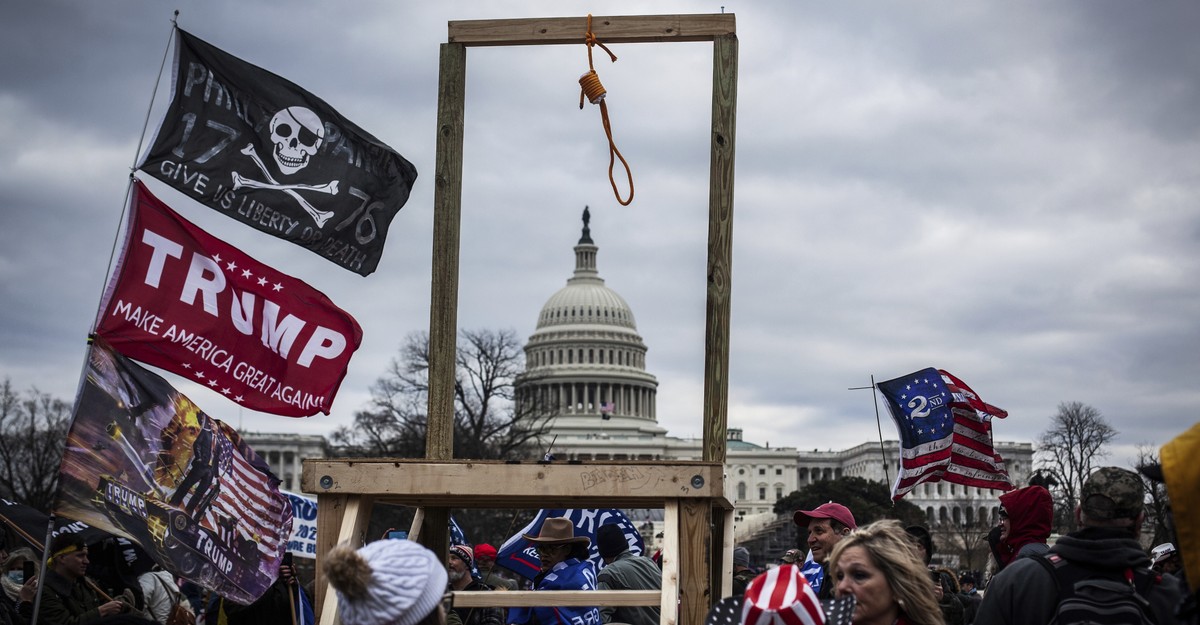
Details of the mob's actions filtered in: They carried zip ties, erected gallows outside the Capitol, and chanted for blood. Reactions among the sheltering group varied; one colleague wept upon seeing the so-called 'QAnon Shaman' in the House speaker's chair, while another texted loved ones silently. The aide admitted to making dark jokes to cope. Their boss, Rep. Jones, had been evacuated from the floor to a secure location and was only sporadically reachable by phone. When his battery died in the early evening, contact was lost entirely.
Even after reports indicated the Capitol complex had been cleared of intruders around 5:30 p.m., and the aide glimpsed dejected rioters leaving through her window, uncertainty lingered about Jones's safety. Relief came at about 6:30 p.m. when he appeared unannounced at the office, clutching a gas mask and nearly speechless. 'Only when he showed up in our office unannounced at about 6:30 p.m., clutching a gas mask, as close to speechless as I would ever see him, did we know for certain that he was alive,' she wrote.
With the building secured, first responders cleared debris from the Capitol, allowing Congress to reconvene around 9 p.m. under heightened security. Then-House Speaker Nancy Pelosi had pushed to resume the certification to fulfill Congress's constitutional duty. Some Republicans persisted in objecting to the results, prolonging the session for nearly seven more hours. The aide spent much of that time curled on an office couch, the proceedings droning in the background, before driving home with Jones at 4 a.m. amid a citywide curfew and boarded-up buildings.
The aide described being shell-shocked in the aftermath, suffering from sleepless nights for months. Yet, on January 7, she felt a glimmer of hope. The violent events, she believed, had exposed the authoritarian undercurrents in Trump's movement. In the days following, Trump faced bans from major social media platforms, and some Republicans, including Sen. Lindsey Graham, publicly rebuked him. Then-Senate Minority Leader Mitch McConnell reportedly expressed private support for impeachment, according to various accounts.
Democrats saw an opening to advance priorities like ending partisan gerrymandering and bolstering the social safety net. However, the aide's optimism faded as Republicans realigned behind Trump. By her departure from Capitol Hill in June 2022, figures who had briefly distanced themselves were either sidelined or back in line. Elon Musk's acquisition of Twitter — now X — included promises to reinstate Trump's account. Statements downplaying the riot as a 'normal tourist visit' or the actions of 'ordinary citizens engaged in legitimate political discourse' became common in GOP circles, including from the Republican National Committee.
The 2022 midterm elections handed Republicans control of the House, which the aide attributed in part to Democrats' failure to capitalize on the moment. Disillusioned, she moved abroad that December, citing frustration with American politics and the nation at large. Her return visits have felt increasingly disheartening, she said, as Trump's influence grew. In November 2024, voters reelected Trump to the presidency, a outcome she described as a personal betrayal, given his pledges to pardon January 6 participants who, she alleged, sought to prevent people like her from holding power.
Looking back, the aide views January 6 not as an endpoint but the start of an era of political nihilism. Under Trump's second term, which began in January 2025, his supporters have pursued policies targeting the free press, universities, transgender individuals, and immigrants, according to her essay. Measures have included slashing Medicaid to fund tax cuts for the wealthy and redrawing electoral maps to maintain GOP advantages. Democrats, locked out of power, have struggled to mount effective opposition or offer a compelling alternative, she observed.
Rep. Jones, who left Congress after redistricting eliminated his seat ahead of the 2022 midterms, did not immediately respond to requests for comment on the aide's account. The events of January 6 remain a flashpoint in American politics, with ongoing legal proceedings against hundreds of rioters and debates over the attack's legacy. More than 1,200 individuals have been charged in connection with the breach, according to the Justice Department, though Trump has vowed to pardon many if not all. As the nation grapples with these divisions, personal stories like this one underscore the human toll of that fateful day.
The aide's reflections, published ahead of the fifth anniversary of the attack, highlight how the assault reshaped not just institutions but individual lives. While initial hopes for accountability and reform dissipated, the episode continues to influence the trajectory of U.S. democracy, with implications for future elections and governance.