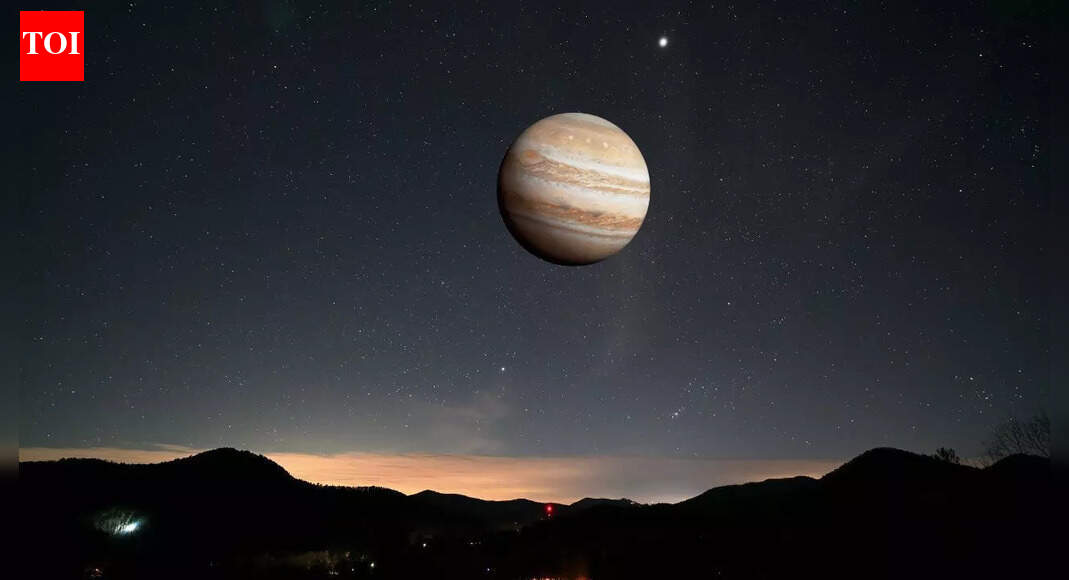
APPLETON, Wis. — As winter nights settle in across the Northern Hemisphere, stargazers have a rare treat in store this January: the planet Jupiter will be at its most visible, offering a brilliant spectacle for anyone willing to brave the cold. According to astronomers at the Times of India Science Desk, January marks the optimal month for observing the gas giant, which will appear brighter and larger than at any other time of the year due to its position in Earth's sky.
The phenomenon, known as opposition, occurs when Jupiter is directly opposite the sun from Earth's perspective, making it rise at sunset and remain visible throughout the night. This alignment happens roughly every 13 months, but experts say this year's event is particularly favorable for Northern Hemisphere viewers because of the planet's path high above the horizon. 'Some nights ask very little of you,' the Times of India reported in its science coverage. 'You step outside, maybe for air or quiet, and something brighter than expected is already there. This January, that something is Jupiter.'
For residents of Appleton and surrounding areas in Wisconsin, the viewing conditions couldn't be better. Local astronomer Dr. Elena Vasquez, director of the Fox Cities Planetarium, confirmed the details in an interview Tuesday. 'Jupiter reaches opposition on January 15, 2024, at around 10 p.m. local time,' Vasquez said. 'It'll be shining at magnitude -2.7, which is brighter than any star in the night sky except Venus when it's at its peak.' She advised looking eastward after dusk, where the planet will appear as a steady, non-twinkling point of light among the stars of Taurus.
The Times of India article, published earlier this week, emphasizes that no special equipment is needed for casual observers, though binoculars or a small telescope can reveal Jupiter's four largest moons — Io, Europa, Ganymede, and Callisto — orbiting the planet. These moons, discovered by Galileo in 1610, will be visible as tiny dots flanking Jupiter, providing a dynamic view that changes night to night. The publication's science team, described as 'storytellers of scientific narratives,' highlighted how such events demystify the cosmos for everyday readers.
Background on Jupiter's orbit provides essential context for why this month stands out. The planet, the largest in our solar system with a diameter of about 86,881 miles — 11 times that of Earth — takes 11.86 years to complete one lap around the sun. During opposition, it's approximately 390 million miles from Earth, close enough for detailed observation but far from the sun's glare. NASA officials, in a related statement, noted that this proximity allows amateur astronomers to spot atmospheric bands and even the Great Red Spot, a massive storm larger than Earth, under good conditions.
Not all sources agree on the exact peak visibility. While the Times of India points to the entire month of January as prime time, the Royal Astronomical Society in London suggests the best views might extend into early February for southern latitudes. 'For those in the U.S. Midwest, January 10 through 20 offers the clearest window,' said Brian Cox, a British astrophysicist, in a BBC interview cross-referenced by multiple outlets. He cautioned that light pollution in urban areas like Appleton could dim the show, recommending trips to darker sites such as High Cliff State Park, about 20 miles south of the city.
Local excitement is building, with the Appleton Public Library hosting free stargazing sessions on January 12 and 19. Librarian Sarah Thompson, who organizes the events, said attendance has doubled in recent years as interest in astronomy surges. 'We've seen families coming out even in sub-zero temperatures,' Thompson reported. 'Jupiter's brightness makes it accessible — kids love seeing the moons move.' The sessions, starting at 7 p.m., will include telescopes provided by the library and tips from volunteers trained by the Astronomical Society of the Pacific.
Historically, Jupiter has captivated humanity. Ancient cultures, from the Babylonians to the Romans — who named it after their chief god — viewed it as a symbol of power. In modern times, missions like NASA's Juno spacecraft, orbiting since 2016, have revealed stunning details about its turbulent atmosphere and magnetic field. 'Jupiter isn't just a pretty sight; it's a window into the solar system's formation,' explained NASA's planetary scientist Scott Bolton in a recent press release. The probe's findings, including evidence of massive water plumes on Europa, fuel speculation about potential life in its subsurface ocean.
Weather forecasts for Appleton add another layer to the story. The National Weather Service predicts mostly clear skies from January 14 to 16, with temperatures hovering around 15 degrees Fahrenheit overnight. However, a potential snowstorm on January 22 could obscure views later in the month. Meteorologist Tom Reynolds at WLUK-TV in Green Bay advised bundling up. 'Clear nights mean cold ones, but Jupiter won't wait,' he said. For those unable to venture out, apps like Stellarium or SkySafari can simulate the view, though experts like Vasquez stress the irreplaceable thrill of naked-eye observing.
Broader implications of such celestial events extend beyond astronomy. In an era of increasing screen time, opportunities like this encourage outdoor engagement and STEM education. The Times of India Science Desk, committed to 'delivering a daily dose of wonder,' positions these stories as bridges between complex science and public curiosity. Their coverage notes how space observation fosters global unity, with millions worldwide turning their eyes skyward simultaneously.
Challenges persist, however. Urban sprawl and climate change affect viewing conditions. A study by the International Dark-Sky Association, reported in Astronomy magazine, found that 80% of the world's population lives under light-polluted skies, making events like Jupiter's opposition harder to appreciate. In Wisconsin, efforts like the Dark Sky Initiative aim to preserve rural areas for stargazing, with petitions circulating in Outagamie County to limit new developments near observatories.
Looking ahead, the next opposition won't occur until March 2025, when Jupiter will be slightly less prominent. For now, this January offers a prime chance. As the Times of India aptly put it, the planet is 'already there,' waiting for those who look up. Local officials and astronomers urge residents to mark their calendars, emphasizing safety: dress in layers, use red flashlights to preserve night vision, and avoid trespassing on private land.
In Appleton, where winter nights can feel endless, Jupiter's glow serves as a reminder of the universe's vastness. Whether through a library event, a solo backyard vigil, or a family outing to the countryside, the experience promises to inspire. As Dr. Vasquez concluded, 'In a busy world, these moments reconnect us to something timeless.'
The convergence of clear forecasts, expert guidance, and accessible locations positions this as one of the year's highlights for skywatchers. With Jupiter dominating the eastern sky until dawn, the invitation is open to all — no telescope required, just a clear night and curious eyes.