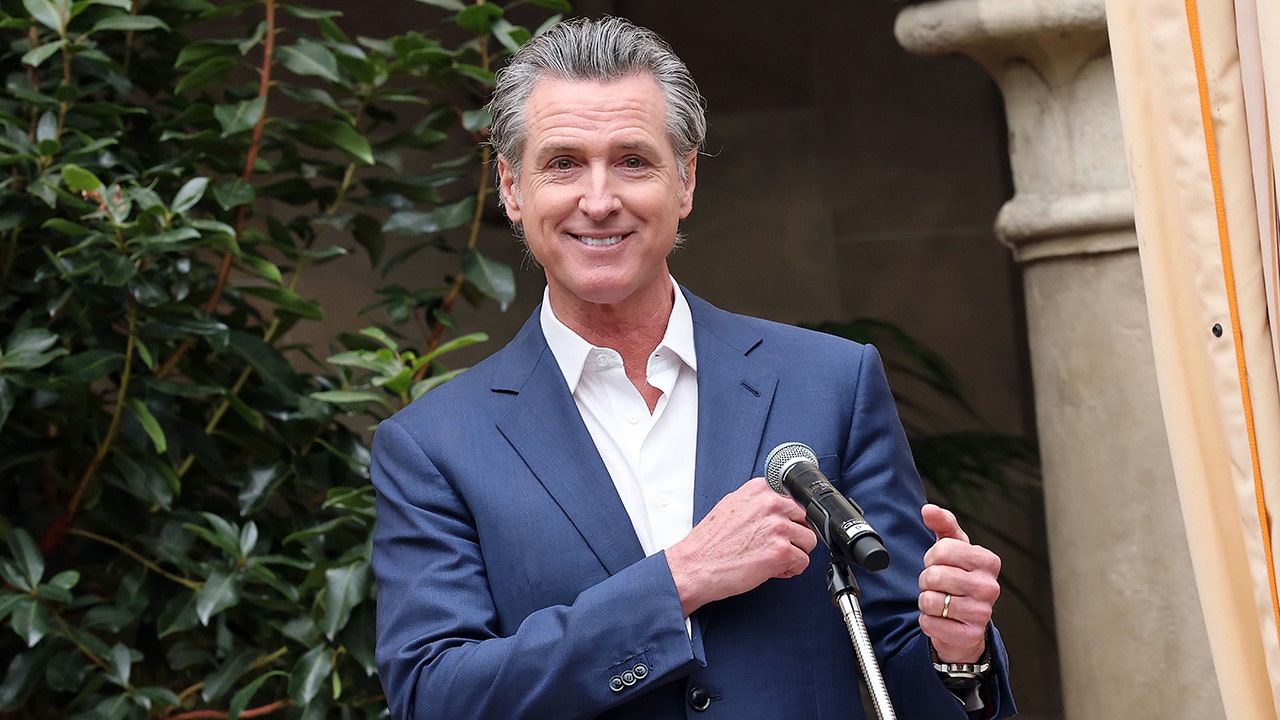
SAN FRANCISCO — California Governor Gavin Newsom recently touted progress on the state's long-delayed high-speed rail project in a video announcement, highlighting the beginning of construction after more than a decade of planning and over $15 billion in spending. However, the event has drawn sharp criticism for what detractors call a misleading photo op, as no actual high-speed rail tracks have been laid despite the massive investment.
The project, first approved by voters in 2008 through a $9.95 billion bond measure, was envisioned as a transformative 520-mile line connecting Los Angeles to San Francisco, with an initial cost estimate of around $33 billion. Proponents at the time promised economic benefits and reduced traffic congestion, but the initiative has faced repeated delays, escalating costs, and scaled-back ambitions. Today, the official projected cost for even a partial 171-mile segment from Merced to Bakersfield stands at over $35.3 billion, surpassing the original estimate for the entire system, according to state reports.
In his announcement, Newsom stood beside a conventional diesel freight train rumbling along existing tracks, presenting it as evidence of forward momentum. "All of the hard work behind us. Now we’re going to see the fruits of that. We’re going to start seeing precisely what you see here. Real tracks, real progress," Newsom said in the video, according to footage reviewed by The Appleton Times.
Critics, including legal scholar Jonathan Turley, have lambasted the display as grandstanding. Writing in a recent Fox News opinion piece, Turley described the scene as a "bizarre photo op" reminiscent of propaganda, arguing that it obscures the project's failures. "Without laying a single yard of track after burning $12 billion, Newsom showed a diesel freight train on a conventional track to create the appearance of a working railroad," Turley wrote. He has tracked the project for years, noting that initial low cost estimates were designed to secure voter approval and lock in billions for influential companies and figures.
The California High-Speed Rail Authority, which oversees the project, reports that construction on the initial central valley segment is indeed advancing, with some groundwork and viaducts underway. However, an independent review by Inspector General Benjamin Belnap paints a more cautious picture. In a recent report on the Merced-to-Bakersfield phase, Belnap concluded that meeting the 2033 completion target is unlikely. "With a smaller remaining schedule envelope and the potential for significant uncertainty and risk during subsequent phases of the project, staying within the 2033 schedule envelope is unlikely. In fact, uncertainty about some parts of the project has increased as the authority has recently made decisions that deviated from the procurement and funding strategies that were part of its plans for staying on schedule," Belnap wrote.
Environmental challenges remain a major hurdle, with uncompleted assessments needed for routing through mountainous terrain. The project's ridership projections have also declined by 25% in recent years, according to authority documents cited by Turley. For the Merced-Bakersfield stretch alone, which serves cities with a combined population of about 500,000, the cost could approach $128 billion for the full envisioned line, potentially exceeding $1 billion per mile.
Newsom's promotion of the rail comes amid broader scrutiny of California's infrastructure priorities. The state faces a budget deficit estimated at $68 billion for the fiscal year, even as it grapples with high gas prices and residents leaving in record numbers—over 800,000 net departures between 2020 and 2022, per U.S. Census data. Fox News host Jesse Watters echoed the criticism, calling the announcement a stunt in a segment that highlighted the lack of actual high-speed infrastructure.
Supporters of the project argue it represents a necessary investment in sustainable transportation. While the authority has not issued a direct response to the recent critiques, past statements emphasize the long-term benefits, including job creation—over 10,000 positions funded so far—and reduced greenhouse gas emissions. A 2023 progress report from the authority noted that 119 miles of the central segment are under active construction or environmental review, with federal grants totaling $3.9 billion bolstering efforts.
Turley, a professor at George Washington University and Fox News contributor, frames Newsom's actions within the governor's potential 2028 presidential ambitions. He points to favorable media coverage, such as a Vogue profile by Maya Singer, which portrayed Newsom as "embarrassingly handsome" and at ease with his prominence during his final State of the State address. "Let’s get this out of the way: He is embarrassingly handsome, his hair seasoned with silver, at ease with his own eminence as he delivers his final State of the State address," Singer wrote, describing Newsom's demeanor in detail.
Yet, even outlets like The New York Times have questioned Newsom's national viability in editorials, suggesting the high-speed rail saga could undermine his record. The project was initially championed by former Governor Arnold Schwarzenegger, but under Newsom, it has shifted focus to the central valley as a proof-of-concept, with extensions to major cities dependent on future funding.
Historical context underscores the project's troubled path. The 2008 ballot measure, Proposition 1A, required the rail to reach speeds of up to 220 mph and be operational by 2020—a deadline long passed. Legal battles, including lawsuits from landowners and environmental groups, have further slowed progress. In 2019, Newsom scaled back the scope in his State of the State address, admitting the full Los Angeles-to-San Francisco line was unrealistic without additional federal support.
Actor James Woods, a vocal Newsom critic, recently warned on social media that the governor's presidential appeal may fade amid such "atrocities," specifically citing the rail project. Meanwhile, Newsom has highlighted California's climate leadership internationally, even as residents face the nation's highest gas costs, averaging $4.70 per gallon as of late 2023.
The high-speed rail debate reflects national tensions over infrastructure spending. Similar projects, like Brightline in Florida, have succeeded on a smaller scale with private investment, costing about $3.5 billion for 129 miles. In California, the sunk costs—now exceeding $12 billion without operational track—have created what Turley calls a "train to nowhere," politically and economically difficult to abandon.
Looking ahead, the authority aims to break ground on more segments in 2024, contingent on securing $10 billion in additional state bonds and federal matching funds. Newsom's office has defended the project as essential for the state's future, with spokesperson H.D. Palmer stating in past interviews that "despite challenges, the high-speed rail is moving forward and will deliver real benefits to Californians." Critics like Turley counter that without accountability, the boondoggle will continue to drain resources from pressing needs like housing and education.
As California navigates its fiscal woes, the high-speed rail remains a flashpoint, symbolizing both ambitious vision and cautionary tale. Whether it evolves into a functional network or joins the ranks of infamous white elephants like Boston's Big Dig will depend on forthcoming decisions in Sacramento and Washington.