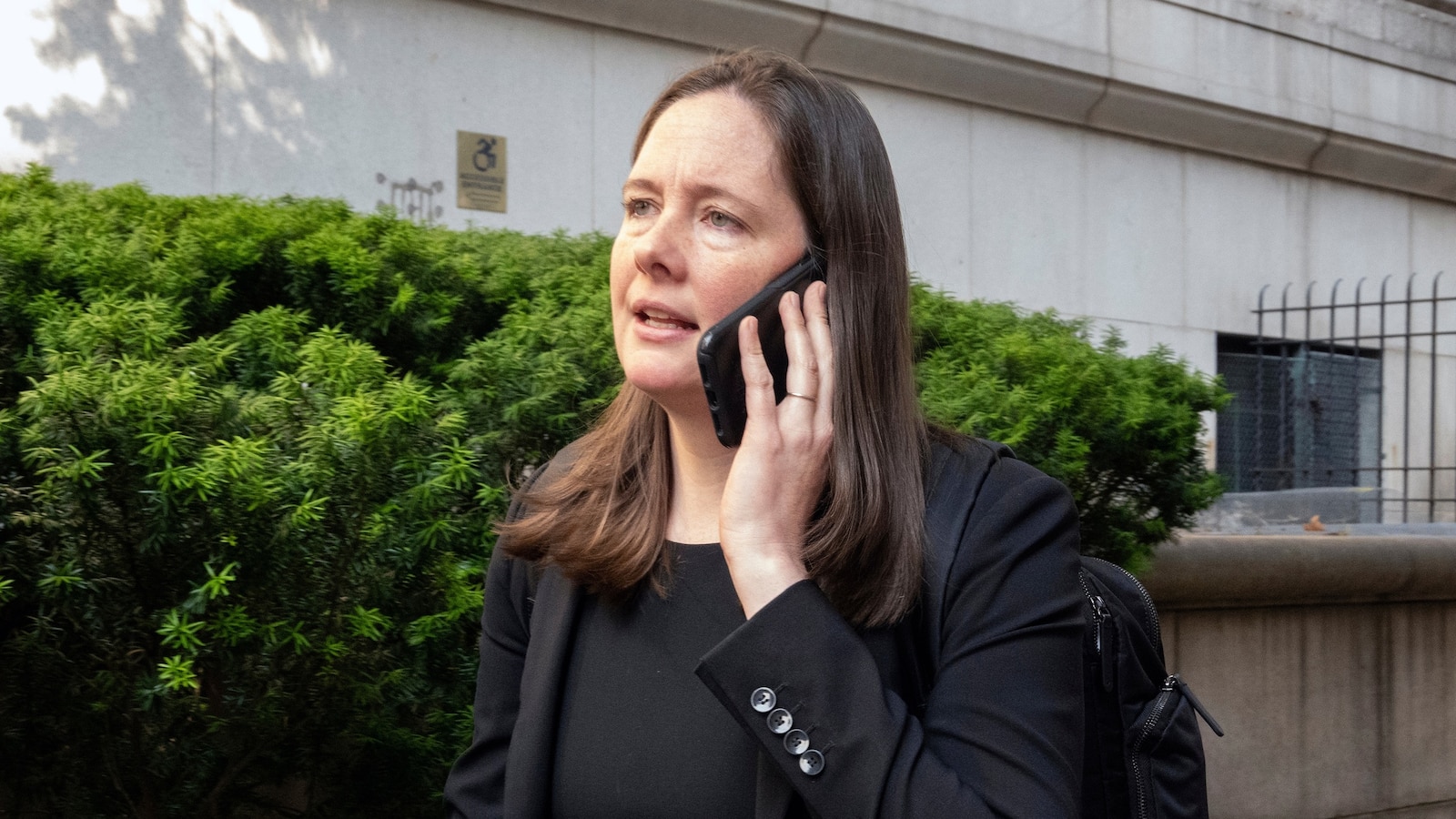
In a significant ruling for federal employment law, a federal judge in New York has denied the Justice Department's request to transfer a high-profile wrongful termination lawsuit filed by former prosecutor Maurene Comey out of federal court. The decision, handed down on Tuesday by U.S. District Judge Jesse Furman, keeps the case in the Southern District of New York, where Comey spent nearly a decade as an Assistant United States Attorney before her abrupt dismissal last year.
Maurene Comey, the daughter of former FBI Director James Comey, alleges in her lawsuit that she was unlawfully fired from the U.S. Attorney's Office for the Southern District of New York due to her family ties or perceived political affiliations. The complaint, filed in federal court, claims the termination violated her rights as a career civil servant. Comey, who has since joined a private law practice, seeks reinstatement and damages for what she describes as a politically motivated ouster.
The Justice Department had argued that Comey's claims should be heard by the Merit Systems Protection Board, a quasi-judicial body that handles disputes over federal employee firings under standard civil service procedures. Government attorneys contended in court filings that the case was "not a novel issue," emphasizing that challenges to removals for being arbitrary, capricious, or procedurally deficient are routine matters for the board. "A federal employee's claims that removal from federal service was arbitrary and capricious or conducted in a manner that did not provide the process to which they contend they were due is not a novel issue," the DOJ's legal team wrote.
Judge Furman rejected this argument, ruling that Comey's termination fell under the president's executive authority as outlined in Article II of the U.S. Constitution, rather than routine civil service protocols. In his opinion, Furman detailed how Comey received an email from Department of Justice officials in Washington, D.C., notifying her that her employment was terminated effective immediately. The sole reason provided, according to the judge, was the constitutional vesting of executive power in the president.
Furman praised Comey's professional record in his decision, noting her exemplary service over nearly ten years in one of the nation's busiest U.S. attorney's offices. "Maurene Comey was, by all accounts, an exemplary Assistant United States Attorney," the judge wrote. "In her nearly ten years working at the United States Attorney's Office for the Southern District of New York, she was assigned some of the country's highest profile cases, and she consistently received the highest accolades from supervisors and peers alike."
Comey's tenure included leading prosecutions in several landmark cases that captured national attention. She was involved in the case against Sean "Diddy" Combs, the music mogul facing federal charges related to sex trafficking and racketeering. Earlier, Comey helped secure convictions in the sex abuse trial of Robert Hadden, a former Columbia University gynecologist accused of assaulting dozens of patients. Her work extended to the high-stakes investigations and trials of financier Jeffrey Epstein and his associate Ghislaine Maxwell, both charged with sex trafficking minors. These assignments underscored Comey's role in tackling complex, sensitive matters of public interest.
The backdrop to Comey's firing adds layers of political context. Her father, James Comey, served as FBI director from 2013 to 2017 under Presidents Barack Obama and Donald Trump. He was controversially dismissed by Trump in May 2017 amid the investigation into Russian election interference. James Comey's tenure and ouster remain flashpoints in discussions about politicization of federal law enforcement, with critics on both sides accusing him of bias in handling investigations involving Hillary Clinton's emails and Trump's campaign ties to Russia.
Maurene Comey's lawsuit explicitly ties her termination to this family legacy. She alleges she was targeted "because her father is former FBI Director James B. Comey, or because of her perceived political affiliation and beliefs, or both." While the DOJ has not publicly commented on the motivations behind the firing, the department's court filings portray the matter as a standard administrative action, devoid of political undertones.
The ruling comes at a time of heightened scrutiny over the independence of federal prosecutors, particularly in the Southern District of New York, known as the "Sovereign District" for its history of pursuing cases against powerful figures regardless of political affiliation. Recent years have seen tensions between the DOJ and career attorneys, including disputes over case priorities and personnel decisions under different administrations. Comey's case could spotlight whether executive branch actions are encroaching on the apolitical nature of career civil service positions.
Legal experts not involved in the case have noted the unusual nature of the termination notice. By invoking Article II authority, the DOJ effectively treated Comey's removal as an at-will decision akin to political appointees, bypassing the typical protections afforded to non-political federal employees. This approach, while legally permissible for certain roles, raises questions about due process for prosecutors who handle sensitive national security and criminal matters.
The Justice Department has indicated it may appeal Furman's decision or seek other avenues to shift the venue. For now, the case remains firmly in federal district court, where Comey can pursue broader discovery and evidentiary hearings than might be available before the Merit Systems Protection Board. The board, established under the Civil Service Reform Act of 1978, typically reviews firings for procedural fairness but lacks the jurisdiction over constitutional claims like those raised here.
As the litigation progresses, it intersects with ongoing debates about the balance of power in the executive branch. President Joe Biden's administration has faced criticism from some quarters for personnel moves perceived as retaliatory, though the White House has not directly addressed Comey's situation. Meanwhile, Republican lawmakers have called for investigations into DOJ practices, citing instances of alleged bias against conservatives.
The next phase of the case is scheduled for May 28, when Judge Furman will preside over a hearing to address further proceedings, including potential motions for summary judgment or discovery schedules. Comey's attorneys have expressed satisfaction with the ruling, viewing it as validation that her claims warrant full judicial review. "This decision ensures that Ms. Comey's story can be told in open court," one of her lawyers said in a statement outside the courthouse, though specific details on representation were not immediately available.
Beyond the immediate legal battle, Comey's suit could influence how future administrations handle career prosecutors. If successful, it might reinforce protections against perceived political firings, encouraging whistleblowers and deterring reprisals. Conversely, a DOJ victory could streamline dismissals under executive authority, potentially affecting morale in federal law enforcement agencies.
For Maurene Comey, the fight represents more than personal vindication; it's a defense of the principles she upheld in her prosecutions. As a prosecutor who targeted some of the most notorious figures in recent scandals, her ouster underscores the vulnerabilities even seasoned attorneys face in a polarized political climate. As the May 28 hearing approaches, all eyes will be on whether this case exposes deeper fissures within the Justice Department or resolves as a one-off employment dispute.