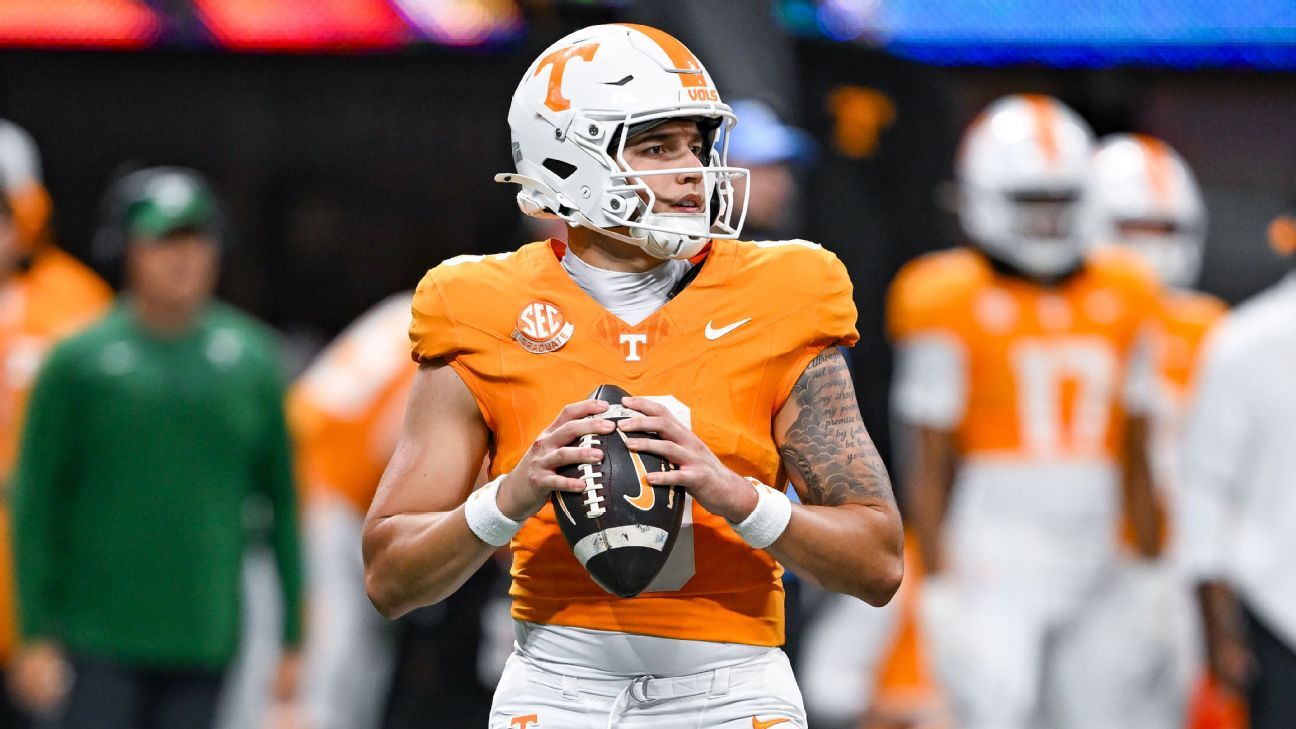
In a setback for the Tennessee Volunteers football program, a state judge in Knoxville on Friday denied quarterback Joey Aguilar's bid for a preliminary injunction that would have allowed him to play another season, effectively closing the door on his college career.
Chancery Court Judge Christopher D. Heagerty issued the ruling in Knox County Chancery Court, rejecting arguments from Aguilar's legal team that his two seasons at Diablo Valley Community College in California should not count toward his four-year Division I eligibility limit. Aguilar, now 24 years old, had transferred to Appalachian State for two seasons before joining the Volunteers last year, where he started and led the team to an 8-4 record, including a 4-4 mark in the Southeastern Conference.
The decision comes after a temporary restraining order granted to Aguilar on February 4, in which Heagerty noted that the quarterback "has demonstrated a substantial likelihood of success on the merits of his claim." However, in his latest ruling, the judge sided against extending that relief, marking a significant win for the NCAA amid ongoing legal battles over eligibility rules.
Aguilar's attorneys had emphasized the financial stakes in court filings, stating that he stood to earn approximately $2 million through name, image, and likeness deals with the Volunteers this upcoming season. It remains unclear whether the quarterback's team plans to appeal the decision, though Aguilar is expected to participate in the NFL combine next week, signaling a potential pivot to professional football.
The ruling delivers a major blow to Tennessee, which lacks a clear successor at the position. Aguilar's backup from last season, Jake Merklinger, transferred to UConn, leaving redshirt freshman George MacIntyre as a leading candidate to start. MacIntyre, ranked as the eighth-best pocket passer in ESPN's class of 2025, saw limited action last year, attempting just nine passes in two games.
The Volunteers have bolstered their quarterback room with other additions, including Ryan Staub, who spent the past three seasons at Colorado, and highly touted recruit Faizon Brandon, the No. 3 pocket passer in the class of 2026. Tennessee's coaching staff now faces the challenge of integrating these players as the team prepares for the 2026 campaign without its established starter.
Aguilar's college journey has been marked by transfers and eligibility hurdles. He redshirted during the 2019 season at City College of San Francisco, and the following year was canceled due to the COVID-19 pandemic. After excelling at Diablo Valley, he moved to Appalachian State, where he threw for 6,760 yards and 56 touchdowns over two seasons.
Entering the transfer portal in December 2024, Aguilar initially committed to UCLA for the 2025 season. But when former Volunteers quarterback Nico Iamaleava unexpectedly transferred to the Bruins in April, Aguilar signed with Tennessee the next day. In his lone season with the Vols, he completed 67.3 percent of his passes for 3,565 yards, with 24 touchdowns and 10 interceptions.
The case stems from broader challenges to NCAA rules that count junior college seasons against Division I eligibility. Aguilar was originally a co-plaintiff in a federal lawsuit filed by former Vanderbilt quarterback Diego Pavia, which contested those policies. However, Aguilar separated from that suit to pursue his claim in Tennessee state court, as a decision in Pavia's case was not anticipated until at least February 10.
Pavia secured a preliminary injunction from a federal judge, enabling him to play for the Commodores in 2025. He finished second in Heisman Trophy voting that year and has since entered the NFL draft, though he continues his lawsuit to benefit other former junior college players. Notably, the NCAA's Division I board of directors approved a blanket waiver on December 23, 2004, granting an extra year of eligibility to similar junior college transfers.
During last week's hearing, NCAA attorney Taylor Askew, a Knoxville native and graduate of the University of Tennessee's Winston College of Law, urged the court to uphold the rules. "I love Tennessee football," Askew said. "I'm from Knoxville. I grew up watching it. My kids watch him every game. But at some point, when judges are looking at records like this, and in Tennessee we have to say, 'Tennessee is better than this. We're better than this. We don't have to go to court to get our guy back. We don't have to play somebody who is ineligible under the rules to win games. We don't do that at Tennessee.'"
The NCAA celebrated the ruling as a defense of its standards. In a statement, the organization said: "The NCAA is thankful for the judge's decision today which demonstrates the court's consideration of eligibility standards and protecting access to the collegiate experience for current and future student-athletes. We will continue to defend the NCAA's eligibility rules against attempts to circumvent foundational policies and hinder fair competition to all student-athletes. The NCAA is making changes to deliver more benefits to student-athletes and will continue to work with Congress to provide stability for all college athletes."
This outcome contrasts with recent legal developments elsewhere. Last week, a judge in Mississippi ruled that Ole Miss quarterback Trinidad Chambliss qualifies for a medical redshirt, granting him a sixth season of eligibility with the Rebels. Such cases highlight the patchwork of court interpretations on NCAA policies, creating uncertainty for programs and players alike.
For Tennessee, the loss of Aguilar underscores the volatility of the transfer portal era and the evolving landscape of college athletics. With a young quarterback room and a roster still adjusting to new leadership, the Volunteers will aim to maintain their competitive edge in the SEC. As Aguilar eyes the NFL, his story serves as a reminder of the tight timelines and high stakes in modern college football eligibility disputes.
The broader implications extend to the NCAA's ongoing efforts to standardize rules amid lawsuits and legislative pressures. While the organization pushes for congressional support to stabilize athlete benefits, individual rulings like Heagerty's reinforce the boundaries of current eligibility frameworks, potentially influencing future transfers from junior colleges.