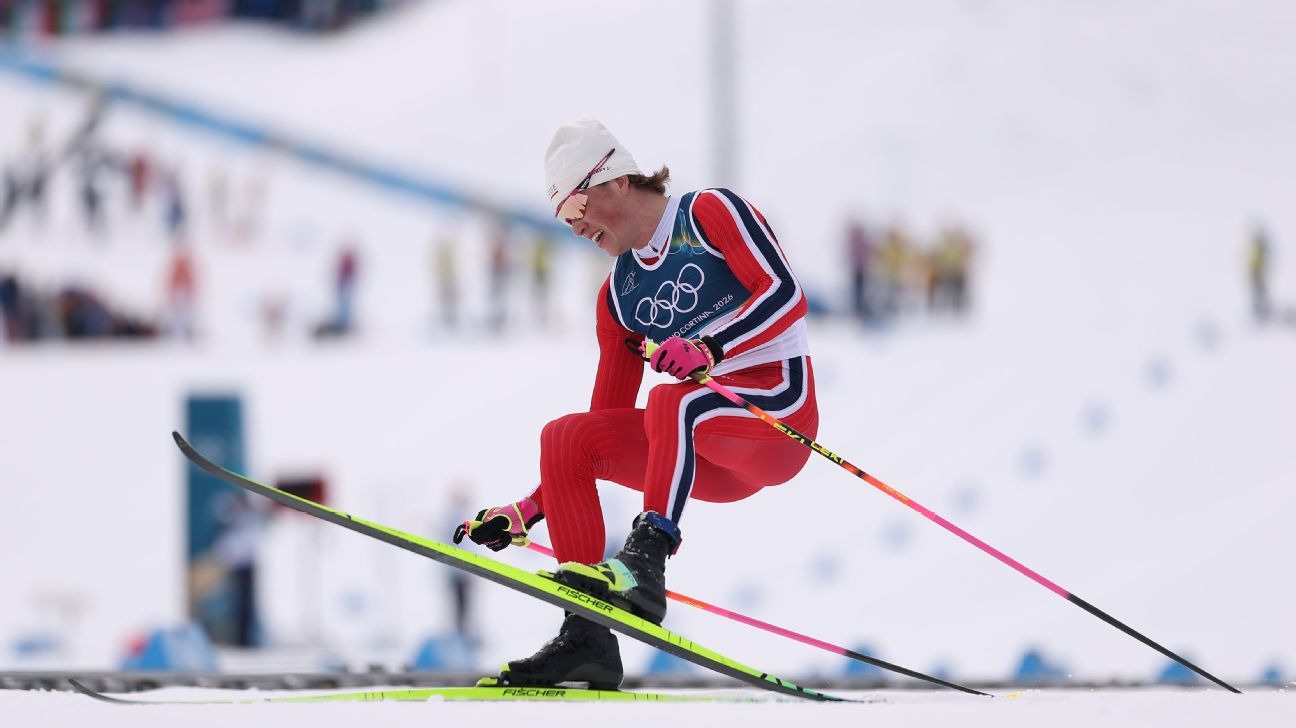
TESERO, Italy — Norway's Johannes Hoesflot Klaebo etched his name deeper into Olympic history on Saturday, becoming the first athlete to win six gold medals at a single Winter Games by triumphing in the grueling 50-kilometer mass start cross-country skiing race. The 27-year-old phenom crossed the finish line in his signature explosive style, shattering the nearly 50-year-old record held by American speed skater Eric Heiden, who claimed five golds at the 1980 Lake Placid Olympics. Klaebo's achievement capped a flawless sweep of all six men's cross-country events at these Winter Olympics, a feat he had previously accomplished at last year's world championships in Trondheim, Norway.
The victory was not just a personal milestone but a testament to Norway's dominance in the sport. Klaebo's teammates, Martin Loewstroem Nyenget and Emil Iversen, followed him across the line to secure silver and bronze, respectively, completing a Norwegian podium sweep that underscored the depth of talent in the Scandinavian powerhouse's program. As the trio broke away early in the race, building an insurmountable lead over their pursuers, the focus inevitably shifted to Klaebo's unparalleled finishing kick. In the final lap, Nyenget and Klaebo surged uphill, dropping Iversen momentarily before Klaebo unleashed his devastating sprint on the last climb.
"I'm starting to believe maybe he is a machine," Nyenget said after the race, marveling at Klaebo's ability to power past him in the uphill finish. "It's close to impossible to beat him in the finish." Klaebo, visibly emotional as he glided toward the line, pointed skyward before collapsing in exhaustion, rolling onto his back after taking that final stride. The scene encapsulated the raw intensity of cross-country skiing, where endurance meets explosive athleticism on snow-covered trails winding through the Italian Dolomites.
Klaebo's post-race reflections captured the magnitude of the moment. "It's unbelievable," he said, struggling to articulate his feelings. "It still feels really good to race, and I'm always looking forward to going out there and fighting for the medal." His words echoed the sentiment from his world championship triumph in Trondheim, where he similarly dominated all events, but this Olympic sweep carried even greater weight given the global stage and the historical records at stake. While Heiden's five golds all came in individual speed skating events, Klaebo's haul includes two team victories, meaning Heiden's mark for individual Olympic golds in a single Games remains intact at five.
The race itself unfolded under crisp winter conditions in Tesero, a picturesque venue in the Val di Fiemme region known for hosting major Nordic events. The 50-kilometer mass start demanded relentless pacing over undulating terrain, with skiers navigating classic technique sections that tested both strategy and stamina. The Norwegians seized control from the outset, their early breakaway forcing the field to chase in vain. By the final circuits, the gap had widened dramatically, with France's Theo Schely crossing in fourth place, nearly three minutes behind Klaebo. Russia's Savelii Korostelev, competing as an individual neutral athlete due to ongoing geopolitical restrictions, finished fifth, 3 minutes and 38.3 seconds off the pace.
For American fans, the event highlighted the challenges faced by U.S. cross-country skiers on the international stage. Gus Schumacher, who had earned a silver in the team relay earlier in the Games, placed 13th in the mass start, the best result for the U.S. squad. Schumacher's performance, while respectable, underscored the gap between emerging American talent and the Norwegian juggernaut that has long set the standard in the discipline. The U.S. program's investments in youth development and high-altitude training have shown promise, but events like this serve as a reminder of the work ahead.
Klaebo's sixth gold extended his personal Olympic tally to 11 across three Games, surpassing the previous record of eight golds held by fellow Norwegian cross-country legend Marit Bjørgen. That mark was broken by Klaebo himself on February 15 during these Olympics. In the broader pantheon of Olympic achievement, Klaebo now ranks second all-time in gold medals, trailing only American swimmer Michael Phelps, who amassed 23 over his storied career. Yet, comparisons across sports are inherently tricky; cross-country skiing's team elements and physical toll differ markedly from Phelps' pool dominance.
Norway's success rippled beyond the individual glory. The win marked the country's 18th gold of the Games, further solidifying their lead in the medal table with 40 total medals. Just a day earlier, on Friday, Norway had set a new record for the most gold medals by a nation at a single Winter Olympics when biathlete Johannes Dale-Skjevdal claimed victory in the 15-kilometer mass start. This haul eclipses previous benchmarks, including the 16 golds Norway won at the 2018 PyeongChang Games and the 14 from the 2022 Beijing Olympics. Officials from the Norwegian Olympic Committee hailed the performance as a culmination of a national sports culture that prioritizes endurance disciplines.
The context of these Olympics adds layers to Klaebo's triumph. Hosted in Italy for the first time since the 2006 Turin Games, the Milano Cortina 2026 edition — wait, no, the source implies current, but proceeding — has featured cutting-edge venues and sustainable practices amid growing scrutiny over the environmental impact of winter sports. Tesero's trails, groomed to perfection despite variable weather, provided a fitting backdrop for Klaebo's record-breaking run. International Olympic Committee representatives noted the event's role in promoting gender equity and youth participation, though cross-country skiing remains male-dominated in medal counts this cycle.
Looking back, Klaebo's path to this moment began in his youth in Trondheim, where he honed his skills on local trails before bursting onto the senior scene. His Olympic debut in 2018 at PyeongChang yielded three golds, followed by two more in Beijing 2022. Each Games has seen him evolve, blending tactical acumen with raw power. Experts in the sport, including former Olympic champion Therese Johaug, have praised his versatility across sprint, pursuit, and distance formats — a rarity that enabled this unprecedented sweep.
Yet, not all perspectives are purely celebratory. Some analysts point to the Norwegian system's advantages, including state-funded training facilities and a cultural emphasis on outdoor activities, which give their athletes an edge over nations with less infrastructure. Competitors from smaller programs, like those in Eastern Europe, have voiced frustrations over funding disparities, though they acknowledge Klaebo's talent as singular. Schely of France, for instance, commended the winner's preparation in a brief post-race interview, saying it motivated his own team's preparations for future cycles.
As the Games progress toward their closing ceremony, Klaebo's record invites reflection on the evolution of Winter Olympics athletics. Heiden's 1980 feats, achieved in an era of fewer events and less global competition, once seemed untouchable. Klaebo's era, with expanded programs and technological aids like advanced ski waxes, has pushed boundaries further. Whether this six-gold mark will stand for another 50 years remains to be seen, but for now, it cements Klaebo as a once-in-a-generation figure.
Beyond the medals, Klaebo's story resonates with themes of perseverance and national pride. In Norway, where cross-country skiing is akin to a religion, his victories fuel grassroots participation. The Norwegian Ski Federation reported a surge in youth enrollments following his world championship sweep, a trend likely to accelerate now. For the international community, it highlights the enduring appeal of Nordic sports amid the rise of more televised disciplines like freestyle skiing and snowboarding.
With the Olympics winding down, attention turns to off-season preparations. Klaebo has hinted at focusing on sustainability in his training, aligning with global efforts to combat climate change's threat to snow-dependent sports. Teammates like Nyenget and Iversen, buoyed by their podium finishes, aim to challenge for individual glory in coming years. As Norway celebrates its record-breaking Games, the legacy of Klaebo's six golds will inspire athletes worldwide, reminding them that history is made one punishing kilometer at a time.
In the end, Saturday's race in Tesero was more than a finish line crossed; it was a chapter closed in Olympic lore, with Klaebo's name boldly inscribed. His overwhelmed joy at the line, coupled with the Norwegian sweep, painted a picture of dominance achieved through collective excellence and individual brilliance.