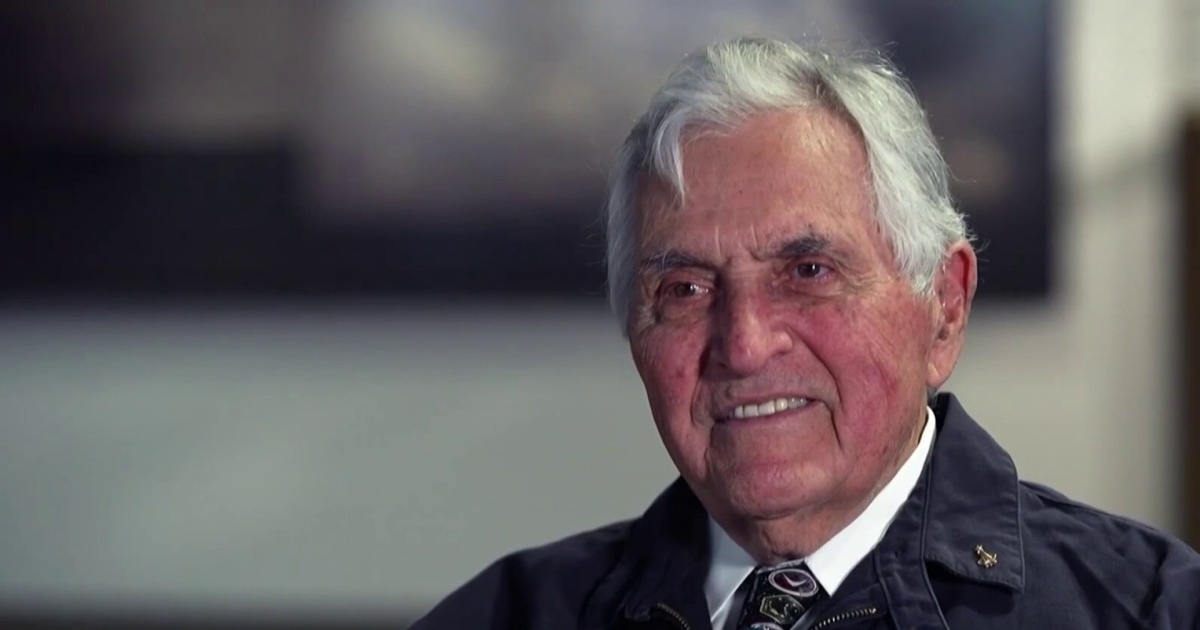
In a poignant reflection on humanity's lunar legacy, Dr. Harrison Schmitt, the last person to walk on the moon during NASA's Apollo 17 mission in December 1972, shared his thoughts on the upcoming Artemis II mission in an interview with NBC News. At 87 years old, Schmitt, a geologist by training and the only scientist to set foot on the lunar surface, spoke candidly about the awe-inspiring experience of his three-day moonwalk and the significance of NASA's plans to return humans to lunar orbit as early as 2025.
Schmitt's journey to the moon culminated on December 11, 1972, when he and mission commander Eugene Cernan spent approximately 22 hours exploring the Taurus-Littrow valley, a site selected for its geological richness. As the lunar module pilot, Schmitt collected over 240 pounds of moon rocks and soil samples, which have since provided invaluable insights into the moon's formation and history. 'It was like stepping into another world,' Schmitt told NBC News correspondent Aaron Gilchrist during the interview, which aired recently on the network's platform. 'The silence, the stark beauty—it's something that words can barely capture.'
The Apollo 17 mission, the sixth and final crewed landing under the Apollo program, marked the end of an era that began with Neil Armstrong's historic steps in 1969. Schmitt, who earned a doctorate in geology from Harvard University before joining NASA in 1965, emphasized the scientific payoff of those missions. According to Schmitt, the moon rocks he gathered revealed evidence of ancient volcanic activity and helped confirm theories about the moon's origins from a massive collision with Earth billions of years ago. 'Those samples are still being studied today,' he said, noting that they continue to fuel research at institutions like NASA's Johnson Space Center in Houston, Texas.
Turning his attention to the future, Schmitt expressed optimism about the Artemis program, NASA's ambitious initiative to establish a sustainable human presence on the moon by the end of the decade. Artemis II, slated for a launch no earlier than September 2025 from Kennedy Space Center in Florida, will send four astronauts—NASA's Reid Wiseman, Victor Glover, and Christina Koch, along with Canadian Space Agency's Jeremy Hansen—on a 10-day mission to orbit the moon without landing. This will be the first crewed flight of NASA's Space Launch System rocket and Orion spacecraft, building on the uncrewed Artemis I test flight that successfully circled the moon in late 2022.
'Artemis II is a crucial step,' Schmitt remarked in the interview. 'It's not just about going back; it's about going further, learning more, and preparing for Mars.' He highlighted how the mission's diverse crew, including the first woman and person of color to venture beyond low-Earth orbit, reflects the evolving inclusivity of space exploration. NASA officials have stressed that Artemis II will test critical systems for deeper space travel, including life support and communication over vast distances—up to 240,000 miles from Earth at lunar distance.
Schmitt's reflections come at a time when the Artemis program faces both excitement and scrutiny. Budget overruns have pushed back timelines; originally targeted for 2024, Artemis II's delay underscores the complexities of developing new spacecraft. According to NASA Administrator Bill Nelson, speaking at a recent congressional hearing, the agency is committed to safety above all, with rigorous testing ongoing at facilities in Ohio and California. 'We've learned from Apollo that haste can be dangerous,' Nelson said, referencing the Apollo 1 fire tragedy in 1967 that claimed three astronauts' lives.
While Schmitt praised the technological advancements, such as Orion's heat shield capable of withstanding re-entry speeds of 25,000 miles per hour, he also cautioned against overlooking the human element. In his NBC interview, he recounted the physical and psychological demands of Apollo 17, including the isolation of lunar night and the precision required for sample collection in bulky spacesuits. 'You have to trust your training and your teammates,' Schmitt advised the Artemis crew. 'The moon doesn't forgive mistakes.'
Broader context for Artemis II ties into international partnerships and geopolitical dynamics. The mission includes Jeremy Hansen, marking Canada's role in the Artemis Accords, a framework signed by 40 nations to promote peaceful lunar exploration. However, tensions persist with non-signatories like China, which plans its own crewed lunar landing by 2030 via the International Lunar Research Station. Schmitt, who served as a U.S. senator from New Mexico from 1977 to 1983, touched on these rivalries, saying, 'Competition drove Apollo, and it can drive us forward again, but cooperation will sustain us.'
Geological perspectives from Schmitt add depth to the Artemis narrative. As a former astronaut-geologist, he advocated for targeting scientifically rich sites like the moon's south pole, where water ice could support future bases. Artemis III, planned for 2026, aims to land the first woman and person of color on the surface near that region. 'The south pole has resources we need,' Schmitt explained, referencing data from NASA's Lunar Reconnaissance Orbiter, which has mapped potential ice deposits since 2009.
Public interest in lunar exploration has surged with Artemis, evidenced by high viewership of Artemis I's launch—over 2 million online streams—and educational outreach programs reaching millions of students. Schmitt, now a professor emeritus at the University of Wisconsin-Madison, often lectures on space policy and has authored books like 'Return to the Moon' in 2006, urging renewed investment. In the interview, he lamented the 50-year gap since Apollo 17, attributing it partly to shifting national priorities post-Vietnam and Cold War.
Critics of the program, including some fiscal conservatives in Congress, question the $93 billion price tag through 2025, arguing funds could address earthly issues like climate change. Space policy experts, however, counter that lunar missions spur innovations in fields like renewable energy and medicine. According to a 2023 report from the Aerospace Industries Association, every dollar invested in NASA yields $7 to $14 in economic returns.
Schmitt's personal anecdotes brought levity to the discussion. He described the thrill of driving the lunar rover at speeds up to 11 miles per hour across the gray regolith and the surreal view of Earth rising over the horizon. 'It's a marble in the black sky,' he said poetically. These stories resonate as Artemis II approaches, with crew training intensifying at NASA's neutral buoyancy lab in Houston, simulating zero-gravity conditions.
Looking ahead, Schmitt sees Artemis as a bridge to Mars, with lunar outposts serving as proving grounds for long-duration spaceflight. NASA aims for human Mars missions in the 2030s, and Schmitt's endorsement carries weight given his expertise. 'We've only scratched the surface—literally,' he quipped, alluding to the 382 kilograms of lunar material returned by Apollo.
As preparations continue, Schmitt's reflections serve as a reminder of the fragile thread connecting past triumphs to future ambitions. With Artemis II on the horizon, the world watches eagerly, hoping to reignite the wonder that captivated a generation during Apollo. For now, the last moonwalker stands as a living testament to what's possible when humanity reaches for the stars.