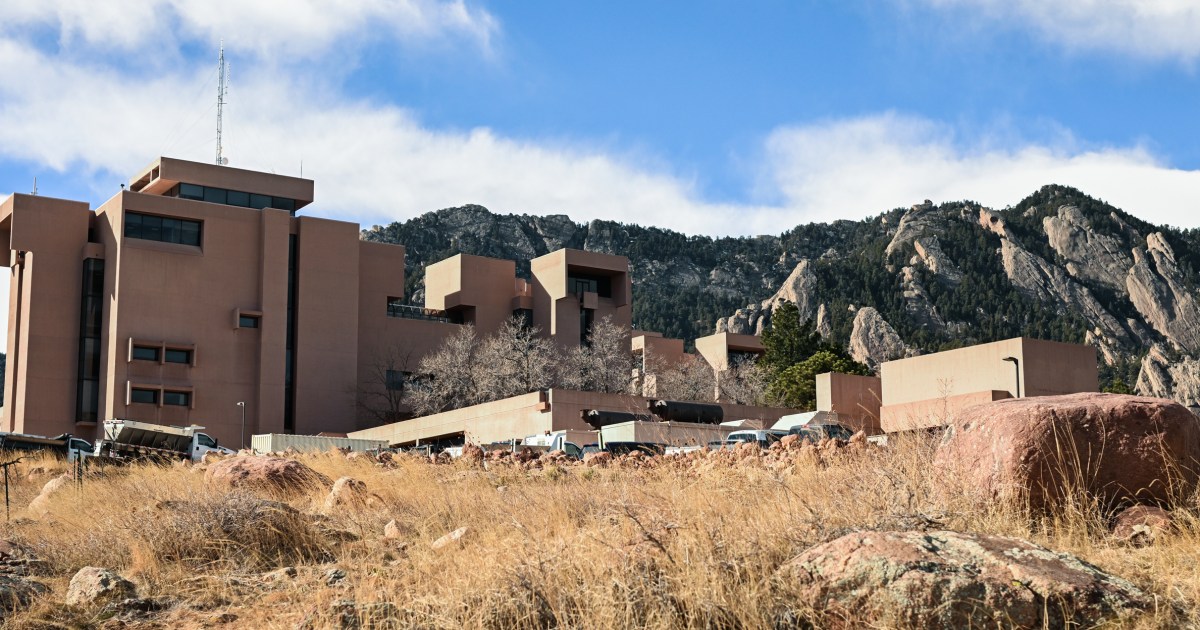
BOULDER, Colo. — A consortium of universities has filed a federal lawsuit accusing the Trump administration of launching a retaliatory campaign against Colorado that threatens to dismantle the nation's premier climate research facility. The suit, lodged Monday in U.S. District Court for the District of Colorado, targets the planned breakup of the National Center for Atmospheric Research (NCAR), a Boulder-based institute renowned for its work in weather modeling, hurricane forecasting, and climate science.
The plaintiff, the University Corporation for Atmospheric Research (UCAR), a nonprofit comprising more than 120 member universities, operates NCAR under a cooperative agreement with the National Science Foundation (NSF). According to the complaint, the administration's December announcement to restructure and fragment the center is not driven by scientific or fiscal rationale but by political vendettas. “UCAR and NCAR are collateral damage,” the lawsuit states, framing the moves as part of a broader “widespread and coordinated campaign of punishment and coercion” against the state.
At the heart of the allegations are simmering tensions between President Donald Trump and Colorado Governor Jared Polis, a Democrat. The dispute traces back to the 2020 presidential election, which Trump lost amid his unsubstantiated claims of widespread fraud. In Colorado, a county clerk was convicted on state charges of tampering with election equipment, a case that drew Trump's ire. The president reportedly urged Polis to pardon the clerk and eliminate the state's mail-in voting system, which Trump has criticized as vulnerable to abuse. Polis declined, escalating the rift.
The lawsuit details how multiple federal agencies — including the NSF, the National Oceanic and Atmospheric Administration (NOAA), the Department of Commerce, and the Office of Management and Budget (OMB) — have allegedly weaponized their authority against NCAR. It claims these entities issued “gag orders” silencing NCAR staff from public discussion of the restructuring, canceled multimillion-dollar research grants focused on climate adaptation and mitigation, and imposed unlawful new reporting mandates. Further, the complaint accuses the government of attempting to wrest control of NCAR's supercomputing facility in Wyoming from UCAR.
NCAR, established in 1960 and funded primarily through federal grants, employs about 1,400 scientists, engineers, and support staff. Its contributions span critical areas: improving hurricane predictions, monitoring wildfires, advancing weather forecasting, and studying space weather phenomena that can disrupt satellites and power grids. The center's powerful supercomputers enable intricate modeling that underpins national and global efforts in environmental science. “The Agencies’ ultimate apparent goal is to destroy NCAR entirely,” the suit asserts, citing a January public notice from the NSF soliciting ideas for repurposing NCAR's Boulder campus for alternative public or private uses.
The legal action invokes the Administrative Procedure Act, arguing that the agencies' decisions were arbitrary, capricious, and procedurally flawed. UCAR seeks a court order to block several initiatives, including the supercomputer transfer and the termination of a key NOAA grant worth millions. In a statement posted on its website, UCAR emphasized the stakes: “The actions taken by the federal agencies named in the lawsuit pose a direct threat to national security, public safety, and economic prosperity and risk setting back the country’s global leadership in weather and space weather modeling and forecasting.” The organization added that it would refrain from further comment until the litigation concludes.
This lawsuit is the latest in a series of legal challenges from Colorado officials alleging federal retribution. The state has separately sued over the administration's decision to relocate U.S. Space Command from its provisional home in Colorado Springs to Alabama, a move announced in January 2021 but only recently finalized amid controversy. Colorado also contested the abrupt termination of $109 million in federal transportation funding and the imposition of stricter work requirements for the Supplemental Nutrition Assistance Program (SNAP), which the state argued was punitive rather than policy-driven.
In the SNAP case, a district judge ruled in Colorado's favor on Monday, granting a preliminary injunction. The judge rejected the administration's defenses — that benefits fraud in the state justified a pilot program and that the federal government held unilateral authority to implement it — finding that Colorado demonstrated irreparable harm. The administration had maintained in court filings that the measures were necessary and that the state failed to prove immediate damage warranting a halt.
Federal responses to the UCAR suit have been muted so far. Three agencies — NOAA, Commerce, and OMB — did not immediately respond to requests for comment. The NSF, however, issued a brief statement: it does not comment on pending litigation. This reticence leaves the allegations unchallenged in the public domain for now, though administration officials have previously defended restructurings as efforts to streamline operations and cut costs in non-essential research areas.
The backdrop to these conflicts includes Trump's long-standing skepticism toward climate science, which he has called a “hoax.” During his first term, his administration rolled back numerous environmental regulations and proposed budget cuts to agencies like NOAA and the NSF. NCAR, while not directly under the president's purview, relies heavily on these bodies for funding — about $200 million annually from the NSF alone. Critics, including environmental groups not involved in the suit, have decried the moves as ideologically motivated, potentially undermining U.S. competitiveness in a field where China and Europe are investing heavily.
Experts in atmospheric science, speaking off the record due to the sensitivity of federal funding, expressed alarm over the potential loss of NCAR's institutional knowledge. One researcher, who requested anonymity, noted that the center's models have been pivotal in events like the response to Hurricane Maria in 2017 and ongoing wildfire predictions in the West. Disbanding it could scatter talent and delay advancements at a time when climate impacts are intensifying.
Colorado's congressional delegation, led by Senators Michael Bennet and John Hickenlooper, both Democrats, has voiced support for UCAR's action. In a joint statement, they called the lawsuit “a necessary stand against politicized interference in vital scientific work.” Republicans in the delegation, including Representative Doug Lamborn, whose district includes much of the affected area, have been more reserved, with Lamborn's office saying only that they are monitoring the situation for impacts on local jobs and defense-related research.
The broader implications extend beyond Boulder. NCAR's dissolution could ripple through academia, as UCAR's member institutions — from MIT to the University of Colorado — depend on its collaborative framework. Economically, the center injects hundreds of millions into Colorado's economy annually through salaries, contracts, and tourism tied to its public outreach. Nationally, it raises questions about the politicization of science funding, echoing debates during Trump's first term over EPA grants and CDC research.
As the case unfolds, legal observers anticipate a protracted battle. Similar suits against administrative actions have seen mixed results, with courts often scrutinizing motives under the Administrative Procedure Act. A hearing on UCAR's request for injunctive relief could come within weeks, potentially freezing the restructuring pending a full review. For now, NCAR staff continue their work amid uncertainty, racing against deadlines for grants and models that inform everything from farm yields to disaster preparedness.
In the end, this lawsuit underscores a deepening divide over the role of science in governance. Whether it's viewed as legitimate reform or partisan payback, the fate of NCAR could set precedents for how federal research priorities are shaped — or shattered — in an era of polarized politics.