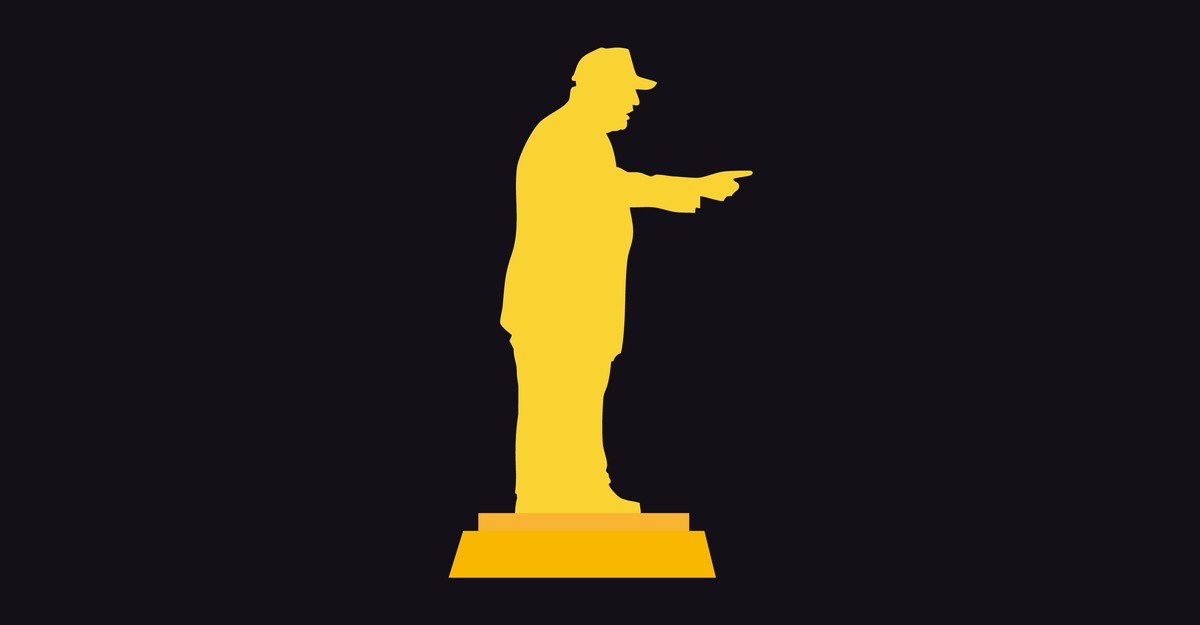
In a striking display of personal branding, a 15-foot-tall golden sculpture of President Donald Trump, dubbed 'Don Colossus' by its creators, is set to be installed at his Miami golf club. The statue, depicting the president with his fist raised triumphantly, will rest on a 7,000-pound pedestal that has already been placed at the site. According to reports from The Atlantic, the project was funded by a group of cryptocurrency investors who raised $300,000 through crowdfunding efforts tied to promoting a memecoin known as $PATRIOT.
The sculpture's creator, a sculptor based in Zanesville, Ohio, has expressed frustration over delayed payments. He told organizers that he will not release the statue from his studio until full compensation arrives, a situation that echoes challenges faced by others involved in Trump-related artistic endeavors over the years. Despite these hurdles, the project appears poised to move forward, with President Trump himself praising the work in a letter to one of the organizers. 'It LOOKS FANTASTIC,' Trump wrote, indicating his enthusiasm for the piece.
Plans for the statue extend beyond Miami. Sources close to the project suggest that a smaller version could soon find a home at the White House, further expanding the presence of presidential imagery in official spaces. This development comes amid a series of initiatives aimed at immortalizing Trump's likeness and legacy, including proposals to rename major landmarks such as Dulles International Airport and Penn Station in his honor.
The statue's unveiling highlights a pattern in Trump's approach to public spaces and infrastructure. Over the years, his administration and associated projects have seen ambitious renovations and rebrandings. For instance, the East Wing of the White House was reportedly altered to accommodate a larger ballroom, while plans for an 'Arc de Trump'—a grand archway inspired by Parisian landmarks—have been floated. Additionally, the Kennedy Center for the Performing Arts is undergoing a major gut renovation, with discussions about incorporating Trump's name into its official title, potentially dubbing it the Trump Kennedy Center.
While these efforts underscore Trump's affinity for gold-plated grandeur and self-naming, they draw comparisons to more extravagant displays by world leaders elsewhere. In Turkmenistan, for example, former President Saparmurat Niyazov commissioned a 40-foot-tall golden statue of himself in the late 1990s. Positioned atop a 246-foot monument in the capital city of Ashgabat, the effigy was designed to rotate 360 degrees throughout the day, always facing the sun—a feat of engineering meant to symbolize eternal vigilance and adoration.
Trump's projects, however, have not yet reached such mechanical extremes, nor have they incorporated elements seen in other authoritarian regimes. There are no reports of Trump commissioning a version of his book The Art of the Deal transcribed in his own blood, as Saddam Hussein did with a special edition of the Quran. Similarly, no cadre of armed female escorts akin to Muammar Qaddafi's 'Amazonian Guard'—a group of women carrying AK-47s—has been associated with the president. Still, observers note that the Miami statue represents a bold step in personal monument-building.
Historically, the United States has maintained a tradition of restraint when it comes to living presidents erecting statues of themselves. Posthumous monuments, such as the Lincoln Memorial in Washington, D.C., and the faces carved into Mount Rushmore, have become iconic but were not commissioned by the individuals they honor. Even these have sparked debate. In 1842, for the centennial of George Washington's birth, sculptor Horatio Greenough created a 12-ton marble statue portraying the first president in a toga and sandals, modeled after classical depictions of Zeus. The work, intended for the U.S. Capitol, provoked widespread discomfort due to its semi-nude, god-like portrayal of Washington, leading it to be moved repeatedly—including to a shed on the East Lawn—before finding a more permanent, if obscure, spot.
The discomfort surrounding Greenough's statue illustrates a broader American aversion to overt presidential self-glorification during a leader's lifetime. Unlike in some authoritarian states where images of the 'Dear Leader' are mandated in public and private spaces—such as during China's Cultural Revolution, when portraits of Mao Zedong were required in homes—the U.S. has generally viewed such practices as antithetical to democratic norms.
The cryptocurrency backers behind the Trump statue have leveraged the project for promotional purposes, tying it directly to their $PATRIOT memecoin. This fusion of art, politics, and digital finance has raised eyebrows, particularly since the sculptor claims he was unaware of the promotional angle when he began the work. As of now, the full $300,000 raised has not entirely cleared the payment issues, leaving the statue in limbo in Ohio.
President Trump's approval of the statue aligns with polling data on his supporters' priorities. Surveys indicate that his base primarily seeks action on economic issues, such as making housing and goods more affordable, strengthening U.S. foreign policy, and securing favorable trade deals. Cultivating a personal image through monuments ranks lower on their list, according to analysts cited in recent reports.
Globally, the toppling of leader statues has often marked the end of oppressive regimes, serving as a symbolic release of public frustration. Just over a year ago, following the fall of Bashar al-Assad's government in Syria, crowds in Damascus pushed over a massive bust of the former president, dancing on its remains. In the coastal city of Latakia, a giant bronze figure was toppled and dragged through the streets, with demonstrators riding its head in celebratory fashion. These acts targeted not just the leaders but the misplaced priorities they represented—resources funneled into glorification rather than public welfare.
A similar scene unfolded in Russia after the Soviet era. In Moscow's Fallen Monument Park, now a grassy repository for discarded idols, visitors can see toppled statues of Lenins pointing in random directions and a reclining Joseph Stalin. The park stands as a reminder of how regimes that devolve into personal idolatry often neglect the everyday needs of their people, contributing to their eventual downfall.
The Trump statue project evokes ancient precedents as well. Biblical accounts describe the Israelites, impatient while Moses received the Ten Commandments on Mount Sinai, melting their gold jewelry to fashion a calf idol. They reveled around it until Moses returned, shattered the statue, ground it to powder, and forced the people to drink the mixture as punishment. This story, as recounted in religious texts, underscores the fragility of such symbols of misplaced devotion.
As the 'Don Colossus' nears installation, questions linger about its long-term impact. Will it inspire emulation among future leaders, or serve as a cautionary tale? For now, the pedestal awaits in Miami, a tangible sign of ongoing efforts to etch Trump's name into the landscape. Organizers expect the full statue to arrive soon, pending resolution of the payment dispute, potentially setting the stage for more such monuments in the years ahead.
Whether these initiatives will reshape public perceptions of the presidency remains to be seen. Historians and political observers continue to debate the boundaries of executive legacy-building in a democracy, drawing on examples from Washington to the present day. With the White House version in discussion, the coming months could bring further developments in this evolving story of presidential commemoration.