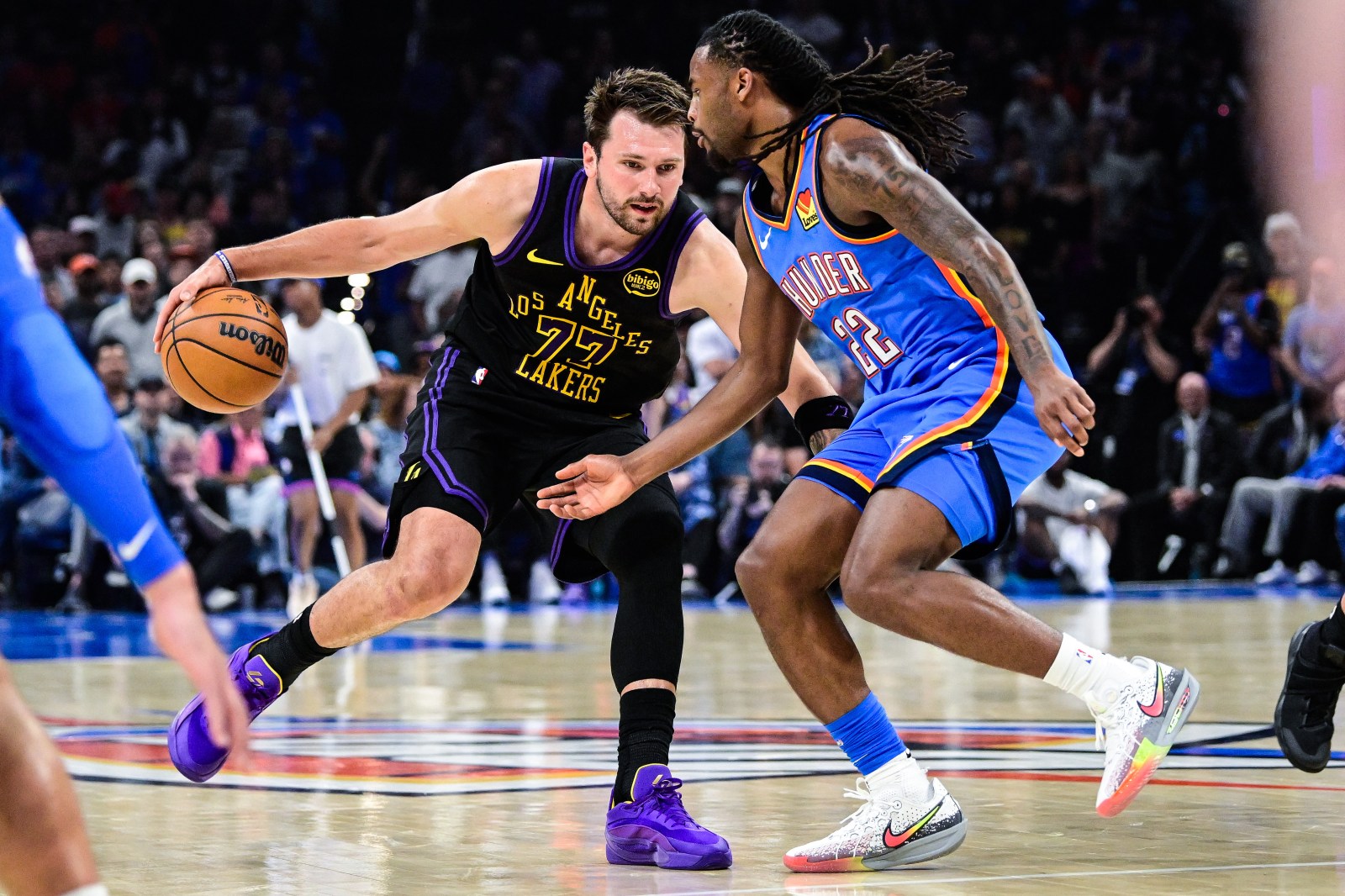
LOS ANGELES — Luka Doncic, the Dallas Mavericks' superstar guard, faces an uncertain end to his regular season after suffering a left hamstring injury during Thursday's game against the Atlanta Hawks. With only about a week left in the NBA's 2025-26 regular season, the injury has thrust Doncic into the spotlight not just for his on-court performance but for its potential to sideline him from major award considerations. Doncic has appeared in 64 games this season, putting him just one short of the league's 65-game eligibility threshold for awards like MVP and All-NBA honors.
According to reports from the Mavericks' medical staff, Doncic underwent an MRI on Friday to assess the severity of the hamstring strain. If the injury keeps him out for the remaining games, he would fall short of the 65-game mark, rendering him ineligible for several prestigious accolades despite leading the league in scoring at 33.5 points per game. Betting platforms like BetMGM Sportsbook have already removed Doncic from MVP futures markets in response to the injury news.
The 65-game rule, introduced as part of the NBA's collective bargaining agreement in the 2023-24 season, requires players to participate in at least 65 regular-season games—or 62 games if sidelined by a season-ending injury—to qualify for awards including Most Valuable Player, Defensive Player of the Year, Most Improved Player, All-NBA teams, and All-Defensive teams. This policy, jointly agreed upon by the NBA and the National Basketball Players Association, aims to encourage player participation and combat load management trends that had previously led to stars missing significant portions of seasons.
For Doncic, the hamstring issue does not appear to qualify as a season-ending injury under the rule's strict definitions. A jointly selected doctor from the NBA and NBPA would need to certify that he cannot return before May 31 for any exception to apply. Without such a designation, Doncic's path to awards eligibility is narrow, though the Mavericks could petition for a grievance or extraordinary circumstances review—processes described by league insiders as difficult to navigate successfully.
"Health is wealth. … We’ll see what happens," Lakers forward LeBron James said after his team's practice on Friday, commenting on the rash of injuries affecting award contenders. James himself is among those impacted, having played only 62 games this season due to various ailments, which has already disqualified him from major honors.
Doncic is not alone in this predicament. Minnesota Timberwolves guard Anthony Edwards, another MVP candidate, was held out of Thursday's game due to illness and has now maxed out at 64 games, ensuring he misses the threshold as well. The list of sidelined stars is extensive: Five of the NBA's six highest-paid players—Golden State's Stephen Curry, Miami's Jimmy Butler, Philadelphia's Joel Embiid, Milwaukee's Giannis Antetokounmpo, and Boston's Jayson Tatum—are ineligible. Denver Nuggets center Nikola Jokic, the lone exception among top earners, has played 64 games and risks disqualification with even one more absence, despite his triple-double averages and leads in rebounding and assists.
Looking back at last season's award winners, at least 10 players from that group are out of contention this year, including Antetokounmpo, Curry, Edwards, James, Tatum, Detroit's Cade Cunningham, Indiana's Tyrese Haliburton, the Clippers' Ivica Zubac, Memphis' Jaren Jackson Jr., and Oklahoma City's Jalen Williams. Four others—Jokic, OKC's Luguentz Dort, Golden State's Draymond Green, and Cleveland's Evan Mobley—are hovering near the threshold but appear on track to qualify if they avoid further setbacks.
The rule's enforcement has sparked debate within the league. The players' union has expressed interest in modifications, particularly as an unusually high number of contenders face exclusion this season. However, NBA Commissioner Adam Silver defended the policy during a media session last month, stating, “I think it is working. I think if you look at the numbers, the pre-implementation of this rule, numbers were going in the wrong direction. I may have this a little bit off: I think the three years before we adopted this rule, almost a third of the All-NBA players had not played 80% of the games. That was a huge issue for the league.”
Silver's comments highlight the league's rationale: Prior to the rule, player participation had dipped alarmingly, with many stars playing fewer than 80% of games, contributing to fan frustration and diluted competition. While some players and executives, including NBPA executive director Andre Iguodala, have praised the rule for promoting health and accountability, others argue it penalizes athletes for unavoidable injuries in a grueling 82-game schedule.
Even if Doncic misses out on All-NBA selection, his scoring prowess remains intact. He is on the verge of clinching the NBA scoring title, a feat that would mark a rare historical anomaly if paired with All-NBA ineligibility. Only twice before has a scoring champion failed to earn All-NBA honors: In the 1968-69 season, rookie Elvin Hayes led the league in scoring but missed both the All-NBA team and Rookie of the Year award. Similarly, in 1975-76, Bob McAdoo captured his third straight scoring title and finished second in MVP voting—behind Kareem Abdul-Jabbar—but was overlooked for All-NBA, with voters opting for Abdul-Jabbar on first team and Dave Cowens on second at center.
Of the 79 previous scoring champions, 64 made first-team All-NBA, and 13 earned second-team nods, underscoring how unusual Doncic's potential fate would be. To catch him, Oklahoma City Thunder guard Shai Gilgeous-Alexander, last season's scoring leader at 31.6 points per game this year, would need an extraordinary finishing kick—scoring 292 points over the final five games, a total unmatched outside of Wilt Chamberlain's legendary stretches.
The disparity between statistical titles and individual awards stems from differing eligibility criteria. While awards demand 65 games, most stat leaders need only 58 appearances (70% of the season). Exceptions exist for shooting percentages, requiring minimum makes: 300 for field-goal, 125 for free-throw, and 82 for three-point. This lower bar has allowed players like San Antonio's Victor Wembanyama to win the blocks title last season despite playing just 46 games; even padding his stats to 58 games without additional blocks would have kept him ahead of Utah's Walker Kessler.
Jokic exemplifies this divide: The three-time MVP is poised to win rebounding and assist crowns while averaging a triple-double, yet his award ballot status hangs in the balance with 64 games played. As the regular season winds down—with key matchups like the Mavericks' finale against the Memphis Grizzlies on April 13—the focus shifts to playoff implications. Dallas, currently fourth in the Western Conference, relies heavily on Doncic's return for a deep postseason run, regardless of award outcomes.
The injury wave has broader ramifications for the NBA's narrative this season. With so many marquee names sidelined from awards, voters and fans alike are left pondering alternatives: Emerging stars like Oklahoma City's Chet Holmgren or New York's Jalen Brunson could see their profiles rise in MVP and All-NBA discussions. Meanwhile, the league's ongoing negotiations with the NBPA may accelerate talks on rule tweaks, though Silver's office shows no immediate appetite for change based on one anomalous year.
As Doncic awaits MRI results, the basketball world watches closely. His potential scoring title without All-NBA recognition would join a short list of ironies in NBA history, reminding players and executives of the fine line between glory and exclusion in a sport defined by endurance as much as talent. For now, the Mavericks' training facility in Dallas buzzes with cautious optimism, hoping their Slovenian sensation can return before the playoffs tip off on April 19.