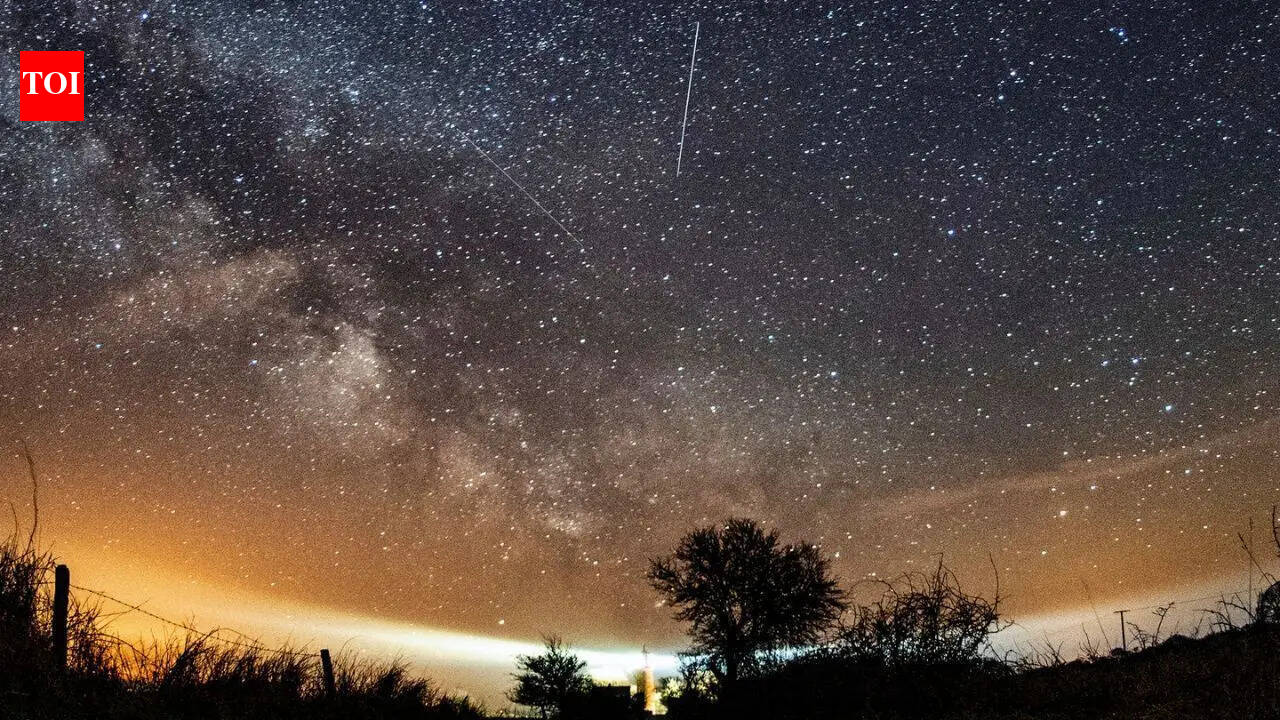
APPLETON, Wis. — Stargazers across the United Kingdom are preparing for a dazzling display in the night sky as the annual Lyrid meteor shower reaches its peak tonight, promising a spectacle rich with fireballs and shooting stars. According to astronomers at the Royal Astronomical Society, the Lyrids, one of the oldest recorded meteor showers, will be visible under clear conditions from dark-sky locations, with the best viewing opportunities between midnight and dawn.
The Lyrid meteor shower, named after the constellation Lyra, originates from debris left by Comet C/1861 G1 Thatcher. This year's event is expected to deliver up to 20 meteors per hour at its peak, though some reports suggest brighter fireballs could make the show even more memorable. 'The Lyrids are known for their swift and bright meteors, often accompanied by persistent trains that linger in the sky,' said Dr. Emily Hargrove, an astrophysicist with the British Astronomical Association. 'Viewers in the UK should head to rural areas away from city lights for the clearest views.'
Historical records trace observations of the Lyrids back more than 2,500 years, making it one of the most ancient celestial events documented by humans. Chinese astronomers first noted the shower in 687 B.C., describing it as a 'stars falling like rain.' The shower remains active from April 16 to 30, but tonight marks the height of activity, with the moon in its waning gibbous phase providing relatively dark skies after midnight.
In the UK, visibility will vary by region. Southern England, including areas around London and the South Downs National Park, may face challenges from light pollution, but northern spots like the Lake District and Scottish Highlands offer prime viewing. The Met Office forecasts clear skies in much of England and Wales overnight, with temperatures dipping to around 5 degrees Celsius (41°F). 'It's a perfect opportunity for families to step outside and connect with the cosmos,' noted Sarah Wilkins, outreach coordinator for the Science and Technology Facilities Council.
While the Lyrids are reliable, their intensity can fluctuate. In 1982, for instance, an outburst produced over 90 meteors per hour, but typical years see modest rates. This year's shower coincides with minimal interference from other celestial events, though a thin crescent moon will rise later in the morning, potentially washing out fainter meteors toward dawn. Experts recommend lying back in a comfortable spot, allowing eyes to adjust to the darkness for at least 20 minutes before scanning the sky.
The event draws enthusiasts from around the world, but for UK residents, it's a rare chance to witness a natural fireworks display without the crowds of larger showers like the Perseids. Local astronomy clubs, such as the Liverpool Astronomical Society, are hosting viewing parties at observatories and parks. 'We've seen a surge in interest this year, with many first-timers joining us,' said club president Mark Thompson. 'The fireballs are the highlight—those bright streaks that light up the entire sky.'
Beyond the visual spectacle, the Lyrids offer educational value. Meteors are fragments of comets or asteroids burning up in Earth's atmosphere at speeds up to 110,000 miles per hour. The shower's parent comet, Thatcher, orbits the sun every 415 years and won't return until around 2276. 'Studying these showers helps us understand the solar system's history and potential hazards from space debris,' explained Hargrove.
Not all reports align on the expected meteor rates. While the International Meteor Organization predicts 10 to 20 per hour, some amateur astronomers anticipate fewer due to recent solar activity affecting particle streams. 'It's unpredictable, but that's part of the charm,' said Wilkins. 'Even a handful of bright ones can make the night unforgettable.'
For those unable to view from the UK, the Lyrids will be visible in the Northern Hemisphere, including parts of the United States and Canada, under similar conditions. In Appleton, Wisconsin, local stargazers might catch glimpses if skies remain clear, though the shower favors eastern longitudes. The Fox Cities Planetarium is offering a virtual guide to the event, complete with live streams from UK observatories.
Safety is key for observers. Experts advise avoiding traffic hazards when choosing viewing spots and dressing in layers against the chill. Binoculars are unnecessary, as the meteors are best seen with the naked eye. Apps like Stellarium or SkySafari can help identify the radiant point in Lyra, near the bright star Vega, which rises in the northeast after sunset.
The Lyrids' enduring appeal lies in their simplicity—no telescopes required, just patience and clear skies. As urban light pollution grows, events like this underscore the importance of preserving dark skies. Organizations like the International Dark-Sky Association advocate for more protected areas, citing the UK's Exmoor National Park as a model.
Looking ahead, the Lyrids pave the way for other showers, including the Eta Aquarids in May and the Perseids in August. Astronomers also watch for potential enhancements from cometary activity. 'Each year brings subtle changes, reminding us how dynamic our night sky is,' Hargrove added.
For tonight's peak, the window opens around 11 p.m. local time, with activity tapering by 4 a.m. Reports from early observers in Scotland already note a few early meteors streaking across the heavens. As the world turns its gaze upward, the Lyrids remind us of the universe's quiet wonders, accessible to all who look.
In a broader context, celestial events like the Lyrids foster public interest in space science amid growing exploration efforts. NASA's recent missions to study comets, such as the OSIRIS-REx sample return from asteroid Bennu, highlight the relevance of these ancient phenomena. Closer to home, the UK's Space Agency is investing in ground-based observations to track meteoroids that could pose risks.
Whether you're a seasoned astronomer or a curious novice, the Lyrid shower offers a brief escape from earthly concerns. As Dr. Hargrove put it, 'In the silence of the night, these fleeting lights connect us to the stars' timeless dance.' With forecasts holding steady, tonight could deliver one of the year's most enchanting sky shows.