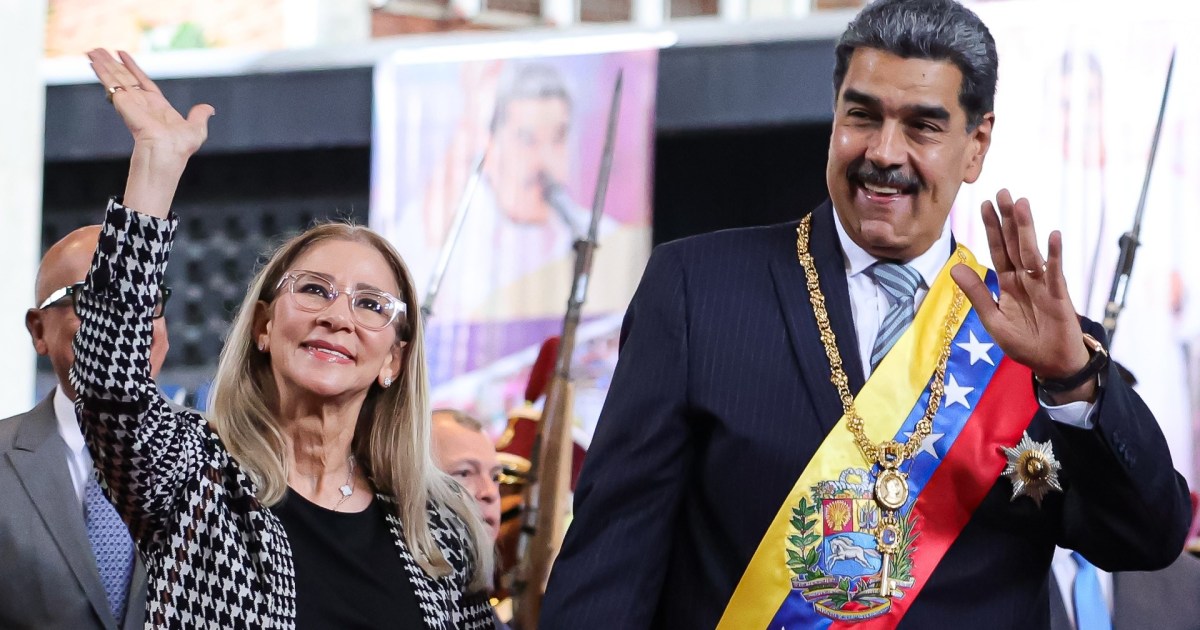
In a dramatic escalation of tensions between the United States and Venezuela, Attorney General Pam Bondi announced on Saturday that Venezuelan President Nicolás Maduro and his wife, Cilia Flores, have been indicted in the Southern District of New York on charges related to drug trafficking and weapons violations. The indictment, unveiled during a press briefing in Washington, D.C., follows a series of U.S. military strikes on Venezuelan targets and President Donald Trump's declaration earlier in the week that Maduro and Flores had been captured by American forces. The developments mark a significant turning point in the long-standing U.S. efforts to dismantle what officials describe as Maduro's involvement in international narcotics networks.
The announcement came on January 3, 2026, as reported by NBC News correspondent Julie Tsirkin during a segment on Saturday TODAY. Bondi, speaking from the Department of Justice headquarters, detailed the charges, which stem from allegations that Maduro and Flores facilitated the shipment of cocaine and arms through Venezuela's ports and airspace. "Nicolás Maduro and Cilia Flores have for years led a criminal enterprise that threatens the security of the United States and our allies," Bondi stated in her remarks. "Today's indictment holds them accountable for their roles in narco-terrorism and arms smuggling."
According to the indictment, unsealed in federal court in Manhattan, the couple is accused of conspiring with the Venezuelan military's Cartel of the Suns, a shadowy group within the armed forces allegedly responsible for protecting drug convoys bound for the U.S. and Europe. Prosecutors claim that between 2018 and 2025, Maduro's administration enabled the transport of over 20 tons of cocaine, valued at more than $1 billion on the street, while also supplying weapons to Colombian rebel groups and Mexican cartels. The charges carry potential life sentences if convictions are secured.
The capture of Maduro and Flores reportedly occurred on December 30, 2025, during a joint operation involving U.S. special forces and Venezuelan opposition elements in Caracas. President Trump, addressing the nation from the White House Rose Garden on January 1, 2026, confirmed the arrests. "We have Maduro and his wife in custody," Trump said. "This is the end of the line for a dictator who has terrorized his people and flooded our streets with poison." Trump credited the operation to enhanced intelligence sharing with regional partners, including Colombia and Brazil, amid ongoing border security concerns.
Background on the U.S.-Venezuela rift dates back to 2017, when the Trump administration first imposed sanctions on Maduro's regime over human rights abuses and electoral fraud. Maduro, who assumed the presidency in 2013 following the death of Hugo Chávez, has faced international isolation as his socialist policies led to hyperinflation, food shortages, and mass emigration. By 2019, the U.S. recognized opposition leader Juan Guaidó as interim president, a move that deepened the divide. Previous indictments against Maduro surfaced in 2020, accusing him of narco-terrorism, but extradition efforts stalled due to Venezuela's non-cooperation with international law enforcement.
The recent U.S. strikes, which targeted military installations in the Orinoco River basin on December 28, 2025, were justified by the Pentagon as preemptive actions against imminent threats from Venezuelan-backed militias. Defense Secretary Lloyd Austin, in a briefing to Congress, described the operations as "limited and precise," resulting in the neutralization of several radar sites and command centers. No civilian casualties were reported, according to U.S. Central Command, though Venezuelan state media claimed dozens of deaths and vowed retaliation.
Venezuelan officials, still loyal to Maduro's United Socialist Party of Venezuela (PSUV), have decried the indictments as a "Yankee imperialist plot." Vice President Delcy Rodríguez, speaking from Havana where she sought asylum, called the charges "fabricated lies designed to justify invasion." Rodríguez, who is Maduro's niece, urged the international community to condemn the U.S. actions at the United Nations. Meanwhile, opposition figures in Venezuela celebrated the news, with María Corina Machado, a prominent dissident, stating in an interview with The New York Times, "This is justice long overdue. Maduro's fall opens the door to democracy and relief for millions suffering under his rule."
International reactions have been mixed. The European Union issued a statement expressing concern over the military strikes but welcoming the legal proceedings against corruption in Venezuela. Russia, a key ally of Maduro, condemned the captures as a violation of sovereignty, with Foreign Minister Sergey Lavrov warning of "severe consequences" for U.S.-Russia relations. China, another supporter, called for dialogue through multilateral channels. In Latin America, Brazil's President Luiz Inácio Lula da Silva advocated for peaceful resolution, while Colombian President Gustavo Petro hailed the indictments as a blow to regional drug trafficking.
The Southern District of New York, known for high-profile cases like those against Joaquín "El Chapo" Guzmán, will handle the prosecution. Lead attorney Amanda Kramer emphasized the evidence's robustness, including intercepted communications, financial records, and testimony from defectors. "We have irrefutable proof linking the highest levels of the Venezuelan government to these crimes," Kramer said during the unsealing ceremony. The case builds on prior convictions of Maduro associates, such as the 2023 guilty plea by former Defense Minister Vladimir Padrino López, who cooperated with U.S. authorities.
Economically, Venezuela's oil-rich economy has crumbled under sanctions and mismanagement, with GDP contracting by over 75% since 2013, according to the International Monetary Fund. The drug charges highlight how Maduro allegedly used state resources to fund his regime, siphoning petrodollars into illicit networks. Human rights groups, including Amnesty International, have documented widespread repression, with over 300 political prisoners reported as of late 2025.
As Maduro and Flores await transfer to the U.S.—currently held in an undisclosed location in the Caribbean—the implications for Venezuela's future remain uncertain. Interim governance talks, mediated by the Organization of American States, are slated to begin in Bogotá next week. Analysts suggest that the power vacuum could lead to factional infighting within the military or renewed protests from the streets.
President Trump, in a follow-up tweet on January 3, 2026, reiterated his administration's commitment to hemispheric security. "America First means stopping the drugs and dictators at our doorstep," he wrote. Bondi echoed this in her briefing, noting that the Justice Department is pursuing additional indictments against PSUV officials. The case underscores the U.S. strategy of using legal tools alongside military pressure to address transnational threats.
Looking ahead, the extradition process could face legal hurdles under international law, particularly the principle of non-extradition of heads of state. Legal experts at the Council on Foreign Relations predict a protracted battle in The Hague, potentially involving the International Criminal Court. For Venezuelans, who have endured blackouts, medicine shortages, and violence, the events signal hope but also risks of instability. As one Caracas resident told reporters, "Maduro's gone, but what comes next? We need real change, not just another strongman."
The unfolding saga continues to captivate global audiences, blending elements of geopolitics, crime, and justice. With trials expected to commence in the spring of 2026, the world watches closely as the U.S. seeks to enforce accountability in a nation long mired in crisis.