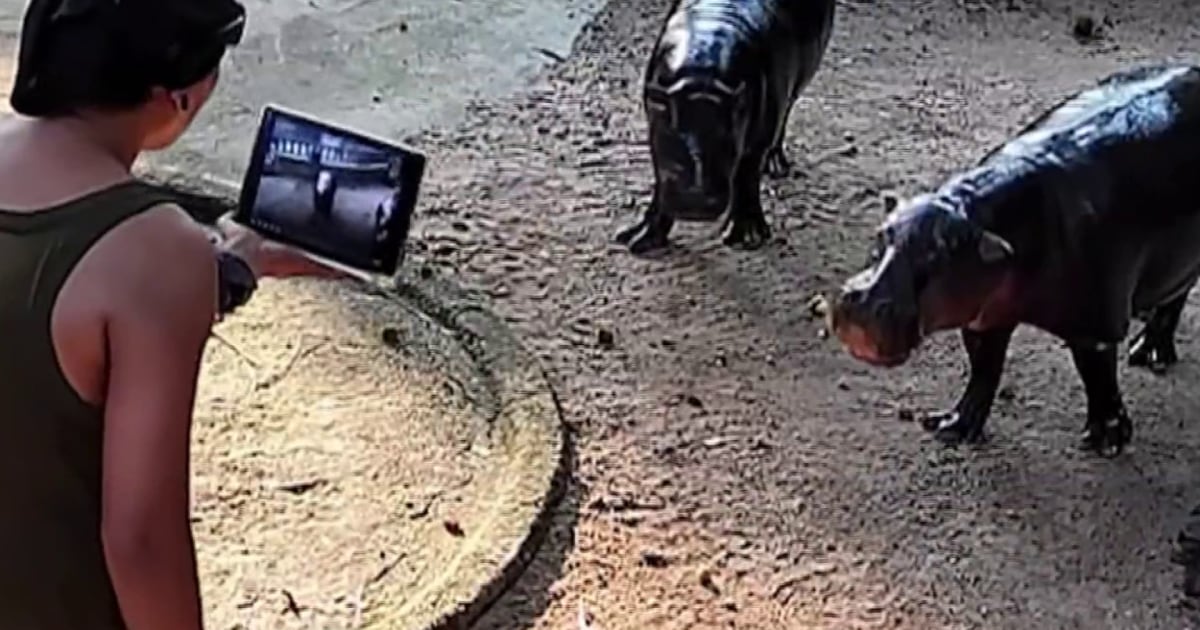
BANGKOK, Thailand — A Thai man was arrested on Tuesday after allegedly climbing into the enclosure of Moo Deng, the internet-famous pygmy hippo that has captivated millions with her playful antics, according to zoo officials at Khao Kheow Open Zoo.
The incident, which unfolded in the early afternoon at the zoo southeast of Bangkok, has raised fresh concerns about visitor safety and animal welfare at the popular attraction. Moo Deng, a one-year-old female pygmy hippopotamus, shot to viral stardom last September when videos of her bouncing and splashing in her habitat began circulating on social media platforms like TikTok and Instagram. Her chubby, expressive face and energetic behavior quickly amassed over 10 million followers across various accounts dedicated to her, turning the zoo into a must-visit spot for tourists and fans alike.
Zoo officials reported that the man, whose identity has not been publicly released pending further investigation, scaled a fence to enter the restricted area around 1 p.m. local time. Security footage captured the breach, showing the individual approaching the water-filled enclosure where Moo Deng and her mother, Bua Loy, reside. 'He jumped over the barrier and landed inside the hippo pen,' said Narongrit Laoppinij, the zoo's director, in a statement to local media. 'Our staff responded immediately, and the man was detained without incident.'
According to authorities, the man claimed he wanted a closer look at the celebrity animal, but officials emphasized that such actions pose significant risks. Pygmy hippos, though smaller than their Nile counterparts, can weigh up to 600 pounds and are known for their unpredictable tempers, especially in confined spaces. No injuries were reported to either the man or the animals, but the event prompted a temporary closure of the viewing area for several hours while staff ensured the enclosure's security.
The arrest comes amid a surge in visitors to Khao Kheow Open Zoo, which has seen attendance double since Moo Deng's rise to fame. In the past year, the facility has hosted over 2 million guests, many drawn by the hippo's online popularity. Social media posts about Moo Deng have garnered billions of views globally, with celebrities like Lisa from Blackpink and international influencers sharing content featuring her. This influx has boosted the zoo's revenue, allowing for expansions like new educational exhibits on endangered species, but it has also strained resources and heightened the potential for unruly behavior.
Police in Chonburi province, where the zoo is located, charged the man with trespassing and endangering wildlife under Thailand's animal protection laws. 'This is a serious violation,' stated Captain Somchai Thongkham, the lead investigator, during a press briefing. 'Moo Deng is not just an animal; she's a symbol of conservation efforts for pygmy hippos, a vulnerable species with fewer than 2,000 left in the wild.' The suspect faces potential fines up to 40,000 baht (about $1,200) and up to one year in prison if convicted.
Witnesses at the scene described a chaotic moment as zookeepers rushed to intervene. 'I was taking photos of Moo Deng when suddenly this guy hopped the fence,' recounted tourist Maria Gonzalez, a visitor from Spain who shared her account on X (formerly Twitter). 'Everyone started screaming, and the hippo just looked confused. It was scary— she could have gotten hurt.' Gonzalez's video of the aftermath quickly went viral, amassing over 500,000 views within hours and sparking debates online about personal responsibility at animal attractions.
Experts in wildlife conservation weighed in on the broader implications. Dr. Sarah Jenkins, a zoologist with the International Union for Conservation of Nature (IUCN), noted that incidents like this underscore the challenges of managing human-animal interactions in the age of social media. 'Viral animals like Moo Deng bring much-needed attention to conservation, but they also attract thrill-seekers who disregard boundaries,' Jenkins said in an email interview. 'Pygmy hippos are shy by nature, and stress from intrusions can lead to health issues or altered behaviors.'
The zoo has faced similar challenges before. Just last month, officials installed additional barriers and increased patrols following reports of fans tossing food into enclosures to elicit reactions from Moo Deng. In one prior event, a group of teenagers was fined for leaning too far over railings, nearly falling into the moat. 'We've enhanced our security measures, including more signage in multiple languages and AI-monitored cameras,' Laoppinij added. 'But ultimately, it comes down to visitors respecting the rules.'
Moo Deng's story began humbly in July 2023 when she was born at the zoo, weighing just 15 kilograms. Her name, meaning 'bouncy pork' in Thai, reflects her lively personality. Unlike the more aggressive common hippos, pygmy hippos are semi-aquatic herbivores native to West African rainforests, listed as endangered due to habitat loss and poaching. Khao Kheow's breeding program has been pivotal, with Moo Deng's birth marking a success in efforts to bolster captive populations.
The viral phenomenon has had ripple effects beyond the zoo. Merchandise featuring Moo Deng—plush toys, T-shirts, and even coffee mugs—has generated significant income, part of which funds anti-poaching initiatives in Africa. Partnerships with platforms like YouTube have led to live streams of her daily routines, educating viewers on hippo ecology. However, critics argue that the fame commodifies wildlife, potentially encouraging risky behaviors for likes and shares.
Local authorities are now reviewing zoo protocols in light of the breach. Thailand's Department of National Parks, Wildlife and Plant Conservation announced plans for a joint task force to audit high-traffic enclosures nationwide. 'We can't let one person's recklessness jeopardize these animals,' said department spokesperson Supakij Vongkumklang. Similar incidents have occurred at other zoos, such as a 2022 case in Indonesia where a visitor entered a tiger exhibit, resulting in fatal injuries.
As news of the arrest spread, Moo Deng's online fanbase expressed outrage and support. Hashtags like #ProtectMooDeng trended worldwide, with posts calling for stricter penalties. One prominent influencer, Thai comedian Pokmindset, tweeted: 'Moo Deng is our national treasure. Climbing in to 'meet' her? That's not love; that's danger.' The zoo, meanwhile, reassured fans that the hippo is 'playful as ever,' resuming her feedings and swims under close watch.
Looking ahead, Khao Kheow officials plan to launch a public awareness campaign emphasizing 'look but don't touch' principles. Educational workshops for school groups are also in the works, aiming to channel Moo Deng's popularity into long-term conservation advocacy. For now, the little hippo continues to splash and play, oblivious to the human drama that briefly invaded her world.
This event serves as a stark reminder of the double-edged sword of social media fame for animals. While it amplifies conservation messages, it also invites boundary-pushing that threatens the very subjects of adoration. As Moo Deng's star rises, so do the stakes for those tasked with protecting her.