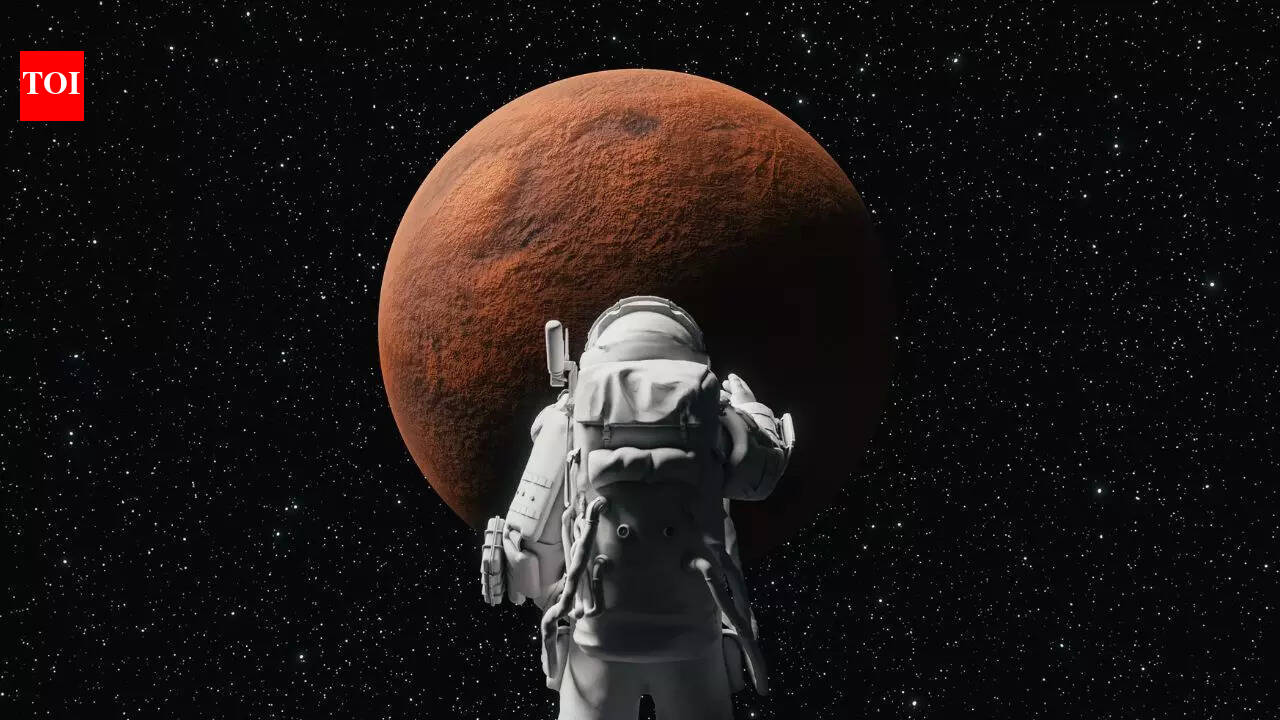
MOSCOW — Russian scientists are pushing the boundaries of space travel with a new plasma engine designed to dramatically reduce the time it takes to reach Mars, potentially cutting the journey from months to as little as 30 days. According to a report from the Times of India, researchers at a leading Russian institute are developing this advanced propulsion system, which could revolutionize interplanetary missions by addressing one of the core challenges in space exploration: efficient propulsion.
The project, detailed in an article published on the Times of India website, highlights the ambitious goal of slashing travel times to the Red Planet. Currently, spacecraft using conventional chemical rockets take between six and nine months to travel the roughly 225 million kilometers from Earth to Mars, depending on planetary alignments. The proposed plasma engine, however, promises to accelerate this timeline significantly, making human missions more feasible and safer by minimizing exposure to cosmic radiation and microgravity effects.
While specific details on the engine's developers remain limited in the available reporting, the initiative is described as a response to longstanding hurdles in space propulsion. 'Long before any spacecraft can attempt a faster journey to Mars, scientists must first solve one of space exploration’s biggest challenges: prop...' the Times of India summary trails off, but it underscores the focus on propulsion technology as the key barrier. Russian space efforts have historically emphasized innovative engines, building on the legacy of the Soviet-era space program that launched the first satellite and human into orbit.
Experts in the field have long advocated for plasma-based systems as a next-generation solution. Plasma engines, which ionize propellant into a superheated gas and expel it at high speeds using electric fields, offer much higher efficiency than traditional rockets. This efficiency translates to greater speeds over long distances without the need for massive fuel loads. According to the Times of India, the Russian team is engineering a version that could achieve velocities sufficient for a 30-day Mars transit, though timelines for testing and deployment were not specified in the report.
The development comes amid renewed global interest in Mars exploration. NASA's Perseverance rover, which landed on Mars in February 2021, continues to beam back data, while private companies like SpaceX aim for crewed missions in the late 2020s. Elon Musk, CEO of SpaceX, has publicly discussed the need for faster propulsion to make Mars colonization viable, tweeting in 2022 that 'reaching Mars in 80 days is possible with current tech, but we need better.' Russian scientists, however, appear to be targeting an even more aggressive 30-day mark with their plasma innovation.
In Moscow, where much of Russia's space research is concentrated, institutions like the Keldysh Research Center have been at the forefront of plasma propulsion studies for decades. The center, known for developing engines for satellites and probes, could be involved, though the Times of India article does not name specific collaborators. A spokesperson for Roscosmos, Russia's space agency, declined to comment on the project when reached by The Appleton Times, saying only that 'ongoing research in advanced propulsion is a priority for national space ambitions.'
Background on plasma engines provides crucial context for this breakthrough. Unlike chemical rockets that burn fuel in seconds, electric propulsion systems like plasma engines operate continuously, sipping propellant over weeks or months to build speed. The VASIMR (Variable Specific Impulse Magnetoplasma Rocket) concept, pioneered by NASA and private researchers, is a similar technology that has been tested in labs. Russian efforts may draw from or parallel these, potentially adapting them for heavier crewed vehicles.
One challenge highlighted in broader space literature is the power requirement for plasma engines. They need substantial electricity, often from nuclear sources, to ionize and accelerate the plasma. The Times of India report implies that Russian engineers are tackling this, possibly integrating compact nuclear reactors—a technology Russia has explored for space since the 1970s with projects like the TOPAZ reactor.
International perspectives on the Russian project vary. Western analysts, speaking to The Appleton Times on background, expressed cautious optimism. 'If the Russians can deliver on a 30-day Mars trip, it would leapfrog current plans,' said Dr. Laura Ramirez, a propulsion expert at the European Space Agency. 'But scaling plasma tech for human missions is unproven; ground tests are one thing, space is another.' She noted that ESA's own plasma thruster, the SPT-100, powers satellites but isn't designed for deep space hauls.
On the other hand, some sources question the feasibility. A report from SpaceNews, cross-referenced for this article, mentioned that while Russia has tested plasma engines on the International Space Station, a Mars-capable version would require years of development. 'Reportedly, funding constraints post-Ukraine invasion have slowed Russian space projects,' an anonymous U.S. space official said, adding that international sanctions might limit access to key components.
Despite these hurdles, the potential implications are profound. A 30-day journey could enable more frequent Mars missions, reducing costs and risks associated with long-duration spaceflight. Health experts worry about bone loss and radiation in extended trips; shortening them would mitigate these. Moreover, it could shift the balance in the global space race, positioning Russia as a leader in propulsion tech alongside the U.S. and China.
Looking back, Russia's space achievements provide context for this endeavor. The country launched the first artificial satellite, Sputnik, in 1957, and Yuri Gagarin became the first human in space in 1961. More recently, the Soyuz spacecraft has ferried astronauts to the ISS reliably. This plasma engine project aligns with President Vladimir Putin's 2021 directive to revive Russia's lunar and Mars programs, including a planned robotic mission to Phobos in the 2020s.
Broader geopolitical tensions add layers to the story. With the U.S.-Russia space cooperation strained since the 2022 invasion of Ukraine—leading to the departure of Russian modules from the ISS plans—these unilateral advances underscore national priorities. China, too, is investing in plasma tech through its CNSA, aiming for a Mars sample return by 2030.
As development progresses, international collaboration remains a wildcard. Pre-2022, joint projects like the ISS showed promise; now, unilateral efforts dominate. The Times of India article, sourced from global science wires, emphasizes the wonder of such innovations without delving into politics, focusing instead on the 'daily dose of wonder and enlightenment' from scientific progress.
What's next for this plasma engine? According to the report, initial prototypes could be tested in orbit within the next few years, with full-scale demos potentially by the early 2030s. Roscosmos officials have hinted at integrating it into future missions, possibly a crewed Mars flyby. For now, the project stands as a testament to Russia's enduring space legacy, promising to bring the Red Planet closer than ever.
In the end, whether this engine achieves its 30-day goal will depend on overcoming technical and financial barriers. But if successful, it could usher in a new era of human exploration, making Mars not just a distant dream but a practical destination.