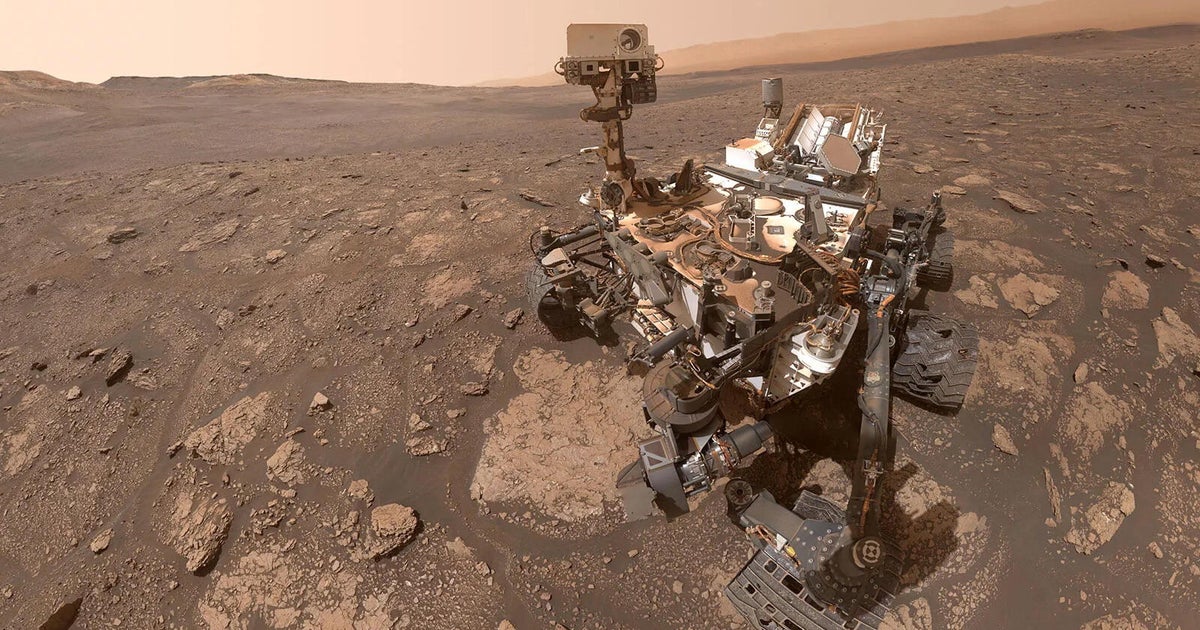
NASA's Curiosity rover has uncovered a trove of organic molecules on Mars, including building blocks essential for life, through a groundbreaking chemistry experiment never before performed beyond Earth, scientists announced Tuesday.
The discovery, detailed in a study published in the journal Nature Communications, highlights the preservation of these molecules on the Martian surface for more than 3 billion years, offering fresh insights into the planet's ancient habitability. The rover, which has been exploring the Gale crater since its landing in 2012, conducted the experiment in 2020 using tubes filled with a chemical called TMAH, or tetramethylammonium hydroxide, designed to break down organic matter and reveal its composition.
"This experiment's never been run before on another world," said Amy Williams, an astrobiologist on the Curiosity mission and lead author of the study, in an interview with AFP. The team had limited resources, carrying just two tubes of the chemical, which added significant pressure to the operation. "We only had two shots to get it right," Williams added.
The analysis detected more than 20 organic molecules, several of which had not been previously confirmed on Mars. Among them was benzothiophene, a compound also found in meteorites and asteroids. Williams explained to reporters that such materials likely bombarded both Mars and Earth in the distant past. "The same stuff that rained down on Mars from meteorites is what rained down on Earth, and it probably provided the building blocks for life as we know it on our planet," she said.
Another notable find was a nitrogen-containing molecule, which Williams described as a precursor to the formation of DNA. "We cannot yet say that Mars ever harbored life, but our findings further support the evidence that Mars was a habitable world around the time that life on Earth originated," she told Reuters. Scientists emphasized that while these organics are crucial clues, they do not constitute definitive proof of past life, as the molecules could have formed through non-biological processes on Mars or arrived via meteorites.
The Gale crater, where Curiosity touched down on August 6, 2012, was once a vast lake bed, with evidence suggesting the presence of large lakes and rivers teeming with liquid water billions of years ago—a vital ingredient for life as we understand it. "The ongoing characterization of organic matter on Mars is a pillar of modern robotic exploration, as space agencies send rovers and landers to explore Mars' past and present habitability and to search for signs of life," the study's authors wrote.
This latest breakthrough builds on Curiosity's long-term mission to probe for signs of ancient microbial life. The rover's Sample Analysis at Mars instrument suite facilitated the TMAH experiment, heating rock samples to react with the chemical and then analyzing the resulting gases. The process revealed a diversity of carbon-based compounds, reinforcing the idea that Mars' surface has retained these potential biomarkers despite harsh radiation and chemical weathering over eons.
Williams noted the significance of the experiment's success for future missions. One potential next step involves returning Martian samples to Earth for more detailed study, which could help substantiate extraordinary claims about past life. NASA's Perseverance rover, which landed in Jezero crater in February 2021, has already collected dozens of rock samples for a planned Mars Sample Return mission. However, according to reports, the mission faced setbacks, with the administration of former President Donald Trump effectively canceling it following a congressional vote in January.
Despite these challenges, Perseverance made its own intriguing find last year, uncovering rocks in a dry river channel that may preserve signs of ancient microscopic life. Officials with NASA have not confirmed the full implications of those samples, but they are being preserved for potential return. Williams suggested that bringing rocks back could allow for advanced lab techniques unavailable on a rover.
Curiosity's demonstration that TMAH experiments function effectively on other worlds paves the way for upcoming explorations. The European Space Agency's Rosalind Franklin rover, equipped with a longer drill for deeper sampling, will carry the chemical to Mars. After years of delays, NASA announced last week that the rover is now slated for launch in late 2028, aiming to drill up to 2 meters into the surface at Oxia Planum, a site rich in clays indicative of past water activity.
Similarly, the chemical will feature on NASA's Dragonfly rotorcraft, scheduled to launch in 2028 toward Titan, Saturn's largest moon, to investigate its organic-rich dunes and potential prebiotic chemistry. These missions underscore a growing international effort to unravel the origins of life in our solar system, with Mars remaining a primary focus due to its geological similarities to early Earth.
The announcement comes amid a series of vivid discoveries from Curiosity's cameras. In June, the rover captured the first close-up images of enigmatic ridges in Gale crater that resemble spiderweb patterns from orbit, providing new evidence of how water once sculpted the Martian landscape. NASA scientists described these features as remnants of seasonal salt deposits formed as briny water evaporated.
Five months earlier, in January, Curiosity photographed colorful clouds drifting across the Martian sky, a rare glimpse of atmospheric dynamics that included water ice crystals and dust particles. These images, taken during the rover's 3,000th Martian day, or sol, highlighted the thin but dynamic atmosphere that continues to intrigue researchers.
Broader implications of the organic findings extend to astrobiology and the search for extraterrestrial life. While no mission has yet detected unambiguous biosignatures on Mars, the accumulation of evidence—from organics to hydrated minerals—paints a picture of a once-wetter world capable of supporting microbial organisms. Experts like Williams caution against overinterpretation, but the data fuels optimism for continued exploration.
Looking ahead, NASA's Mars program faces budgetary and technical hurdles, including the overhaul of the Sample Return mission, which could cost up to $11 billion. International partnerships, such as those with the ESA, may help mitigate these issues. As Curiosity nears the base of Mount Sharp, its primary science target, it continues to drill and analyze, with scientists anticipating more revelations from the red planet's layered history.
In the end, these discoveries remind us that Mars, though barren today, holds secrets about our own origins. Whether life ever took root there remains an open question, but each experiment like this one brings us closer to answers.