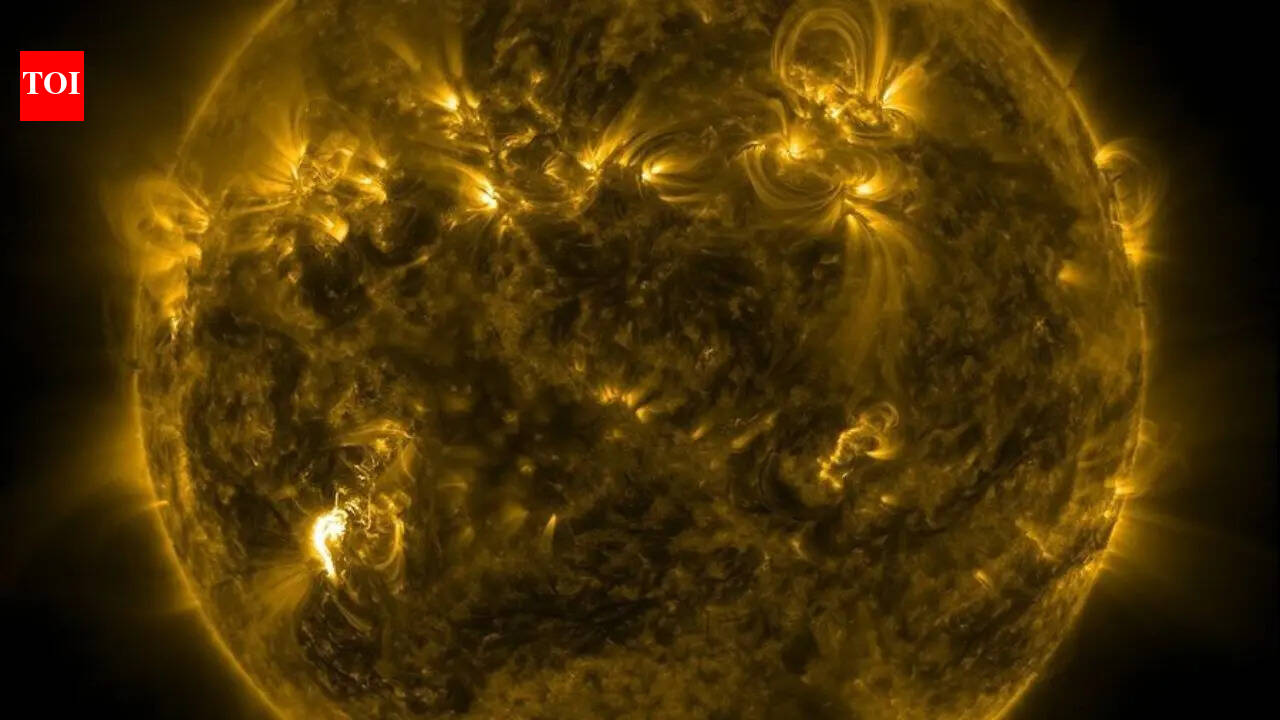
APPLETON, Wis. — A powerful X1.4 solar flare erupted from the sun on Tuesday, sending a wave of charged particles hurtling toward Earth just days before NASA's highly anticipated Artemis II mission is set to launch. The event, detected by NASA's Solar Dynamics Observatory, has drawn attention from space agencies worldwide as they monitor potential disruptions to satellite communications and power grids, though officials emphasized that the timing poses no direct threat to the upcoming crewed lunar orbit flight.
The flare, classified as an X1.4 on the scale of solar activity intensity, peaked at around 11:15 a.m. EDT, according to data from the National Oceanic and Atmospheric Administration's Space Weather Prediction Center. Such X-class flares are among the strongest, capable of triggering radio blackouts and auroras visible as far south as the U.S. Midwest. This particular outburst originated from a sunspot region known as AR 3848, which has been active in recent days, producing multiple smaller flares leading up to the major event.
NASA spokesperson Kelly Humphries stated in a press release that the agency is closely tracking the solar activity but remains confident in the Artemis II timeline. "While solar weather is always a factor in spaceflight planning, our models show no significant impact on the mission's preparations," Humphries said. The Artemis II launch, scheduled for no earlier than September 2025 from Kennedy Space Center in Florida, will mark the first crewed flight of the Space Launch System rocket and Orion spacecraft since the Apollo era.
The crew for Artemis II includes NASA astronauts Reid Wiseman, Victor Glover, and Christina Koch, along with Canadian Space Agency astronaut Jeremy Hansen. Their mission will involve a 10-day journey looping around the moon without landing, testing systems critical for future Mars expeditions. With the launch window approaching, any solar interference could complicate ground communications or spacecraft electronics, but experts downplayed the risks associated with this flare.
According to the Times of India, which first reported the story in detail, the flare's arrival underscores the unpredictable nature of solar cycles. The current solar maximum, peaking in 2024-2025, has seen heightened activity, with over 20 X-class flares recorded this year alone. "A powerful burst of solar activity briefly caught attention this week, arriving just days before one of the most closely watched space missions," the report noted, highlighting NASA's reassurances.
Solar physicists at the University of Wisconsin-Madison, monitoring the event from their space weather lab, provided additional context. Dr. Gina Wrobel, a researcher in heliophysics, explained that while the flare could cause minor geomagnetic storms, its effects are expected to dissipate within 48 hours. "The charged particles from this coronal mass ejection might enhance auroral displays tonight, but for space missions like Artemis, we've built in redundancies," Wrobel said in an interview.
Historical precedents add weight to NASA's optimism. During the 2003 solar maximum, a series of X-class flares disrupted communications but did not derail the Space Shuttle program. Similarly, the 1989 Quebec blackout, caused by a massive geomagnetic storm, prompted modern upgrades to power grids and satellite protections. Today's infrastructure, including hardened electronics on the Orion capsule, is designed to withstand such events, according to a 2022 NASA report on space weather resilience.
Yet, not all perspectives are entirely dismissive. Independent space analyst Dr. Emily Chen, writing for SpaceNews, cautioned that cumulative solar exposure could subtly affect long-duration missions. "Even if this flare doesn't delay Artemis II, the broader solar maximum means crews will face elevated radiation risks during transit," Chen said. She referenced data from the European Space Agency showing a 20% increase in solar proton events this cycle compared to the last.
The timing of the flare has sparked discussions in Appleton, home to a vibrant community of amateur astronomers and space enthusiasts. At the local Fox Cities Planetarium, director Mark Smith hosted an impromptu viewing session Tuesday evening, where about 50 attendees observed faint auroras tinged green and red. "It's a reminder of how connected we are to the sun's moods, especially with Artemis on the horizon," Smith remarked.
Beyond immediate concerns, the event ties into larger efforts to predict and mitigate space weather. NASA's Parker Solar Probe, launched in 2018, has provided unprecedented data on coronal mass ejections, helping refine forecasts. The probe's recent flybys, including one in December 2024, captured similar flare dynamics, aiding models used by the Artemis team. International collaboration, through the International Space Weather Initiative, ensures shared warnings across agencies like Roscosmos and JAXA.
As preparations continue at Kennedy Space Center, the Orion spacecraft underwent final systems checks last week, with no anomalies reported. Launch director Charlie Blackwell-Thompson confirmed in a briefing that weather and solar forecasts are integrated into daily operations. "Our go/no-go criteria are robust; this flare doesn't change that," she said.
The broader implications of increased solar activity extend to everyday life. Airlines rerouted polar flights Wednesday to avoid radiation hotspots, and GPS signals experienced brief glitches in the Pacific region, per FAA reports. Economists estimate that severe space weather events could cost the global economy up to $2 trillion in a worst-case scenario, underscoring the stakes for missions like Artemis II.
Looking ahead, NASA plans to incorporate real-time solar data into Artemis III, the 2026 lunar landing mission. Partnerships with private firms like SpaceX and Blue Origin aim to diversify launch capabilities amid variable solar conditions. For now, the agency urges public excitement over caution, with live streams of the launch expected to draw millions.
In Appleton, residents like retired engineer Tom Reilly expressed awe at the cosmic coincidence. "Seeing the sun flare up right before humans head back to the moon—it's poetic," Reilly said while viewing NASA footage at a community watch party. As the solar cycle wanes post-2025, such events may become less frequent, but they serve as a humbling prelude to humanity's next giant leap.
With the flare's effects fading, focus returns to the stars. Artemis II represents not just technical achievement but a step toward sustainable lunar presence, potentially hosting international crews by decade's end. Officials from the White House Office of Science and Technology Policy echoed NASA's stance, calling the mission a "beacon of progress" unaffected by transient solar drama.