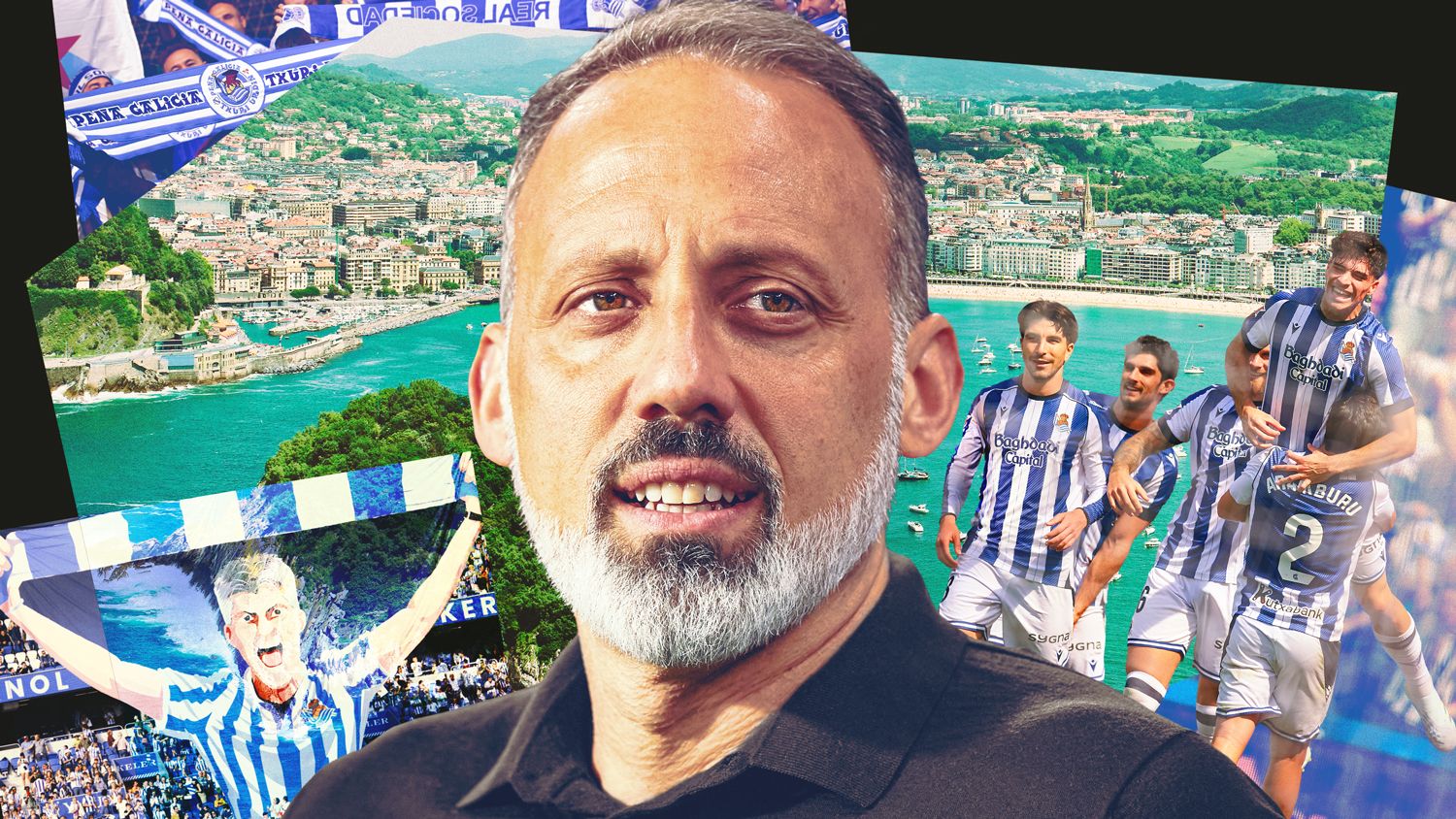
SAN SEBASTIAN, Spain -- In the spring sunshine outside Anoeta Stadium, home of Real Sociedad, a young boy named Iñaki, about six or seven years old, waits eagerly with his father Aimar. Earlier this year, the team they support was struggling, mired in its worst start to a LaLiga season in two decades and just one point from the relegation zone. Headlines described the club as being in a "crisis," sunk and unresponsive. But then a new coach arrived, and everything changed.
Iñaki, who knew little about the 48-year-old New Jersey native Pellegrino Matarazzo at the time, now calls him "like our God, the savior." Matarazzo, who had never worked in Spain before, took over on January 4 and immediately steadied the ship. In his debut match, Real Sociedad held Atlético Madrid to a draw. From there, the team won seven of its next eight games, including a dramatic victory over Barcelona. It took two months for them to suffer a loss. Four months into his tenure, Matarazzo has lifted the club from the brink of relegation to the cusp of UEFA Champions League qualification and a spot in Sunday's Copa del Rey final against their Basque rivals, Athletic Club.
If Real Sociedad wins that final on April 18 at 3 p.m. ET -- streamed live on ESPN+ in the U.S. -- Matarazzo would become the first U.S.-born coach to claim a major trophy with a club in one of Europe's top five leagues. The victory would mark only the fourth Copa del Rey title in the club's 116-year history. "We needed someone to revive the team, the talent we know they have," said Erik Bretos, Real Sociedad's sporting director, explaining the decision to hire the applied mathematics graduate who had been out of work for over a year.
Matarazzo's path to this moment has been anything but straightforward. Born in 1977 in Wayne, New Jersey, and raised in Paterson and Fair Lawn, he grew up in a working-class Italian-American family. His father, Leopoldo, was a car mechanic from near Avellino, Italy, and his mother, Gemma, worked at a local factory in Salerno, about 20 miles south. The family was passionate about soccer, particularly Napoli during the Diego Maradona era. "There was a big rivalry, a big football derby that was always very heated," Matarazzo told ESPN. "But the main team for all of us was Napoli."
His parents' humble roots instilled a strong work ethic. "They were humble, hardworking, doing everything they could to create the opportunities me and my brothers had," Matarazzo said. "My family, my Italian roots, meant that my love of the game was instilled at a very early age watching Serie A on my dad's small TV." One vivid memory is from 1982, when Italy won the World Cup: His father spray-painted their red Wrangler Jeep in the colors of the Italian flag -- green, white, and red -- and led a parade through Paterson's city center with Italian immigrants beeping horns and waving flags.
Soccer wasn't as popular in the U.S. back then, dominated by other sports, but Matarazzo's family made it central. They played in the park every Sunday, and his father coached a recreational team alongside a friend's dad. Leopoldo had his own flair on the field: "My dad used to take penalty kicks with the outside of his foot; that was like his trademark play. It was very deceptive. He was very quick." Matarazzo himself excelled, becoming the top player on his high school team, the Fair Lawn Cutters, and a starter as a freshman at Columbia University, where he studied applied mathematics.
Despite his academic success -- Ivy League degree in hand, with job offers in finance rolling in -- Matarazzo chose soccer over a corporate path. "I had opportunities to start working. There was interest from several companies," he recalled. "But I didn't want to start in the corporate world, without giving football a shot." After college, he aimed for Italy, promised a trial with Salernitana through an agent. But it fell through, leading to a brief, unfulfilling stint training with a third-division club. "The coach said, 'Listen, I see your potential, but there's no way we can sign you. You should start in the lower leagues.' I lost a year."
That "lost" year included six months on his grandparents' hazelnut farm in Italy, which Matarazzo described as "an amazing experience." Back in the U.S., pressure mounted from family and friends to enter business, but his father encouraged him. A trial opportunity in Germany's fourth division changed everything. "A German fellow saw me playing and asked me to go on trial in Germany," he said. "I didn't even think. I left the U.S. immediately, with one [piece of] luggage. And I never came back."
Over the next 25 years in Germany, Matarazzo transitioned from player to coach. As a player, he moved from an attacking No. 10 to a defensive No. 6, despite standing 6-foot-5 -- a height that drew fan jokes about his header struggles. He progressed from the fourth tier to the third, playing for clubs like SG Wattenscheid 09, SV Wehen, Preussen Munster, and Eintracht Bad Kreuznach, but never reached the top levels. His highest moment was a cup game against Werder Bremen. "I earned enough money to get by," he said. "I wouldn't say I was a professional player, but it was my occupation."
Coaching proved even tougher. Securing licenses was a battle, and early roles were grueling. By the time he joined Hoffenheim's academy as an assistant -- his first professional gig -- his finances were dire. "My bank account was ... there were red numbers. There was below zero. It was tight, very tight," Matarazzo admitted. His wife, Dani, teased him about his frugality: "My wife makes fun of me because my currency was doner kebabs. Whenever she would buy something, I would say: 'Dani, you know how many doner kebabs we could have got with that?!'"
A return to the U.S. was tempting, but Matarazzo's drive kept him in Europe. At one low point in Hoffenheim's academy, he considered settling down. "I said to my wife, 'Maybe this is it. Maybe I just settle here. Build a family. Do something productive. I'm still in the game,'" he recounted. But she pushed back: "'Rino, look at all you sacrificed. There's no way you're going to be happy with just this.' That hit home." In late 2018, after 18 years in Germany, Stuttgart called, and he knew it was his breakthrough. On New Year's Eve before taking the job, his family danced in their apartment to celebrate. "This is the moment we can dance," he said, reflecting on a lifetime of effort.
Success followed: He promoted Stuttgart to the Bundesliga and led Hoffenheim to European competition. But after being let go from Hoffenheim amid club politics, Matarazzo took a year off to recharge. "At Hoffenheim it was pretty clear what was going to happen. The politics, the dynamic in the club had changed," he explained. Interest came from strong European leagues, but he was selective, nearly reaching his limit on time out of the game.
When Real Sociedad came calling in autumn, with the team on just 16 points from 16 games under former coach Sergio Francisco, Matarazzo said yes immediately. He cut short a trip to London to meet club president Jokin Aperribay and sporting director Bretos in Biarritz. "From the first conversation, I knew: There's something here. I identify with the values of the club, the region," he said. "I fell in love right away."
The Basque culture resonated deeply. Matarazzo, who often says "Poliki, poliki" -- Basque for "slowly, slowly" or step by step -- appreciates the region's hardworking, humble ethos. "The culture around this city and region is: hardworking, humble, grounded. I identify with it," he noted. Captain Mikel Oyarzabal embodies that, a star player who remains connected to his roots. San Sebastian, or Donostia, has won him over with its beauty, food, and people. Walking the promenade along La Concha Bay, he enjoys pintxos in the old town and chats with fans who shout "Win!" as the cup final nears.
His family remains in Germany for now -- his 16-year-old son has high school exams left, and their Weimaraner, Jiraiya (named after a resilient anime character), factors in too. But Matarazzo has embraced the city, helping endear him to supporters. "Well, let's be honest, the results are a big part. Winning games is important," he said with a laugh. Still, he acknowledges broader challenges for American coaches in Europe. "I've felt that, yes. I felt that as a player. And as a coach. In the initial phases: 'What can he do?' And you [still] get comparisons to Ted Lasso."
Compared to fellow U.S. coaches like Jesse Marsch, who won Austrian doubles with RB Salzburg, or Bob Bradley and David Wagner, none have lifted trophies in Europe's elite leagues. Matarazzo doesn't feel burdened by representation but hopes his success opens doors. As Real Sociedad prepares for the final, the stakes are high. A win could not only bring historic glory but also elevate the profile of American talent abroad, one step at a time -- poliki, poliki.