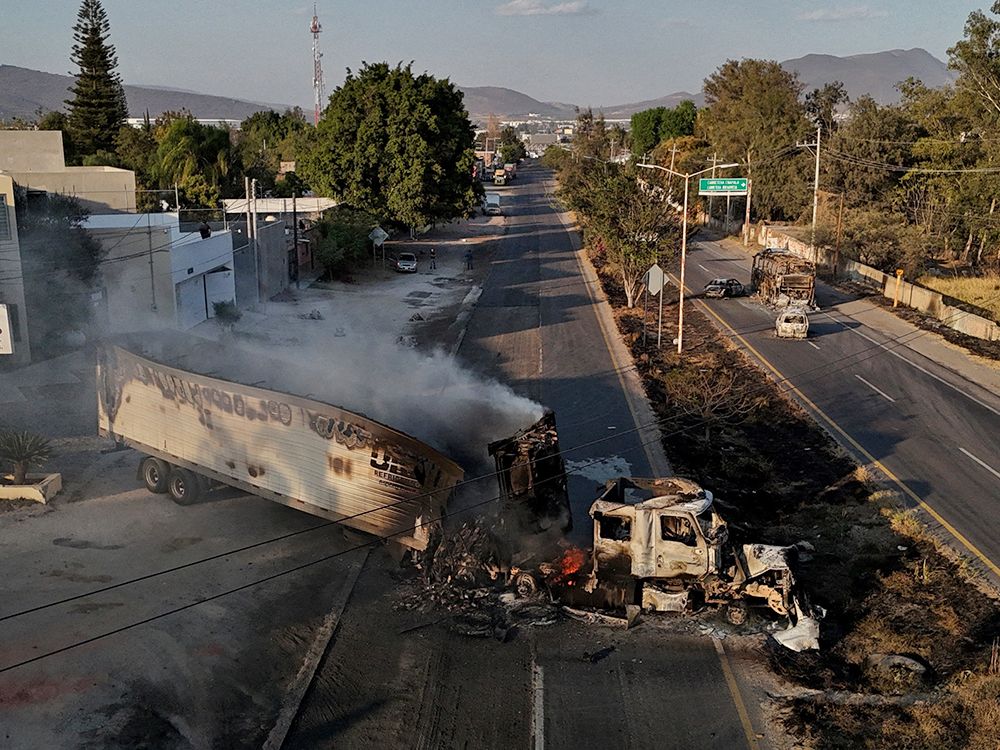
BOGOTÁ, Colombia — The killing of Nemesio Oseguera Cervantes, the notorious leader of Mexico's Jalisco New Generation Cartel known as 'El Mencho,' has ignited a wave of retaliatory violence across Mexico, with authorities reporting clashes and unrest in several states since last Sunday. Mexican officials confirmed the death of the 58-year-old drug kingpin during a confrontation in the western state of Michoacán, though details of the operation remain closely guarded. El Mencho, who had evaded capture for over a decade despite a $10 million U.S. bounty on his head, led one of the world's most powerful criminal organizations, overseeing the trafficking of fentanyl, methamphetamine, and cocaine to at least 40 countries, according to the U.S. Drug Enforcement Administration.
The immediate aftermath in Mexico has been marked by mayhem, including arson attacks on government buildings and shootouts in cartel strongholds like Guadalajara and Colima. Local media reported at least 15 deaths tied to the violence in the days following the announcement, as rival factions and cartel enforcers positioned themselves amid the power vacuum. Yet, as Mexican security forces scramble to contain the domestic fallout, experts warn that the ripples of El Mencho's death could extend far beyond Mexico's borders, destabilizing criminal networks across Latin America and potentially fueling new conflicts in neighboring countries.
Analysts tracking the cartel's operations suggest that without a clear successor, the CJNG — as the cartel is commonly known — faces the risk of internal fragmentation, which could upend alliances and rivalries long established in the region's underworld. 'The true impact of his death is yet to be seen,' one security expert noted, highlighting the opaque nature of cartel leadership transitions. The CJNG, founded in 2010 as a splinter from the Sinaloa cartel, has grown into a ruthless empire under El Mencho's command, notorious for its use of extreme violence, including public beheadings and attacks on law enforcement.
Among the regions most vulnerable to spillover effects is northern Guatemala, where the CJNG has aggressively expanded its influence in recent years. The cartel's dominance in Mexico's southern border state of Chiapas has come at the expense of its arch-rival, the Sinaloa cartel, through a series of brutal confrontations that have left dozens dead. Adam Isacson, director for defense oversight at the Washington Office on Latin America (WOLA), pointed to this volatile frontier as a flashpoint. 'One place to watch is northern Guatemala and Chiapas, where the CJNG appears to have mostly elbowed (the) Sinaloa (cartel) aside very violently lately,' Isacson said.
Should El Mencho's demise weaken the CJNG's grip, Isacson added, it could invite a Sinaloa resurgence. 'If Mencho’s departure weakens the CJNG, Guatemala will feel it,' he explained, predicting that the rival cartel might exploit any divisions to reclaim smuggling routes in Chiapas. Guatemala's border areas, already strained by drug and human trafficking, have seen rising organized crime, with local groups like the so-called Chiapas and Guatemala cartel reportedly receiving backing from the CJNG. Guatemalan media outlets have documented increased extortion and kidnappings linked to these networks in provinces such as Huehuetenango and Petén.
In response to the news, Guatemalan authorities moved swiftly. Just hours after reports of El Mencho's death surfaced, the Guatemalan Army announced enhancements to its border security under Operation Ring of Fire. 'Following reports of the alleged death of… “El Mencho,” the Guatemalan Army, as part of Operation Ring of Fire, increased its operations (monitoring, control, patrols, surveillance, presence and security) in strategic sectors of the Guatemala-Mexico border area,' officials stated in a public release. This escalation includes deploying additional troops to key crossings like Ciudad Hidalgo and Tecún Umán, where smuggling activity is rampant.
Further south, in Ecuador, the CJNG's influence has been even more direct, intertwining with local gang wars that have transformed the country into Latin America's homicide capital. Ecuador's national murder rate surged by 429 percent between 2019 and 2024, driven largely by violence in the port city of Guayaquil, a critical hub for cocaine exports bound for Europe and North America. There, two major gangs — Los Lobos, designated a terrorist group by the U.S., and Los Choneros — have been locked in a bloody turf war over control of trafficking corridors.
Los Lobos receives substantial support from the CJNG, including funding, weapons, and tactical guidance, while Los Choneros maintains ties to the Sinaloa cartel. Elizabeth Dickinson, deputy director for Latin America at the International Crisis Group, emphasized Ecuador's exposure to any CJNG instability. 'If we think about the fallout in the region, potentially for a reconfiguration of power within Jalisco, Ecuador would be probably the place to look,' Dickinson said. She described the Mexican cartels' 'hands-on approach' in Ecuador, where CJNG operatives have embedded themselves to secure drug routes from Andean producers to Pacific shipping lanes.
A potential splintering of the CJNG could erode Los Lobos' advantages, shifting the balance toward Los Choneros and sparking intensified clashes. Guayaquil has already endured prison riots, car bombings, and street battles, with over 4,000 homicides recorded in 2023 alone. 'The role of Mexican groups in Ecuador is very pronounced,' Dickinson noted, adding that the cartel's involvement has amplified local violence. 'I think Ecuador would certainly be a place to watch in the coming months as we see how the internal power dynamics within Jalisco evolve.'
In Colombia, the world's top cocaine producer, the CJNG's operations are more transactional but no less consequential. The cartel sources much of its product from hot spots in regions like Nariño and Putumayo, where Mexican nationals linked to the group have been arrested in raids on processing labs. Colombian authorities reported detaining at least a dozen CJNG affiliates in 2024, often in collaboration with local armed factions, including dissident elements of the demobilized Revolutionary Armed Forces of Colombia (FARC).
These partnerships are primarily economic, focused on purchasing and transporting coca paste northward. However, a CJNG fracture could disrupt these flows, intensifying competition among Colombian groups. 'If CJNG splits up, we can expect some violence in Colombia as competition for the group’s trafficking routes intensifies,' Isacson predicted. Colombia's internal conflict, which saw its deadliest year in a decade in 2025 with over 300 clashes reported by human rights organizations, is often fueled by such territorial disputes over drug profits.
That said, some observers downplay the risk of a total breakdown in supply chains. Dickinson cautioned that the cocaine trade's maturity provides resilience. 'The cocaine market particularly is so mature and has been working for so many decades that it tends to keep operating even when there are these sorts of criminal splits,' she said. Echoing this, analyst Daniel Shuldiner, who studies Latin American organized crime, highlighted the role of intermediaries. 'These transactions and relationships aren’t one to one, there are a lot of brokers and intermediaries involved in the drug trade who are still going to want to move product from Colombia to elsewhere.'
While Sinaloa-linked groups might capitalize on any CJNG weakness to expand their sourcing, the fragmented nature of Colombia's armed landscape — involving ELN guerrillas, Clan del Golfo paramilitaries, and FARC dissidents — means disruptions could be localized rather than region-wide. Colombian President Gustavo Petro's administration has pursued peace talks with some factions while cracking down on others, but cartel volatility adds another layer of complexity to these efforts.
Beyond these immediate neighbors, El Mencho's death raises broader concerns for international security. The CJNG's global reach extends to synthetic drug labs in Asia and distribution networks in Europe, but Latin America's interconnected criminal ecosystem makes regional instability the most pressing issue. U.S. officials, who had long prioritized El Mencho's capture, have yet to comment extensively on the succession, though DEA statements underscore the cartel's enduring threat.
As authorities in Mexico, Guatemala, Ecuador, and Colombia heighten vigilance, the coming weeks will be critical in gauging the CJNG's trajectory. Whether the cartel coalesces around a new figure — rumors swirl around El Mencho's son or a military wing leader — or fractures into warring cells remains unclear. For now, the specter of escalated violence looms large, a reminder of how deeply entrenched these networks are in the fabric of Latin American life.