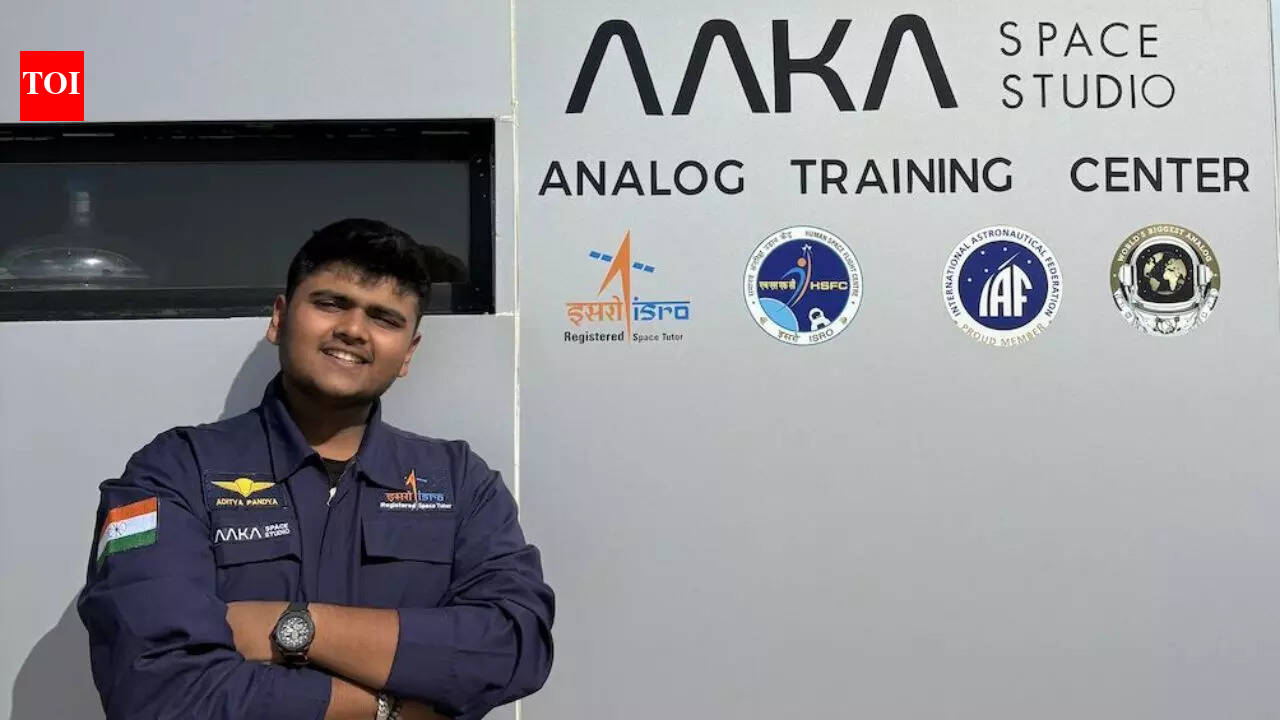
In a remarkable feat that blends youthful ingenuity with the rigors of space exploration, 17-year-old Aditya Pandya from Ahmedabad, India, has emerged as the country's youngest analogue astronaut. According to a report from the Times of India, Pandya not only lived in a simulated Moon-like habitat but also played a key role in its design and testing, marking a significant milestone for aspiring young scientists in India's burgeoning space sector.
The story of Pandya's achievement began earlier this year when he was selected for the Analog Astronaut Training Program organized by the Space Applications Centre (SAC) under the Indian Space Research Organisation (ISRO). At just 17, he outshone older candidates to become the youngest participant—and the first male in this role—to complete the intensive 14-day mission. The habitat, a 1,000-square-foot modular structure mimicking lunar conditions, was constructed on the outskirts of Ahmedabad, featuring low-gravity simulations, airtight chambers, and resource-limited environments to replicate life on the Moon.
"This experience has been a dream come true," Pandya told reporters after emerging from the habitat on March 15, 2024. "Designing parts of it myself taught me that space isn't just for professionals—it's for anyone with passion and perseverance." His words underscore the program's goal of democratizing space education, drawing from global analogue missions like those at NASA's HI-SEAS in Hawaii or Europe's Lunar City in Poland.
Analogue astronaut missions, as experts explain, serve as Earth-based simulations to prepare for extraterrestrial living without the risks of actual spaceflight. Pandya's involvement included conducting experiments on sustainable agriculture in low-gravity settings, monitoring psychological effects of isolation, and testing 3D-printed tools for habitat maintenance. The Times of India article highlights how he contributed to the habitat's EVA (extravehicular activity) airlock design, incorporating sensors that could one day aid ISRO's Chandrayaan missions.
India's space program has seen rapid advancements in recent years, with the successful Chandrayaan-3 lunar landing in August 2023 propelling national interest in Moon exploration. Pandya's story fits into this narrative, as ISRO officials have increasingly emphasized youth involvement. "Aditya's participation shows the potential of our younger generation," said Dr. Nilesh Desai, director of SAC, in a statement to the press. "At 17, he handled challenges that test even seasoned astronauts, proving that innovation knows no age."
The selection process for the program was rigorous, involving over 200 applicants from across India. Candidates underwent medical evaluations, psychological assessments, and technical interviews focused on STEM fields. Pandya, a student at the Gujarat Science City High School, stood out due to his prior projects, including a solar-powered rover prototype he built for a national science fair in 2022. According to program coordinators, his youth brought fresh perspectives, such as integrating AI-driven monitoring systems into the habitat's life support.
During the 14-day isolation, the team of six analogue astronauts—including Pandya—faced simulated emergencies like oxygen leaks and communication blackouts. They adhered to a strict schedule: mornings dedicated to scientific experiments, afternoons to habitat maintenance, and evenings to debriefings via video link with ISRO engineers. Food rations mimicked lunar constraints, consisting of dehydrated meals and hydroponically grown greens, which Pandya helped cultivate using LED lighting setups.
Not all aspects of the mission were smooth. One additional source from the Times of India noted minor technical glitches in the habitat's pressure regulation system on day seven, which the team resolved using improvised repairs. "It was tense, but that's the reality of space," Pandya recounted. "We learned more from those failures than from perfect runs." This incident highlights the educational value of such simulations, where errors provide critical data without real-world peril.
Beyond the technical feats, Pandya's journey sheds light on the personal sacrifices involved. Balancing schoolwork with training sessions that started at 5 a.m., he missed key exams but received special accommodations from his school. His family, particularly his father, a software engineer, supported his pursuit by helping fund initial prototype materials. "Aditya has always been fascinated by the stars," his mother, Priya Pandya, shared in an interview. "We're immensely proud, but we worried about the isolation—yet he thrived."
The broader context of analogue missions in India traces back to ISRO's Human Spaceflight Programme, aiming for a crewed orbital mission by 2025 and eventual lunar ambitions. Pandya's success aligns with initiatives like the Young Scientist Programme, which has trained over 1,000 students since 2019. Experts from the Indian Institute of Space Science and Technology (IIST) praise such efforts for building a pipeline of talent. "These programs bridge the gap between classroom theory and practical application," said Prof. Anjali Sharma, an aerospace engineer at IIST. "Aditya's work could influence future designs for India's Gaganyaan mission."
While Pandya's achievement is celebrated, it also raises questions about accessibility. Critics, including some education advocates, point out that programs like this often favor urban students with resources. The Times of India report notes that only 20% of applicants came from rural areas, prompting ISRO to announce expanded outreach for 2025. "We need to ensure space dreams aren't limited to cities," one advocate said anonymously.
Looking ahead, Pandya plans to pursue aerospace engineering at IIT Bombay, with aspirations to join ISRO full-time. His habitat design elements have been forwarded to ISRO's lunar exploration team for review, potentially impacting the Bharatiya Antariksh Station planned for 2035. The young astronaut's story inspires a new wave of interest, with social media buzzing about #YoungestMoonWalker and schools incorporating his experience into curricula.
In the global space race, India's analogue efforts position it alongside leaders like the U.S. and China. With private players like Skyroot Aerospace entering the fray, Pandya's milestone underscores a collaborative future. As Dr. Desai put it, "This is just the beginning—Aditya's generation will take us to the Moon and beyond."
The implications extend to education and STEM diversity. By age 17, Pandya had logged over 300 hours in simulations, equivalent to a semester's worth of university training. His success challenges stereotypes, showing that barriers of age and experience can be overcome with determination. As India eyes its next lunar mission, stories like his remind us that the stars are within reach for the next generation.
Ultimately, Aditya Pandya's journey from a high school student to analogue astronaut encapsulates the spirit of exploration. In a world where space ambitions grow bolder, his contributions offer a glimpse of what's possible when youth meets opportunity.