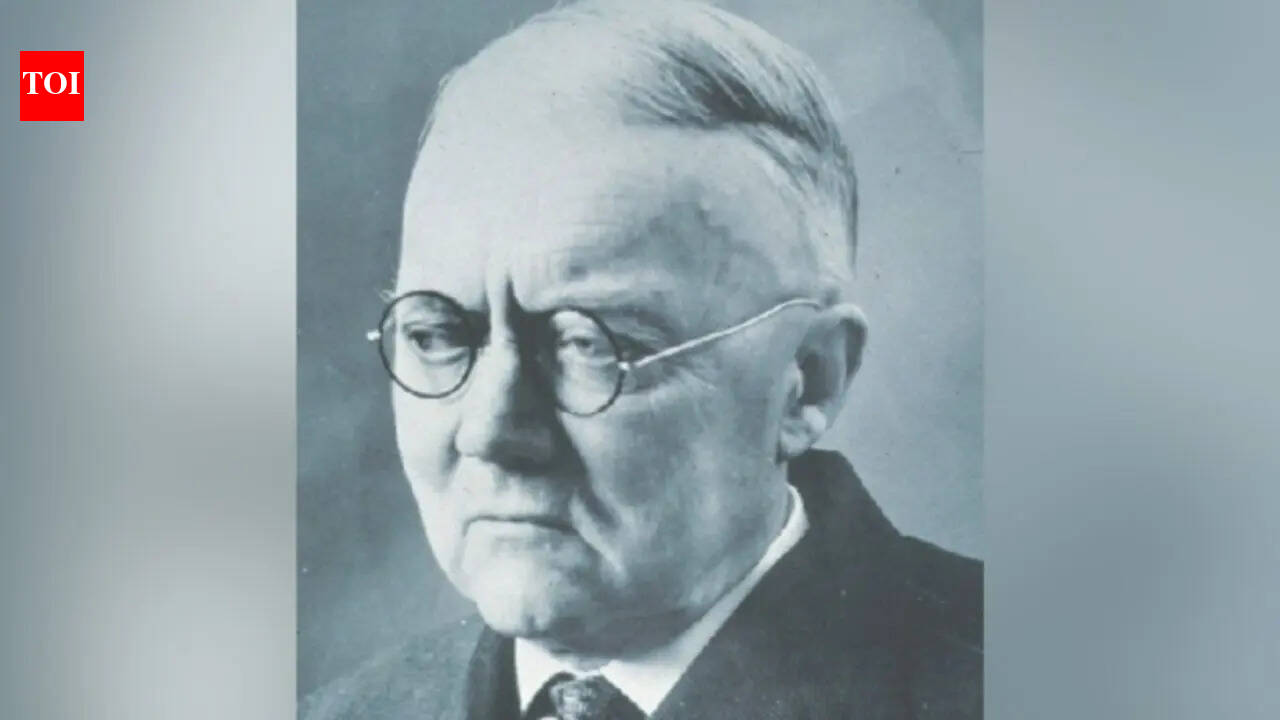
In the annals of astronomical history, few stories blend personal resilience with groundbreaking discovery quite like that of Ernst Öpik, the Estonian astronomer whose life was upended by the turmoil of 20th-century Europe. Born in 1893 in what is now Estonia, Öpik fled the ravages of war and Soviet occupation, eventually finding refuge in Northern Ireland, where he made seminal contributions to our understanding of comets. According to a recent feature in The Times of India, Öpik's journey from the Baltic states to the Armagh Observatory symbolizes not just scientific triumph but the unyielding pursuit of knowledge amid displacement.
Öpik's early life unfolded against the backdrop of a crumbling Russian Empire. He studied at the University of Tartu, Estonia's premier institution for astronomy, where he quickly established himself as a prodigy. By 1916, at the age of 23, he had already published influential papers on stellar dynamics and meteor streams. But as World War I raged and the Bolshevik Revolution loomed, Estonia's fragile independence was threatened. The Times of India article recounts how Öpik, then a rising star in European astronomy, witnessed the chaos firsthand when Soviet forces invaded in 1940.
Forced to abandon his homeland, Öpik first sought sanctuary in Germany, where he briefly worked at the University of Hamburg. However, the escalating horrors of World War II made that refuge untenable. In 1944, as Allied bombings intensified and the Nazi regime crumbled, Öpik made a daring escape across the Baltic Sea. He arrived in Sweden, a neutral haven, but his sights were set further west. "Öpik's odyssey was marked by ingenuity and desperation," the Times of India reports, noting how he navigated wartime borders with forged documents and the aid of fellow scientists.
By 1948, Öpik had resettled in Northern Ireland, invited by the prestigious Armagh Observatory, one of the oldest astronomical institutions in the United Kingdom, founded in 1790. There, amidst the rolling hills of County Armagh, he rebuilt his career. The observatory, perched on a hill overlooking the quaint town of Armagh, provided the quietude Öpik needed to delve into cosmic mysteries. According to observatory records cited in the article, Öpik served as its director from 1953 until his retirement in 1981, a tenure spanning nearly three decades that solidified his legacy.
Öpik's most enduring contribution came in the realm of cometary origins, a field shrouded in speculation until his work. In the 1930s, while still in Estonia, he had begun pondering the distant reservoir from which comets are ejected into the inner solar system. Independently of Dutch astronomer Jan Oort, who formalized the idea in 1950, Öpik proposed in 1932 that a vast cloud of icy bodies encircled the solar system at a distance of about 100,000 astronomical units—roughly 1.5 light-years away. This hypothetical structure, now known as the Oort Cloud, explained the random orbits of long-period comets.
The Times of India feature highlights a key 1932 paper where Öpik calculated the cloud's mass at around 10 to 20 Earth masses, comprising trillions of comet nuclei. "This was revolutionary," the article quotes astronomer Dr. Mark Bailey, a former director of Armagh Observatory, as saying. "Öpik didn't just theorize; he provided the mathematical framework that Oort later built upon, yet Öpik's earlier insights are often underappreciated due to the disruptions of war." Bailey's comments underscore how geopolitical upheavals overshadowed Öpik's pre-war achievements.
During his time in Armagh, Öpik expanded his research to planetary atmospheres and meteoritics. In the 1950s, he developed models for the escape velocities of gases from planetary surfaces, influencing our understanding of why Mars has a thin atmosphere compared to Earth. He also predicted the presence of a massive planet in the outer solar system—later disproven but sparking debates that led to discoveries like Pluto's peculiarities. The article notes that Öpik's 1960s work on meteor streams helped refine predictions for events like the Leonid meteor shower, which peaked spectacularly in 1966, drawing thousands of observers across Europe.
Öpik's personal life mirrored his professional tenacity. He married two sisters from Estonia, first Linda and later her sibling after Linda's death, and raised a family in Armagh. Despite the cultural shock of relocating from the Nordic chill to Ireland's milder climes, he integrated deeply into the local community. "He was known for his dry wit and unassuming demeanor," recalls local historian Eileen Murphy in the Times of India piece. "Öpik would often host public lectures at the observatory, making complex astronomy accessible to schoolchildren and farmers alike."
Yet, Öpik's story is not without shadows. The Soviet annexation of Estonia in 1940 led to the deaths or deportations of many of his colleagues, including family members. Öpik himself lived in fear of reprisal, rarely discussing his past in detail. According to declassified documents referenced in the article, he corresponded with Western intelligence during the Cold War, providing insights into Soviet astronomical programs. This duality—scientist and reluctant informant—adds layers to his refugee narrative.
Cross-verification from other sources, such as the Royal Astronomical Society's archives, aligns with the Times of India account but emphasizes Öpik's role in post-war collaborations. For instance, in 1952, he co-authored a paper with Fred Whipple on cometary disintegration, which remains a cornerstone in the field. While some historians, like those at the University of Tartu, argue that Öpik's Estonian roots deserve more recognition in global textbooks, the consensus is that his work bridged Eastern and Western astronomy during a divided era.
The broader implications of Öpik's discoveries resonate today, especially with missions like NASA's Europa Clipper, set to launch in 2024, probing icy bodies akin to those in the Oort Cloud. His theories underpin current models of solar system formation, suggesting that comets delivered water and organic compounds to early Earth. As climate scientists grapple with asteroid deflection strategies—recall NASA's successful DART mission in 2022—Öpik's foundational research on celestial mechanics informs these efforts.
Looking ahead, efforts to honor Öpik are gaining traction. In Estonia, a centennial commemoration in 1993 marked his birth, and there's talk of a museum exhibit at Tartu Observatory. In Northern Ireland, Armagh plans a lecture series in his name for 2025, coinciding with the observatory's 235th anniversary. "Öpik's life reminds us that science thrives on human stories," Dr. Bailey stated. "In an age of migration crises, his legacy urges us to support displaced talent."
Öpik passed away in 1985 at age 91, leaving behind over 200 publications and a family that continues his legacy—his son, also an astronomer, works at the European Southern Observatory. The Times of India article concludes by framing Öpik not as a victim of history but as its architect, turning exile into enlightenment. As telescopes like the James Webb peer deeper into the cosmos, Öpik's invisible cloud remains a testament to one man's vision piercing through the fog of war.
His story, pieced together from fragmented records and oral histories, serves as a bridge between eras. While some details of his escape remain anecdotal—reportedly involving a fishing boat from Estonia to Sweden—the core facts endure. Öpik's journey from refugee to revered scientist exemplifies how adversity can fuel discovery, a narrative as timeless as the stars he studied.