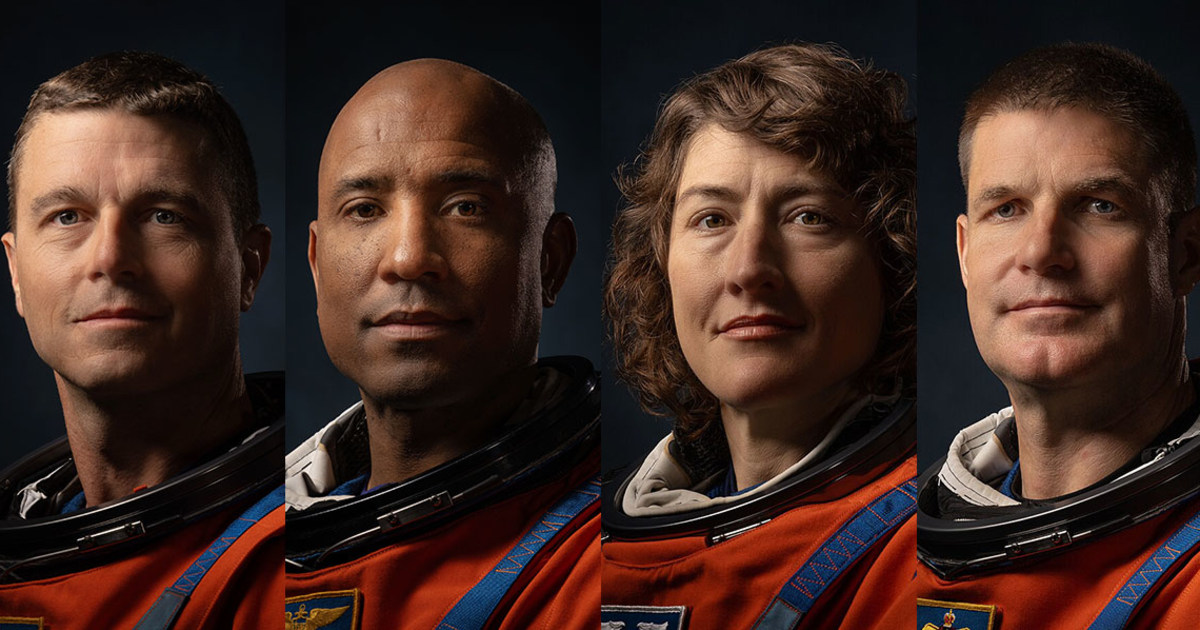
In just over a week, a crew of four astronauts is poised to embark on a historic voyage around the moon, marking the first human mission to Earth's nearest neighbor in more than half a century. NASA astronauts Reid Wiseman, Christina Koch, and Victor Glover, along with Canadian Space Agency astronaut Jeremy Hansen, will lift off aboard the agency's powerful Space Launch System rocket and Orion capsule for the Artemis II mission. Scheduled for a potential launch as early as February 8 from the Kennedy Space Center in Cape Canaveral, Florida, the 10-day flight will not involve a lunar landing but will push the boundaries of human space travel by venturing farther from Earth than any previous crewed mission.
The Artemis II trajectory is expected to carry the astronauts beyond the record set by Apollo 13 in 1970, surpassing 248,655 miles from our planet. According to NASA officials, this journey will serve as a crucial test for the next-generation spacecraft, demonstrating its capabilities with humans on board for the first time. The uncrewed Artemis I mission successfully orbited the moon more than three years ago, paving the way for this crewed follow-up.
Reid Wiseman, the mission commander, expressed his readiness in a recent post on X, stating, “There is nothing left on my to-do list. I’m ready to go.” The crew entered quarantine in Houston a week ago to minimize exposure to illnesses, a standard precaution before launch. They are slated to arrive at the Kennedy Space Center about six days prior to liftoff, though NASA has not yet confirmed the exact date.
Wiseman, a Navy veteran who joined NASA's astronaut corps in 2009, brings experience from a six-month stay on the International Space Station in 2014. As a single father raising two daughters since his wife's passing in 2020, he acknowledged the personal sacrifices involved in a recent interview on NBC's “TODAY” show. “I’m a single father of two daughters,” Wiseman said. “It’d be a lot easier just to sit on my couch and watch football for the weekend, but at the same time, there’s four humans that were put in a position to be able to go explore and do something that is very unique and rare in this civilization.”
He hopes the mission's achievements will validate those sacrifices, emphasizing its inspirational value. “We’ve always looked at the moon and said, ‘We’ve been there.’ But for this whole generation, for our generation, for the younger generation, for the Artemis generation, they’re going to look at the moon now and go, ‘We are there,’” Wiseman added.
Victor Glover, serving as pilot, is a U.S. Navy captain and test pilot selected as an astronaut in 2013. He flew on the first operational mission of SpaceX's Crew Dragon to the International Space Station in 2020. Glover, who was working as a legislative fellow in the U.S. Senate when recruited by NASA, and his wife have four children. For the flight, he plans to carry a Bible, his wedding rings, and family heirlooms for his daughters, items that will become cherished mementos after orbiting the moon.
Christina Koch, one of the mission specialists, holds the record for the longest single spaceflight by a woman—328 days on the International Space Station in 2019. During that expedition, she participated in NASA's first all-female spacewalk with Jessica Meir. Koch, undeterred by the fact that Artemis II won't include a lunar landing, expressed enthusiasm for future missions. “I will be so excited to see someone I know get assigned to be the person and people to walk on the moon, but if it isn’t in my space destiny to do that, that’s just fine with me,” she said. NASA has not announced the crew for the subsequent Artemis III landing mission.
Jeremy Hansen, the other mission specialist and the only rookie on the crew, represents a milestone as the first Canadian to travel to the moon. A former fighter pilot and colonel in the Canadian Armed Forces, Hansen was selected by the Canadian Space Agency in 2009. He and his wife have three children. Hansen described the crew's bond, forged through years of training, as familial: “like a family at this point.” He intends to bring a moon pendant engraved with “moon and back” and embedded with his family's birthstones.
The astronauts' personal tokens underscore the emotional layer of the mission. Wiseman and Koch each plan to carry letters from their families, allowing loved ones to symbolically join the journey. Such flown-in-space items often become treasured keepsakes, connecting the explorers back to Earth.
Vanessa Wyche, director of NASA’s Johnson Space Center, highlighted the crew's historic composition when their selection was announced in 2023. “Among the crew are the first woman, first person of color, and first Canadian on a lunar mission,” Wyche said. “And all four astronauts will represent the best of humanity as they explore for the benefit of all.” This diversity reflects NASA's push for inclusive space exploration in the Artemis program.
During the mission, the crew will perform a range of tasks to validate systems for future flights. These include practicing docking procedures in Earth's orbit, conducting scientific experiments, and testing Orion's capabilities. Koch framed the mission's success in broader terms: “For us, success is boots on the moon in Artemis III. Success is Artemis 100, whenever that is. And we really define everything off of that.”
The Artemis III mission, targeted for 2027, aims to land four astronauts near the moon's south pole, a region rich in potential water ice resources. Artemis II's outcomes will directly inform that effort, ensuring the rocket and capsule are ready for human-rated operations. NASA's partnership with international agencies, like the Canadian Space Agency, also strengthens the program's global scope.
While the astronauts project confidence, the mission carries inherent risks as the first crewed test of this new hardware. Wiseman noted the stress on families, but the crew's veteran status—except for Hansen—provides reassurance. Their combined experience spans hundreds of days in space, from station expeditions to private spacecraft flights.
Beyond the technical milestones, Artemis II revives the spirit of Apollo-era exploration while addressing modern goals like sustainable lunar presence. The program envisions a lunar Gateway station and eventual Mars missions, with Artemis II as a foundational step. As the launch approaches, anticipation builds at NASA centers and among space enthusiasts worldwide.
With the crew in final preparations, the eyes of a new generation turn to the moon. This mission not only tests humanity's return but also inspires dreams of what lies beyond, setting the stage for landings that could redefine our cosmic neighborhood.