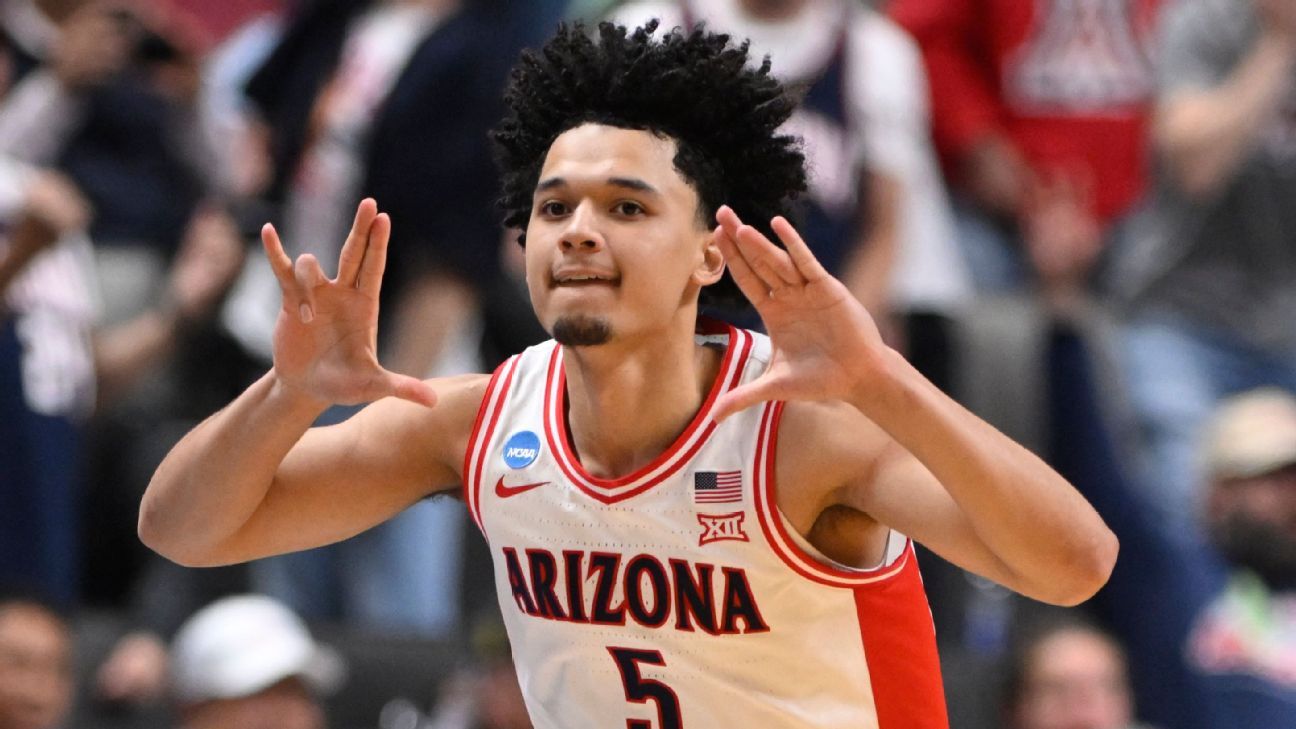
As the 2026 men's NCAA tournament hurtles toward its climax, the Elite Eight stage is set for an electrifying Saturday doubleheader on TBS and truTV. Less than two weeks after the bracket was unveiled, the field has narrowed dramatically to just eight teams vying for Final Four berths. First up at 6:09 p.m. ET is a Big Ten showdown between No. 3 seed Illinois and No. 9 seed Iowa, followed by a marquee clash at 8:49 p.m. ET between No. 1 seed Arizona and No. 2 seed Purdue. ESPN college basketball experts Jeff Borzello and Myron Medcalf have weighed in with their predictions and breakdowns, highlighting the critical matchups that could decide who advances from Indianapolis, where both games will tip off at the Lucas Oil Stadium.
Illinois enters the matchup riding a wave of defensive dominance that has propelled the Illini through the early rounds. According to Borzello, if Illinois maintains its recent form, it could not only defeat Iowa but also contend for the national title. The Illini have held opponents to 55 points in each of their last two games against VCU and Houston, and over their past 10 contests, they've limited five foes to fewer than one point per possession. Borzello emphasized the physicality of guard Kylan Boswell at the point of attack, combined with the team's size and length on the wings, plus strong rim protection, as key factors in disrupting Iowa's Bennett Stirtz. In their first Big Ten meeting this season, Stirtz managed just 12 points on 17 shots, a performance Borzello believes Illinois can replicate.
Offensively, Illinois holds a clear advantage on the boards. The Illini rank in the top five nationally in second-chance points per game, while Iowa finished last in the Big Ten in defensive free throw rate. Borzello noted that getting to the foul line could prove decisive for Illinois in this matchup. Medcalf echoed the sentiment on the outcome, predicting a 77-70 victory for Illinois, slightly higher-scoring than Borzello's 72-66 call. Both experts see the Illini advancing, but they stress that execution in these areas will be paramount.
For Iowa, the path to the Final Four hinges on dictating a slower pace, a strategy that has defined the Hawkeyes' tournament run so far. Borzello pointed out Iowa's ability to control tempo, citing their first-round win over Clemson with just 54 possessions—the slowest game for either team all season. Their second-round triumph against Florida featured the fewest possessions the Gators had all year, and the Sweet 16 victory over Nebraska was similarly sluggish for the Cornhuskers. The first Big Ten clash with Illinois played out closer to the Illini's preferred speed, but Iowa's early deficit and lack of comeback prowess were bigger issues, according to Borzello.
Borzello identified two additional keys for Iowa: Stirtz must outduel Boswell and Keaton Wagler in the point guard battle, and the Hawkeyes need to neutralize Illinois' offensive rebounding prowess—the best in the Big Ten. While Medcalf also favors Illinois, he acknowledged Iowa's tempo control as a legitimate threat, though one that may not fully materialize against the Illini's defensive intensity. Stats from the matchup, as compiled by ESPN, underscore Illinois' edge in rebounding and free throws, with Iowa relying heavily on Stirtz's scoring to keep games competitive.
Shifting to the late game, Arizona faces Purdue in what promises to be a battle of top seeds from the West and Midwest regions, respectively. Borzello predicts an 81-74 win for the Wildcats, while Medcalf sees a tighter affair at 85-82, both agreeing on Arizona's advancement. The Wildcats have feasted on interior play throughout the tournament, and Borzello believes Purdue's defensive vulnerabilities make this an ideal matchup. The Boilermakers allowed nearly 1.27 points per possession to Texas in the Sweet 16 and have surrendered at least 1.05 in 10 of their last 11 games. Purdue ranked only 14th in the Big Ten in two-point defense, leaving Arizona's paint attack ripe for exploitation.
Borzello advised Arizona to stick to its identity by attacking the paint relentlessly. Guards Brayden Burries and Jaden Bradley should penetrate off the dribble, while forwards Motiejus Krivas, Tobe Awaka, and Koa Peat will have post-up opportunities. Although Arizona isn't a high-volume three-point team, Purdue's poor perimeter defense—one of the worst in the Big Ten—could yield extra open looks from beyond the arc. On defense, Bradley and Burries' physicality will be crucial in containing Purdue's Braden Smith, preventing him from dictating the half-court flow.
Purdue, meanwhile, must prioritize stopping Arizona's dominance inside at both ends. The Wildcats excel on the offensive glass, around the rim, and at the free-throw line, areas where Borzello says the Boilermakers cannot afford lapses. Purdue boasts the second-best defensive rebounding percentage in the Big Ten, but they'll need to match Arizona's physicality without fouling excessively. Center Daniel Jacobsen's late-season struggles have increased the burden on Oscar Cluff, and any extended time on the bench for him could spell trouble, according to Borzello.
Offensively, Purdue's success may rest on guard Fletcher Loyer's outside shooting. To counter Arizona's two-point efficiency, the Boilermakers need to heat up from three-point range, and Loyer has delivered exactly that in the tournament, knocking down four triples in each of Purdue's three NCAA games so far. Medcalf's closer prediction suggests he sees more parity here, potentially hinging on Loyer's performance and Purdue's ability to avoid foul trouble. ESPN's matchup stats highlight Arizona's free-throw volume and Purdue's rebounding strength as pivotal battlegrounds.
This Elite Eight comes amid a tournament that has already produced its share of upsets and statement wins. The 2026 field, announced just under two weeks ago, has seen lower seeds like Iowa defy expectations by reaching this stage, while powerhouses like Arizona and Purdue live up to their billing. Illinois' defensive resurgence has been a storyline in its own right, transforming a solid Big Ten team into a national contender. Iowa's methodical pace has frustrated faster opponents, a tactic honed in conference play.
The broader context of these games extends to conference rivalries and individual narratives. The Illinois-Iowa tilt revives a Big Ten feud, with the first meeting this season providing bulletin-board material for both sides. Stirtz's inefficient outing against Illinois lingers as a point of motivation for the Hawkeyes, while Boswell's defensive assignment could define the guard play. In the nightcap, Purdue seeks redemption after a regular season marred by inconsistencies, with Cluff's availability becoming a focal point after Jacobsen's dip in form.
Arizona's balanced attack, led by Bradley and Peat, has carried the top seed through a bracket filled with athletic challenges. The Wildcats' reluctance to rely on threes aligns with their identity, but Borzello notes the potential windfall against Purdue's leaky perimeter. For the Boilermakers, this represents a chance to reassert themselves as a Final Four lock, building on their strong rebounding and Loyer's hot hand. Both games underscore the tournament's theme of matchup advantages, where defensive schemes and tempo control often tip the scales.
Looking ahead, the winners will head to the Final Four in a yet-to-be-determined host city, joining survivors from the other regional semifinals. A Illinois-Arizona final could pit defensive grit against interior power, while Iowa or Purdue advancing would add underdog flair. Fans tuning in Saturday will witness not just games, but potential legacies in the making. As Borzello put it in his analysis, these matchups are about teams sticking to their strengths amid high stakes: "Illinois will have the edge on the offensive glass," and for Arizona, "just needs to stick to its identity and look to attack the paint."
With the clock ticking toward tip-off, anticipation builds in college basketball circles. The Elite Eight has historically delivered drama, and this year's edition—with its blend of familiar foes and stylistic contrasts—appears poised to deliver. Whether it's Illinois' rim protection stifling Iowa or Purdue's three-point barrage testing Arizona, the outcomes will shape the tournament's final act.