The second round of the Men's NCAA Tournament, often called March Madness, ramps up on Saturday with eight gripping matchups that promise to send 16 teams to the Sweet 16. After a first round filled with upsets, buzzer-beaters and standout performances, teams like Duke, Michigan and Illinois look to build on their momentum while underdogs such as VCU and High Point aim to extend their Cinderella stories. Games will tip off across various sites, including arenas in cities like Spokane, Washington, and Omaha, Nebraska, as the tournament progresses toward the Final Four in Indianapolis later this month.
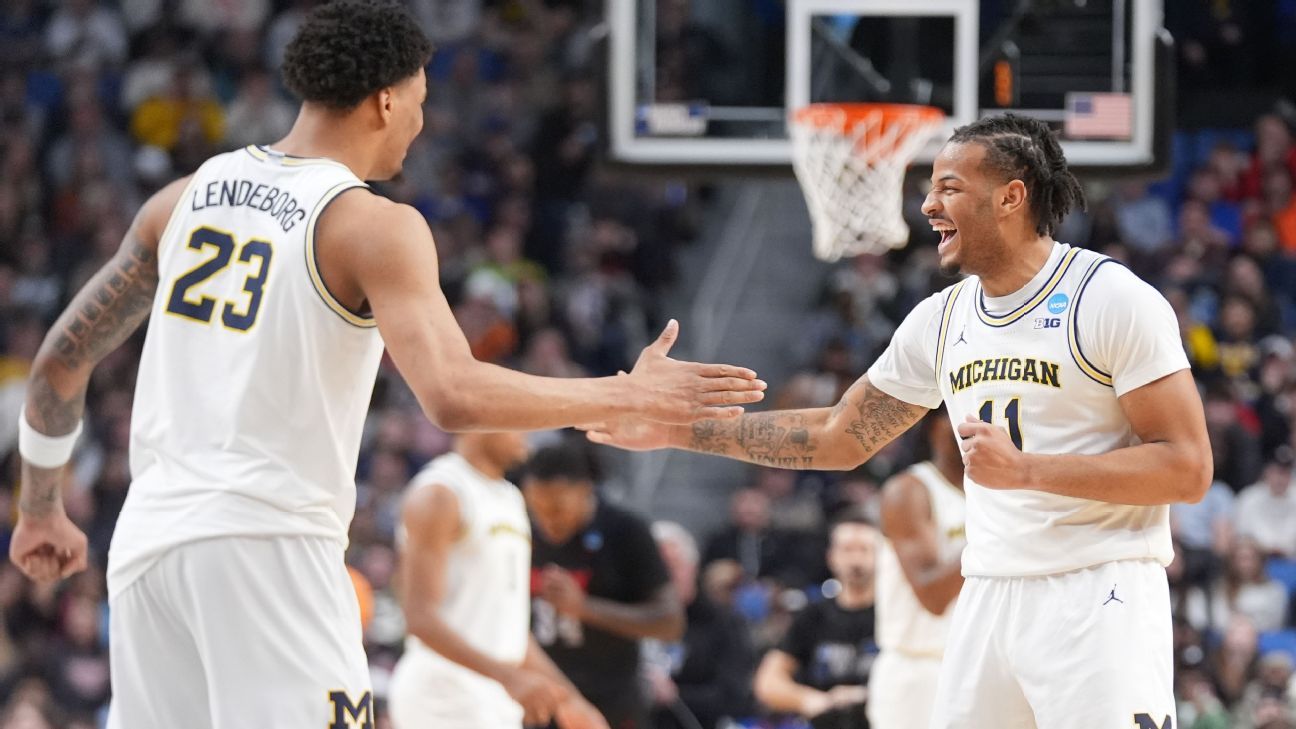
Leading off the action is Michigan against Saint Louis, a clash where size and versatility could decide the outcome. According to ESPN analyst Myron Medcalf, Michigan can advance by leveraging its physical advantages inside while containing Saint Louis's efficient offense. "The Wolverines can advance if they use their size on offense and subdue a unique Saint Louis offense," Medcalf wrote, noting how Michigan's Aday Mara and Morez Johnson Jr. combined for 40 points in their first-round win over Howard despite early struggles against a zone defense. Michigan, which has just three losses this season, held Siena to limited success in the paint after halftime in a recent matchup.
From Saint Louis's perspective, Medcalf highlighted the Billikens' shooting prowess as key, with the team efficient at 59% inside the arc and 40% from three-point range. They scored 66 points in the paint against Georgia in the first round, and Medcalf suggested attacking Michigan's big men like Mara on ball screens, similar to Duke's strategy in a late-season win over the Wolverines. "Saint Louis has six players who have made at least 37% of their 3-point attempts this season," he added. "The Billikens can advance if they exhaust Michigan's frontcourt with an inside-outside game that keeps the Wolverines guessing."
Next up, Michigan State faces Louisville in a battle of rebounding prowess. Jeff Borzello of ESPN emphasized the Spartans' dominant frontcourt, where Carson Cooper, Jaxon Kohler, Coen Carr and Cam Ward tallied 62 points and 24 rebounds against North Dakota State. Michigan State ranks in the top 10 nationally in offensive rebounding, and Borzello said this edge could overwhelm Louisville, which allowed South Florida 18 offensive rebounds in their first-round game. "Jeremy Fears Jr. will be the key -- he didn't score the ball well against North Dakota State and turned it over a season-high four times, but he'll be able to get downhill and put pressure on Louisville," Borzello noted.
Louisville, meanwhile, must tighten its defensive glass and rely on its perimeter shooting to pull off the upset. The Cardinals rank in the top five nationally in three-point attempt rate, making 13 triples against South Florida despite a late surge by the Bulls that cut a 23-point lead. Borzello pointed out Michigan State's middling Big Ten three-point defense, which allowed an average of 11.1 threes in losses. An X-factor is the absence of guard Mikel Brown Jr., sidelined by a back injury, though Louisville has won its past five without him. "South Florida grabbed 18 offensive rebounds -- 37.5% of its misses -- and Louisville will have a harder time against Michigan State," Borzello observed.
In a rematch of sorts, Duke takes on TCU after the Blue Devils' comeback against Siena. Myron Medcalf stressed Duke's need to replicate its second-half intensity, where a zone defense and improved play from Isaiah Evans turned a double-digit deficit into victory. Without injured players Caleb Foster, Duke's top three-point shooter at 40.2%, and Patrick Ngongba II, the defense faltered early. "Duke's offensive rhythm was clearly disrupted without Caleb Foster... In the second half, however, the Blue Devils turned to a zone and played with a different defensive intensity," Medcalf said. Cameron Boozer's near-perfect 13-for-14 free-throw performance will also be crucial.
TCU, which shot 39% from three against Ohio State, must exploit Duke's interior vulnerabilities without Ngongba. Medcalf recalled Siena's historic first-half dominance, scoring 22 points in the paint led by 6-foot-7 forward Francis Folefac—the first 16-seed to lead a 1-seed by double digits at halftime. "That has to be the blueprint for TCU, too," he wrote. "The Blue Devils were vulnerable inside without Patrick Ngongba II... They will also need 3s to fall again, which only happened on occasion during the season when they were 15th out of 16 teams in the Big 12 in 3-point shooting."
Houston versus Texas A&M pits a methodical Cougars squad against the Aggies' high-tempo "Bucky Ball" style. Borzello noted Houston's elite backcourt of Kingston Flemings, Milos Uzan and Emanuel Sharp, who rank seventh nationally in turnover percentage and prefer a slower pace at 63 possessions per game. The Cougars, top 30 in offensive rebounding, face an A&M team that ranked poorly in SEC defensive rebounding. "Houston, on paper, is built to withstand Texas A&M's pressing, up-tempo style," Borzello said, adding that the Aggies force turnovers on 18.6% of possessions but struggled against low-turnover teams like Houston.
For Texas A&M to succeed, Borzello said it must win the pace battle, averaging over 70 possessions per game—top 40 nationally—after grinding out a win over Saint Mary's. "Can A&M win the pace battle? ... This will be a true contrast of styles, but the fact that A&M just beat another grind-it-out team in Saint Mary's should give the Aggies optimism," he explained. The Aggies' fast-break focus could test Houston's discipline under coach Kelvin Sampson.
Gonzaga meets Texas in a matchup where paint scoring will be pivotal. Borzello highlighted Gonzaga's national-leading 45 paint points per game and 59% two-point shooting, but they only outscored Kennesaw State by four in the paint during the first round. Graham Ike must dominate Texas's Matas Vokietaitis, who averages 17.6 points over his last 11 games and had 23 points and 16 rebounds against BYU. "What should determine the outcome will be the paint battle and free throw margin," Borzello wrote. "Ike needs to be his usual dominant self, and it will be helpful to get Matas Vokietaitis in foul trouble." Vokietaitis, a former Florida Atlantic transfer, commits 5.3 fouls per 40 minutes.
Texas, under Sean Miller, has won back-to-back games after dropping five of six entering the tournament, holding NC State to 0.98 points per possession—their best defensive effort since January 14—and BYU to 1.06. Miller has lamented the Longhorns' fouling issues, but Gonzaga's low free-throw dependency plays to their strengths. "Saturday's game will be key for Matas Vokietaitis to protect the rim and stifle All-American Graham Ike," Borzello said, noting Texas's recent defensive improvements against high-powered offenses.
Illinois, boasting the nation's No. 1 offense, faces VCU in a David-versus-Goliath scenario. Medcalf described the Fighting Illini's dominance, scoring 40 points in the first half and 65 in the second against Penn at a blistering 197 points per 100 possessions—far surpassing the NBA's best at 120. David Mirkovic's 29 points and 17 rebounds kept their title hopes alive. "That's how good Illinois is right now. Brad Underwood's team can advance with another overwhelming offensive effort," Medcalf stated.
VCU, coached by Phil Martelli Jr., stunned with resilience against North Carolina, scoring at 138 points per 100 possessions in the second half to force overtime despite a 19-point deficit. To upset Illinois, Terrence Hill Jr. must continue his heroics, and Lazar Djokovic—15 points and two blocks in the first round—needs a big game. "The Rams can advance past Illinois if Terrence Hill Jr. plays the role of Superman again and his teammates employ the same resilience... for 40 minutes," Medcalf advised, acknowledging the challenge against one of college basketball's most potent attacks.
Nebraska versus Vanderbilt features a historic Cornhuskers team seeking its first Sweet 16. After their first-ever tournament win, Nebraska's top-10 defense could frustrate Vanderbilt's Tyler Tanner, who shot 2-for-6 in the first half against McNeese's pressure. Medcalf praised Nebraska's clamps, holding Troy to 47 points (77 per 100 possessions) early on. "Nebraska has the ability to force Vanderbilt star Tyler Tanner into difficult shots," he said. Shooters like Pryce Sandfort, Rienk Mast and Sam Hoiberg, who hit big shots in round one, add firepower.
Vanderbilt relies on Tanner, a projected first-round NBA pick, who scored 17 of his 26 points after halftime against McNeese. The Commodores are 13-3 when he scores 20-plus, but Nebraska's Big Ten-best defense will test him. They must also limit Nebraska's three-point barrage—34 made in the past three games. "Vanderbilt needs Tyler Tanner to excel and to limit Nebraska's shooters in order to advance," Medcalf noted.
Closing the slate, Arkansas takes on High Point in a potential shootout. Borzello said John Calipari's Razorbacks thrive in high-scoring games with playmakers Darius Acuff Jr. and Meleek Thomas, who protect the ball better than anyone nationally. Their mobile frontcourt outmatches Wisconsin's in the first round. "If Acuff and Thomas take care of the ball and the Razorbacks can dominate the paint like they've done countless times this season, High Point likely won't have an answer," he wrote. Defensively, containing High Point's Chase Johnston is vital.
High Point, winners of 23 of 24 games, upset Wisconsin in a run-and-gun affair and won't shy from Arkansas's pace. They rank top five in defensive turnover percentage but allowed 49 combined points from Nick Boyd and John Blackwell. Success could come from exploiting Arkansas's rotation lapses with threes—15-for-40 against the Badgers. "Don't count the Panthers out against Arkansas," Borzello cautioned. "A repeat 15-for-40 3-point shooting effort would be nice, too."
As these games unfold, the Sweet 16 field will take shape, setting up potential elite-eight clashes and highlighting the tournament's unpredictability. With injuries like Duke's and Louisville's influencing outcomes, and stylistic contrasts abound, Saturday's results could reshape the bracket and propel surprise contenders deeper into March Madness.