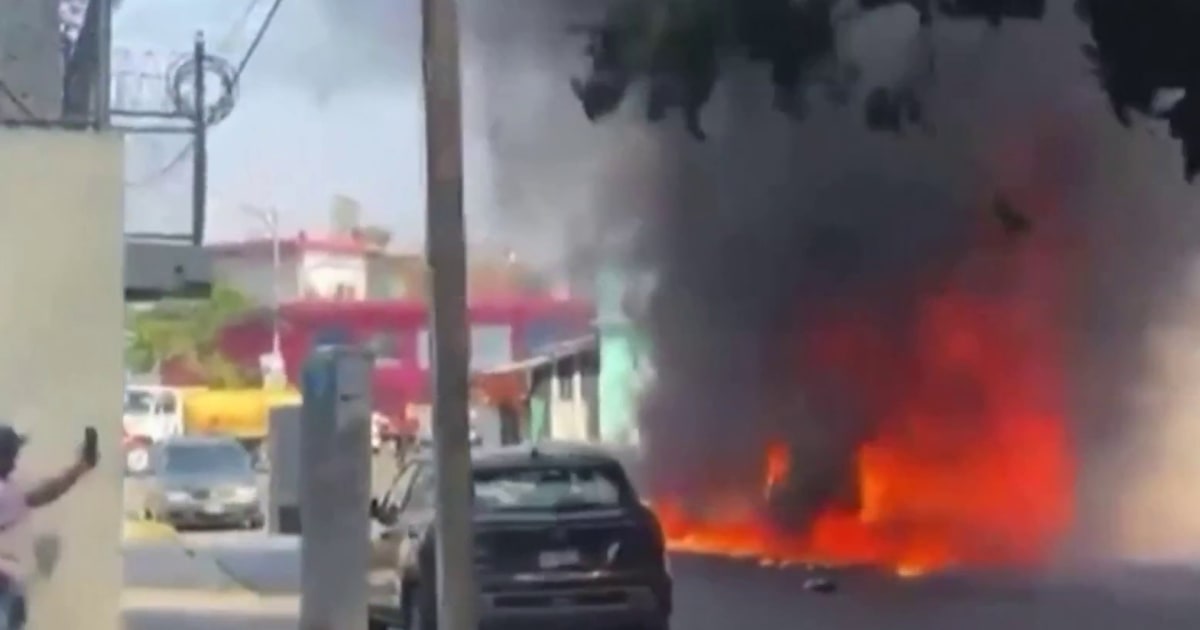
MEXICO CITY — The killing of Nemesio Oseguera Cervantes, better known as El Mencho, the notorious leader of the Jalisco New Generation Cartel, has ignited widespread unrest across Mexico, sending ripples of fear through travelers and residents alike. According to reports from NBC News, Mexican army forces successfully eliminated El Mencho in a high-stakes operation, a development that has prompted retaliatory violence from the cartel and heightened security concerns nationwide.
The operation that led to El Mencho's death remains shrouded in some details, but officials have confirmed it occurred in a remote area of Jalisco state, the cartel's stronghold. El Mencho, long considered one of Mexico's most elusive and powerful drug lords, had evaded capture for over a decade despite multimillion-dollar bounties from both the U.S. and Mexican governments. His demise, reportedly achieved through intelligence gathered over years of surveillance, marks a significant blow to the cartel, which has been responsible for thousands of deaths in turf wars and clashes with authorities.
News of the killing broke late last week, with the Mexican defense ministry issuing a brief statement acknowledging the success of the mission. "This represents a major victory in our fight against organized crime," a ministry spokesperson said, though specifics on the raid's timeline or casualties among security forces were not immediately disclosed. The statement emphasized that operations would continue to dismantle the cartel's remaining leadership.
Almost immediately, the Jalisco New Generation Cartel, or CJNG, responded with a wave of violence. According to eyewitness accounts compiled by NBC News correspondent George Solis, cartel gunmen launched attacks on military checkpoints and public infrastructure in several states, including Michoacán and Guerrero. "We've seen roadblocks set up overnight, and people are afraid to leave their homes," Solis reported from the scene, describing burning vehicles and sporadic shootouts that have paralyzed local economies.
Travelers, many of whom flock to Mexico's popular tourist destinations like Cancun and Puerto Vallarta, are now facing travel advisories from multiple governments. The U.S. State Department updated its warning level for several regions, urging American citizens to reconsider non-essential travel. "The situation is fluid, and violence could spread," a department official said in a press briefing. European nations, including the United Kingdom and Germany, have echoed similar cautions, citing the potential for cartel reprisals to affect tourist areas.
Residents in affected areas express a mix of relief and anxiety. In Guadalajara, a city long under the cartel's influence, local business owner Maria Gonzalez told reporters, "El Mencho's death might end some of the terror, but now his followers are lashing out everywhere. My shop has been empty for days." Her sentiments are shared by many, as schools and markets in Jalisco have closed temporarily amid the unrest.
Experts on Mexican cartels provide additional context to the chaos. Dr. Ana Herrera, a security analyst at the University of Mexico, noted that El Mencho's leadership style was uniquely brutal, overseeing expansions into fentanyl production and human trafficking. "His elimination could fragment the CJNG, leading to infighting or alliances with rivals like the Sinaloa Cartel," she said in an interview. However, she cautioned that power vacuums often exacerbate violence in the short term.
Background on El Mencho reveals a man who rose from humble beginnings in Michoacán to command a criminal empire valued in the billions. Born in 1966, Oseguera Cervantes reportedly began his criminal career in the 1990s with marijuana cultivation before aligning with larger syndicates. By 2010, he had founded the CJNG, which quickly became known for its sophisticated use of drones, armored vehicles, and social media propaganda. The U.S. Drug Enforcement Administration had offered a $10 million reward for his capture, describing him as a key figure in the opioid crisis ravaging North America.
The Mexican government's response has been multifaceted. President Claudia Sheinbaum, who took office earlier this year, has pledged to intensify anti-cartel efforts while addressing root causes like poverty and corruption. In a national address, she stated, "We will not allow criminals to dictate the future of our country." Yet, critics point to past operations, such as the 2019 capture of Ovidio Guzmán, son of Sinaloa leader Joaquín "El Chapo" Guzmán, which also triggered deadly backlash.
International implications are mounting as well. The U.S. has long collaborated with Mexico on extraditions and intelligence sharing, and El Mencho's death could accelerate efforts to prosecute remaining CJNG members. FBI Director Christopher Wray commented during a congressional hearing, "This is a testament to bilateral cooperation, but we must remain vigilant against retaliation." Meanwhile, border communities in Texas and Arizona report increased smuggling attempts, possibly as cartels reroute operations.
On the ground, humanitarian concerns are rising. The United Nations Office on Drugs and Crime has called for protection of civilians caught in the crossfire, estimating that cartel-related violence has displaced thousands in recent years. In one incident reported by local media, a bus carrying tourists was stopped by armed men in Colima state, though all passengers were released unharmed after a brief interrogation.
Local law enforcement faces immense pressure. Jalisco state governor Pablo Lemus Rodriguez announced the deployment of 5,000 additional National Guard troops to hotspots, saying, "Our priority is restoring peace and safety for families." However, some residents accuse authorities of inadequate preparation, with social media flooded by videos of abandoned police posts.
As the dust settles, questions linger about the long-term impact. Will El Mencho's successors escalate the violence, or will this weaken the CJNG irreversibly? Analysts like those at the Wilson Center suggest a combination of both, drawing parallels to the 2010 death of Arturo Beltrán Leyva, which sparked a bloody power struggle. For now, the unrest serves as a stark reminder of Mexico's enduring battle with narco-trafficking.
Travelers planning trips are advised to monitor official updates closely. Airlines like Delta and American have added flights or cancellations to affected routes, while hotels in resort areas report a 30% drop in bookings. The Mexican tourism board, despite the challenges, maintains that most areas remain safe, emphasizing, "Mexico welcomes visitors with open arms, and our security measures are robust."
Looking ahead, the government plans a series of summits with U.S. counterparts to bolster joint operations. As Mexico navigates this turbulent period, the hope is that El Mencho's fall paves the way for stability, though the path forward is fraught with uncertainty. Residents and visitors alike await signs that the violence will subside, allowing normalcy to return to a nation long scarred by cartel influence.