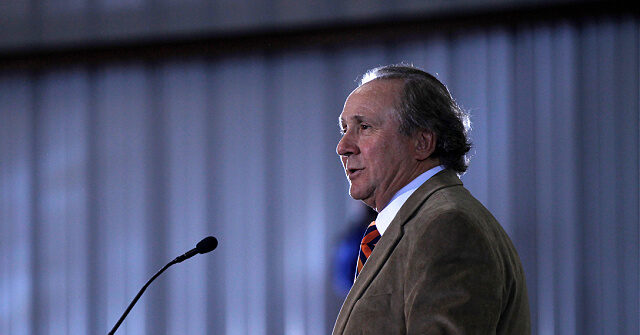
Michael Reagan, the eldest son of former President Ronald Reagan, died on Sunday at the age of 80, his family announced. Reagan, a prominent conservative commentator and broadcaster, passed away in Los Angeles, California, surrounded by loved ones. The news, shared through a heartfelt family statement, marks the end of a life dedicated to preserving his father's political legacy and engaging with younger generations on conservative principles.
According to the family's statement, Michael Edward Reagan was called home to be with the Lord on January 4. 'It is with great sadness that we announce the passing of Michael Edward Reagan,' the statement read. 'Michael was and will always remain a beloved husband, father, and grandpa. Our hearts are deeply broken as we grieve the loss of a man who meant so much to all who knew and loved him.' The announcement was penned by Andrew Coffin, vice president and director of the Reagan Ranch, who also requested privacy for the family during this time. 'We appreciate your prayers and ask that you would respect our family’s privacy during this difficult time,' Coffin added.
Born on March 18, 1945, in Los Angeles to Ronald Reagan and his first wife, actress Jane Wyman, Michael was adopted shortly after his birth. His early life was marked by the glamour of Hollywood, given his parents' careers in entertainment, but it was his father's entry into politics that profoundly shaped his path. Ronald Reagan's rise from California governor to the 40th president of the United States in 1981 placed the family in the national spotlight, and Michael often reflected on those years in his writings and broadcasts.
Michael Reagan's career spanned acting, radio, and advocacy. After attending Arizona State University and Los Angeles Valley College, he pursued acting, appearing in television shows such as the popular 1980s soap opera Falcon Crest. However, his true calling emerged in conservative media, where he hosted a talk radio show for nearly two decades, becoming a voice for Reagan-era conservatism. Listeners tuned in for his candid takes on politics, family values, and the principles that defined his father's administration.
Beyond broadcasting, Reagan committed himself to philanthropy and legacy preservation. He served as chair of the board for the John Douglas French Alzheimer's Foundation for three years, a role that underscored his personal dedication to health causes, especially poignant given the former president's own battle with Alzheimer's disease in his later years. Additionally, Michael held the position of president of the Reagan Legacy Foundation, ensuring that his father's ideals of limited government, free markets, and strong national defense endured.
The outpouring of tributes following his death highlighted Reagan's impact on conservative circles. Young America's Foundation, a nonprofit that promotes conservative activism among students, issued a statement calling him 'an American hero, a faithful son, and a devoted father and grandfather.' The organization emphasized his role in inspiring the next generation, noting how he connected with young audiences through personal anecdotes from his father's presidency.
Andrew Coffin echoed this sentiment in his reflections. 'Students who heard Michael speak gravitated to that same sense of authenticity that made his father such a successful leader,' Coffin wrote. He recounted a favorite story Michael often shared: Ronald Reagan's long-held desire to firmly tell a Soviet leader 'Nyet,' a moment realized during the 1986 Reykjavik summit with General Secretary Mikhail Gorbachev. 'Few who had the privilege of listening to his stories will soon forget' that tale, Coffin added, illustrating Michael's gift for making history relatable.
The Ronald Reagan Presidential Foundation and Institute also mourned the loss, describing Michael as 'a steadfast guardian of his father’s legacy.' In a statement, the foundation praised his life as one 'shaped by conviction, purpose, and an abiding devotion to President Reagan’s ideals.' They drew from Ronald Reagan's 1990 memoir, An American Life, where the former president expressed deep pride in his son: 'When I read his book, I had even more of a fatherly pride in Mike than I had had before … he was happy and at peace with himself.'
The foundation's tribute continued, interpreting those words as a testament to Michael's 'quiet strength and authenticity.' 'Michael Reagan’s passing is a profound loss to all who knew him and to the millions who valued his dedication to preserving President Reagan’s legacy,' the statement concluded. 'His presence, warmth, and unwavering commitment will be deeply missed at the Reagan Library and far beyond its walls.' The Reagan Library in Simi Valley, California, serves as a key repository for the former president's papers and artifacts, where Michael frequently contributed to events and programs.
Michael's personal life was equally centered on family. He is survived by his second wife, Colleen Reagan, whom he married in 1975 after his first marriage to Pamela Bush ended in divorce. The couple raised two children: Cameron and Ashley. Reagan often spoke publicly about overcoming a challenging childhood, including adoption and his parents' divorce in 1948, themes he explored in his 1988 autobiography, On the Outside Looking In. That book detailed his search for identity amid the public scrutiny of his famous family.
Throughout his career, Michael navigated the complexities of being a president's son. He was not shy about critiquing aspects of his father's policies when he disagreed, such as on certain social issues, but remained a staunch defender of Reagan's core conservative philosophy. His radio show, syndicated nationally in the 1990s and 2000s, reached audiences across the country, where he blended personal stories with political commentary, often drawing parallels to his father's 'Morning in America' optimism.
Reagan's death comes at a time when the Republican Party continues to invoke Ronald Reagan's name in its platform, particularly on issues like tax cuts and anti-communism. While the sources reporting his passing are consistent in their details, the story has resonated widely in conservative media outlets, underscoring his enduring influence. No immediate plans for memorial services have been announced, but the family's request for privacy suggests any events will be intimate.
Looking ahead, Michael's legacy is likely to live on through the organizations he championed. The Reagan Legacy Foundation, under his leadership, has worked to educate on the former president's achievements, including the end of the Cold War and economic reforms. Similarly, his involvement with the Alzheimer's foundation highlights a quieter side of his activism, raising awareness for a disease that affected millions, including his father, who died in 2004 after a decade-long struggle.
As tributes continue to pour in, figures from the conservative movement have shared memories of Michael's warmth and wit. His ability to humanize the Reagan era—through stories of family dinners at the White House or behind-the-scenes negotiations—made him a bridge between past triumphs and future leaders. In an era of polarized politics, Reagan's voice advocated for unity around shared values, a message that now falls to others to carry forward.
The passing of Michael Reagan closes a chapter for one of America's most iconic political families, but it also reaffirms the lasting impact of the Reagan name. From the ranch in Santa Barbara to the airwaves of talk radio, his life wove personal resilience with public service, leaving an indelible mark on conservative thought.