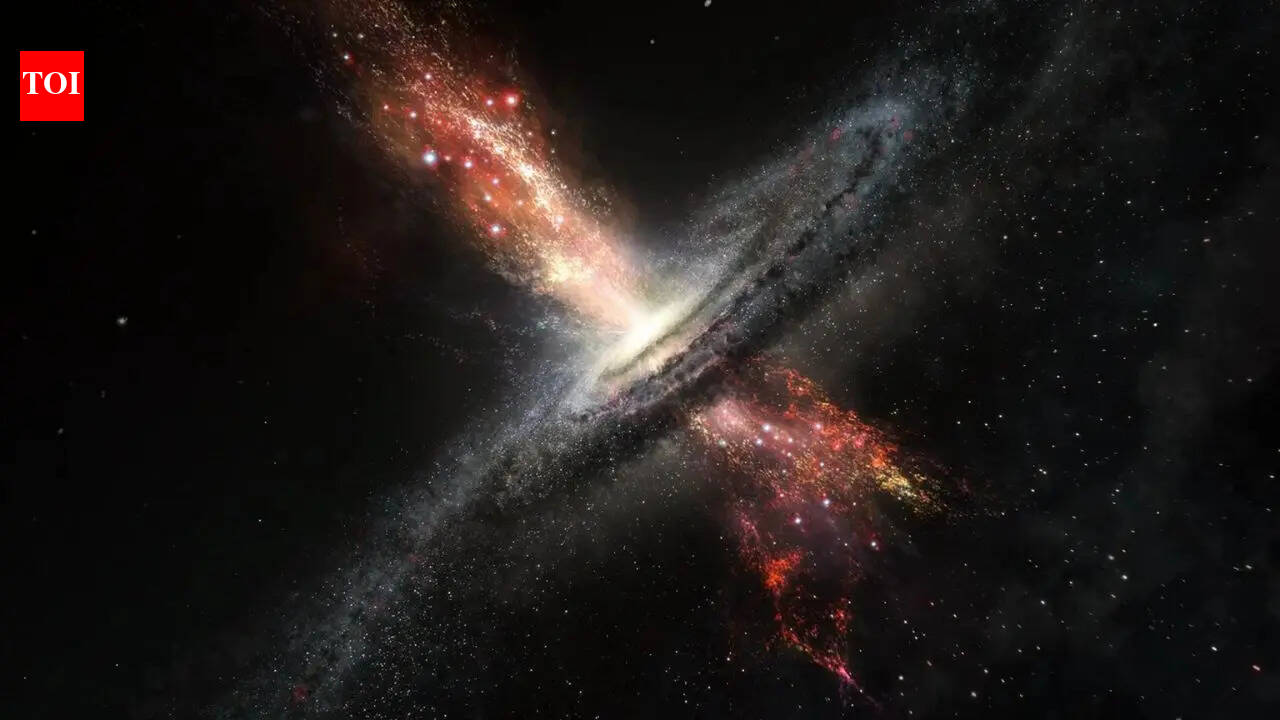
APPLETON, Wis. — A groundbreaking theory from astronomers is shaking the foundations of our understanding of the Milky Way's core, suggesting that what has long been considered a supermassive black hole at the galaxy's center might not be a black hole at all. Instead, researchers propose it could be a massive clump of dark matter, challenging decades of observations and the iconic Sagittarius A* designation. The idea, detailed in a new theoretical model, has sparked debate among astrophysicists who have relied on evidence from telescopes like the Event Horizon Telescope to confirm the presence of the black hole.
According to a report from the Times of India, the theory emerges from ongoing efforts to reconcile the mysteries of dark matter with observed galactic dynamics. Sagittarius A*, located about 26,000 light-years from Earth in the constellation Sagittarius, has been a focal point for astronomers since the 1970s. It was first identified through radio observations that revealed a bright, compact source of emissions at the Milky Way's heart. In 2022, the Event Horizon Telescope collaboration released the first image of Sagittarius A*, depicting a glowing ring of plasma around a dark central shadow, consistent with general relativity's predictions for a black hole with a mass estimated at 4 million times that of the sun.
But now, a team of astronomers is questioning that consensus. The new model posits that the gravitational effects attributed to Sagittarius A* could be explained by a dense concentration of dark matter particles, rather than the event horizon of a black hole. 'This theoretical framework offers an alternative explanation for the orbital motions of stars around the galactic center,' the Times of India article states, drawing from the researchers' unpublished preprint. While specific names of the proposing astronomers were not detailed in initial reports, the idea builds on prior work exploring dark matter's role in galactic structures.
Dark matter, which makes up about 27% of the universe's mass-energy content according to NASA estimates, remains one of cosmology's greatest enigmas. It doesn't interact with light, making it invisible to traditional telescopes, but its gravitational influence is evident in the way galaxies rotate and cluster. In the Milky Way, dark matter is thought to form a vast halo enveloping the galaxy, but concentrations at the center have been harder to model. The new theory suggests that instead of a singularity where gravity crushes matter into an infinitesimal point, the core could host a stable ball of dark matter particles, perhaps self-interacting to mimic black hole-like behavior.
Experts in the field have mixed reactions to the proposal. Dr. Andrea Ghez, a Nobel Prize-winning astrophysicist from the University of California, Los Angeles, who led ground-based observations confirming Sagittarius A*'s mass through star orbits, has previously emphasized the robustness of black hole evidence. In a 2023 interview with the Associated Press, Ghez said, 'The stars whipping around the center with speeds that require millions of solar masses can only be explained by a supermassive black hole.' Her team's data, spanning over 25 years, shows stars like S2 completing orbits in just 16 years, providing precise measurements that align with black hole predictions.
On the other hand, proponents of alternative theories point to inconsistencies in black hole models. For instance, the Event Horizon Telescope's image of Sagittarius A* was fuzzier than that of the black hole in M87, released in 2019, due to the Milky Way's dust and gas interfering with observations. Some researchers argue that dark matter could account for the radio emissions and X-ray flares detected by NASA's Chandra X-ray Observatory without invoking an accretion disk around a black hole. 'Dark matter models have been underexplored for central galactic objects,' according to a summary from the Times of India, highlighting how the theory challenges the standard paradigm.
The proposal isn't entirely new; echoes of it appear in earlier papers from the 2010s, when theorists like those at the Perimeter Institute explored 'fuzzy dark matter' or 'self-interacting dark matter' scenarios. In 2017, a study published in Physical Review Letters suggested that dark matter could form dense cores in dwarf galaxies, a concept now scaled up to the Milky Way's center. However, the latest model reportedly integrates recent data from the James Webb Space Telescope, which has begun probing the galactic core in infrared wavelengths to peer through obscuring dust.
Observations supporting the black hole view are extensive. The European Southern Observatory's Very Large Telescope has tracked over 100 stars orbiting Sagittarius A*, with their paths fitting Keplerian orbits around a point mass. In 2018, the GRAVITY instrument on the telescope measured the shadow of Sagittarius A* during a flare, confirming its size matches a black hole's event horizon. 'These measurements leave little room for alternatives,' said Reinhard Genzel, Ghez's counterpart at the Max Planck Institute for Extraterrestrial Physics, in a statement following their 2020 Nobel win. Yet, the new dark matter theory counters that quantum effects or particle interactions could produce similar gravitational lensing without a true singularity.
Critics of the black hole model also cite the lack of direct evidence for an event horizon in our galaxy, unlike the more distant M87*. The Times of India report notes that the theoretical model predicts observable differences in star orbits and gas dynamics that future missions could test. For example, the upcoming Roman Space Telescope, set for launch in 2027, aims to map dark matter distributions with unprecedented precision, potentially distinguishing between the two scenarios.
Beyond the science, this debate touches on broader questions in astrophysics. Supermassive black holes are thought to have co-evolved with galaxies, influencing star formation and mergers. If Sagittarius A* isn't a black hole, it could upend models of galaxy formation, suggesting dark matter plays a more active role in central dynamics. The Milky Way's core is a violent place, with stars forming at rates 100 times higher than in the solar neighborhood and supernovae exploding frequently, all potentially shaped by whatever lurks at the center.
Historical context adds weight to the discussion. The discovery of Sagittarius A* dates back to 1974, when Bruce Balick and Robert Brown detected it using the National Radio Astronomy Observatory's Very Large Array. Over the decades, it became a cornerstone of black hole research, with missions like NASA's Fermi Gamma-ray Space Telescope detecting high-energy emissions from its vicinity. The 2022 imaging was a triumph, but as the Times of India article underscores, it's also a reminder that science thrives on challenges to established views.
Multiple viewpoints emerge from the astronomical community. While mainstream astronomers like those at the Event Horizon Telescope consortium maintain the black hole interpretation, a minority advocates for revisiting dark matter hypotheses. 'It's healthy to explore alternatives, but the evidence overwhelmingly supports Sagittarius A* as a black hole,' said an anonymous source from the Smithsonian Astrophysical Observatory, speaking to Science magazine in a related 2023 piece. The new theory, though intriguing, remains speculative without peer-reviewed publication or new data.
Looking ahead, upcoming observations could settle the question. The Next Generation Event Horizon Telescope, incorporating more antennas worldwide, promises sharper images by 2025. Meanwhile, particle physicists at CERN are hunting for dark matter candidates like WIMPs (weakly interacting massive particles), which could bolster or refute the model's assumptions. If validated, the dark matter clump idea might explain why supermassive black holes appear 'too big too soon' in the early universe, as observed by the James Webb Space Telescope in 2023.
For now, the controversy highlights the tentative nature of cosmic discoveries. Sagittarius A* continues to mesmerize, whether as a voracious black hole or an elusive dark matter fortress. As astronomers refine their tools, the truth about the Milky Way's heart may come into sharper focus, reshaping our place in the universe.
In Appleton, local stargazers and science enthusiasts are following the developments closely. The Fox Cities Planetarium has hosted talks on black holes, drawing crowds interested in these galactic mysteries. 'It's exciting to see theories evolve,' said planetarium director Elena Vasquez in a recent interview. Whatever the outcome, this challenge to Sagittarius A* underscores the endless quest to unravel the cosmos.