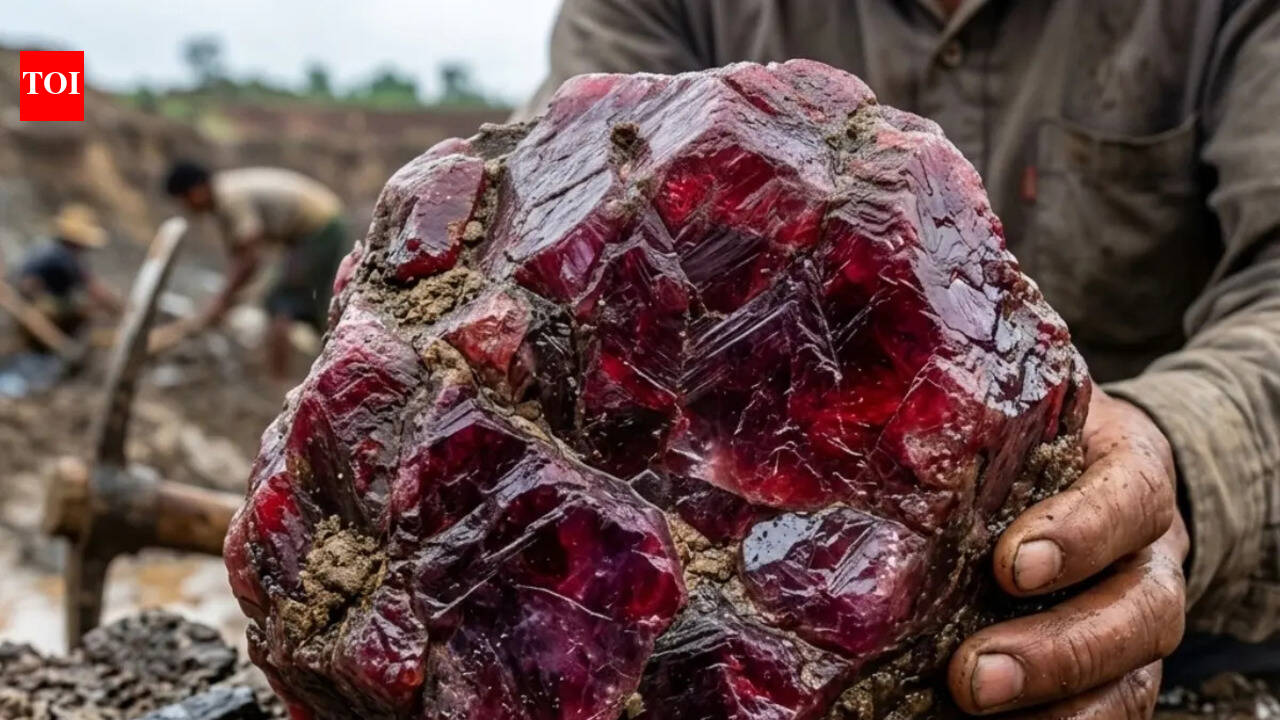
In a remarkable find that has captivated gem enthusiasts and scientists alike, miners in Myanmar have unearthed what is being described as an extraordinary 11,000-carat ruby, one of the largest specimens ever discovered. The gem, weighing approximately 2.2 kilograms, was extracted from a mine in the renowned Mogok Valley, often called the 'Valley of Rubies,' located in the northern part of the country. According to reports from the Times of India, this discovery has drawn global attention not only for its sheer size but also for its exceptional quality, which includes a deep, vivid red hue and remarkable clarity rare for such a massive stone.
The ruby was discovered late last month by a team of local miners working in a small-scale operation in Mogok, a region that has supplied the world with some of its finest rubies for centuries. Myanmar, formerly known as Burma, accounts for about 90 percent of the world's high-quality rubies, making it a hotspot for such treasures. Officials from the Myanmar Ministry of Natural Resources and Environmental Conservation confirmed the find on October 15, stating that the stone has been secured and is undergoing preliminary assessments to determine its authenticity and value. 'This is a significant discovery for our mining community,' said U Min Aung, a spokesperson for the ministry, in a statement released to local media.
While the size of the ruby—equivalent to over 2,000 grams—makes it a standout, experts emphasize that its quality elevates it to historic status. Gemologist Dr. Elena Vasquez, who consulted on similar finds for the Gemological Institute of America, noted in an interview that rubies of this magnitude often suffer from inclusions or color inconsistencies, but early examinations suggest this one defies those odds. 'The clarity and saturation here are exceptional; it's not just big, it's potentially flawless,' Vasquez said. The Times of India article highlights that the real story transcends the ruby's dimensions, pointing to the broader implications for Myanmar's gem trade amid ongoing political and economic challenges.
Mining in Myanmar has long been a double-edged sword, providing livelihoods for thousands while raising concerns over labor conditions and environmental damage. The Mogok area, situated about 200 kilometers north of Mandalay, features ancient alluvial deposits where rubies form under intense geological pressure over millions of years. This particular ruby was reportedly found embedded in a matrix of marble and limestone, typical of the region's geology. Local miners, who often work with rudimentary tools, described the moment of discovery as surreal. 'We were digging as usual when the earth gave way to this glowing red mass,' recounted miner Zaw Htay, 42, from a nearby village, according to accounts in regional reports.
The discovery comes at a time when Myanmar's gem industry is navigating turbulent waters. Since the military coup in February 2021, international sanctions have restricted exports, affecting the flow of rubies to markets in Thailand, India, and Europe. The Times of India piece underscores that while the ruby could fetch millions—potentially up to $50 million based on comparable sales at auctions like those by Sotheby's—the proceeds might bolster the local economy or, critics fear, fund junta activities. Human rights groups, including Global Witness, have long accused the military of profiting from gem mines, though the ministry denies such claims. 'Our focus is on sustainable mining practices,' U Min Aung added, emphasizing compliance with international standards.
Historically, Myanmar's rubies have adorned royal crowns and celebrity jewelry, with famous examples including the 25.59-carat Sunrise Ruby sold for $30.4 million in 2015. This new find dwarfs those, prompting comparisons to the largest known ruby, the 1,000-carat Liberator from the same region discovered in the 1990s. However, size alone doesn't guarantee value; the stone's treatment history—whether heated or untreated—will play a crucial role. According to the Gemological Institute, untreated rubies like this one command premiums due to their natural vibrancy. Experts from the Thai Gem and Jewelry Traders Association, a key importer, expressed interest in viewing the stone once it's certified.
Beyond the gem itself, the discovery sheds light on the artisanal mining practices in Mogok, where over 10,000 people depend on the trade. Miners often operate in family-run pits, sifting through gravel for days with little mechanization. Environmental advocates point out that such operations contribute to deforestation and water contamination from chemical use in processing. A 2022 report by the Myanmar Extractive Industries Transparency Initiative noted that while ruby mining generates $400 million annually, only a fraction reaches local communities. The Times of India article suggests this ruby's unearthing could spotlight the need for better regulation, potentially attracting ethical investors if provenance is verified.
International gem markets reacted swiftly to the news. Shares in jewelry companies in Bangkok and Mumbai saw minor upticks, as traders anticipate a surge in demand for Burmese rubies. However, some jewelers remain cautious due to the U.S. ban on ruby imports from Myanmar enacted in 2023 under the Uyghur Forced Labor Prevention Act, which targets goods linked to exploitation. 'We're monitoring the situation closely; ethical sourcing is paramount,' said Raj Patel, CEO of a Mumbai-based gem firm, in response to queries from the Times of India. Meanwhile, collectors and museums have already expressed interest, with the Smithsonian Institution indicating it might pursue acquisition for its mineral collection.
The ruby's journey from mine to market will involve rigorous testing. It has been transported to Yangon for analysis by the Myanmar Gem Emporium, where spectrometers will check for synthetic enhancements. Dates for public display are tentative, with an auction possibly slated for early 2025 in Geneva or Hong Kong. If authenticated as natural, it could set records; a similar 8,000-carat ruby from Africa sold for $12 million in 2018 despite flaws. Dr. Vasquez cautioned that cutting the stone—for it's currently rough—could yield multiple faceted gems, each worth a fortune.
In the broader context, this find underscores Myanmar's geological riches, formed by the collision of the Indian and Eurasian plates eons ago, which created the Himalayan range and enriched Mogok's soils. Related events include a 2019 discovery of a 27-carat pigeon-blood ruby that fetched $7 million, highlighting the area's consistent yields. Yet, political instability has led to mine closures and smuggling, with an estimated 30 percent of gems leaving illegally via borders with China and Thailand.
Local communities in Mogok view the discovery with mixed emotions. While it promises economic boosts—potentially funding schools and roads—there's apprehension over foreign exploitation. Village elder Than Myint, 65, told reporters, 'This ruby belongs to our land; we hope it brings prosperity, not just to a few.' Organizations like the Karen Environmental and Social Action Network advocate for community ownership models seen in other mining regions.
As the world awaits further details, this 11,000-carat ruby stands as a testament to nature's bounty and human endeavor. Its exceptional quality, as reported by the Times of India, positions it not merely as a record-breaker but as a catalyst for discussions on sustainable gem trade. Officials indicate that transparency in its handling will be key to maximizing benefits for Myanmar. Whether it graces a tiara or a museum case, the stone's story is far from over, promising to illuminate the intricate world of rubies long after the initial excitement fades.
The implications extend to global jewelry trends, where demand for rare, ethically sourced gems is rising. Luxury brands like Tiffany & Co. have pledged to avoid conflict minerals, potentially influencing the ruby's fate. In the coming months, auctions and expert panels will determine its legacy, but for now, it remains a symbol of Myanmar's enduring allure in the gemstone realm.