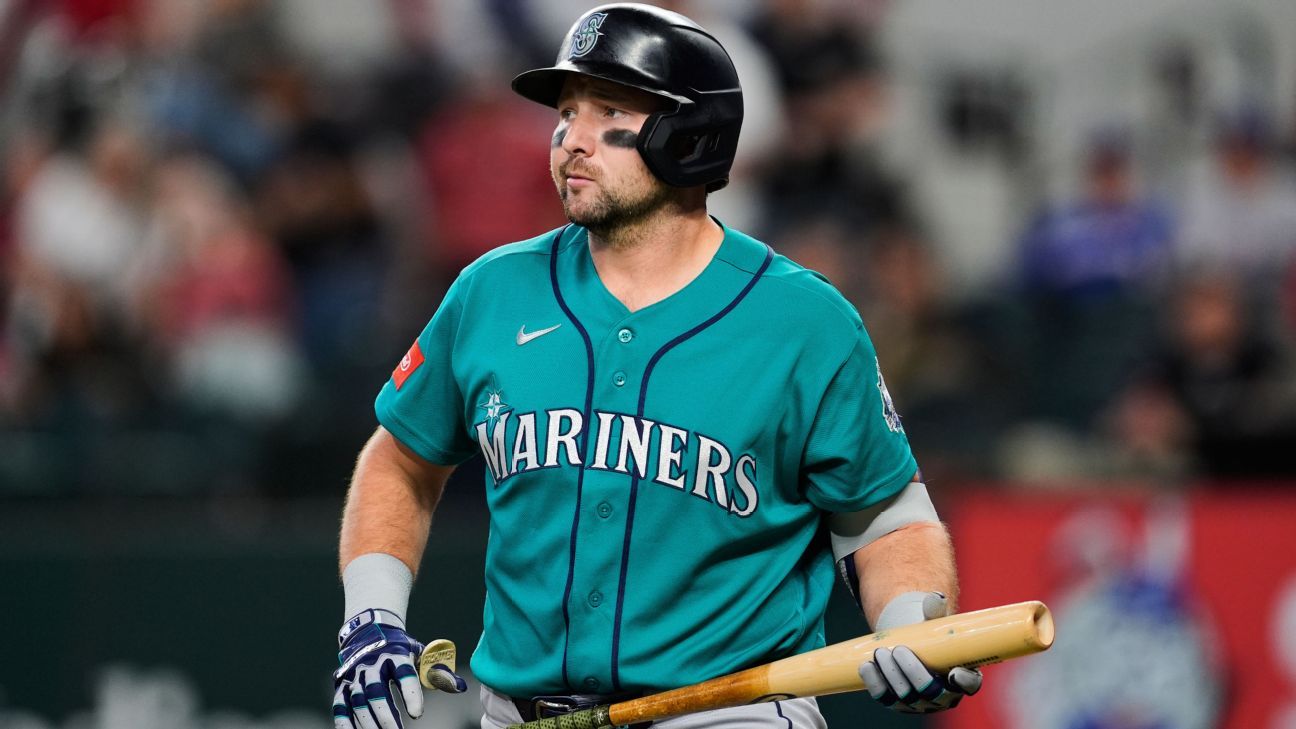
SEATTLE — The Seattle Mariners are mired in an early-season slump that has fans and analysts alike scratching their heads, with catcher Cal Raleigh's struggles at the plate drawing particular attention just two weeks into the 2026 Major League Baseball season. Despite boasting a franchise-best 2.62 earned-run average from their pitching staff over the first 13 games, the Mariners have hit a collective .184 at the plate, landing them at the bottom of the standings with a 4-9 record. The team's woes were on full display during a sweep in Texas this week, where they scored just three runs across three games and managed only 11 hits, capped by a two-hit shutout loss on Wednesday.
At the heart of Seattle's offensive frustrations is Raleigh, the power-hitting catcher who shattered records with 60 home runs in 2025 but is off to a rocky start this year. According to ESPN's breakdown of his performance, Raleigh is batting .143 with just one home run on seven hits and an MLB-second-high 21 strikeouts through 13 games. His teammates in the heart of the lineup — Julio Rodriguez, Josh Naylor, and Randy Arozarena — aren't faring much better, combining for a dismal 26-for-195 (.133) with only one home run between them. Rodriguez has seven hits on the season without an extra-base hit, while Naylor has five hits and a minus-49 weighted runs created plus (WRC+).
The Mariners' upcoming series against the division-rival Houston Astros, starting with ESPN's MLB Game of the Day at 9:40 p.m. ET on Saturday at T-Mobile Park, offers a chance for redemption. But with the team's key hitters all slumping simultaneously, questions linger about whether this is a temporary hiccup or a sign of deeper issues. ESPN analyst David Schoenfield, who reviewed all 55 of Raleigh's plate appearances and the 248 pitches he saw through Wednesday, described the viewing experience as ranking 'somewhere between "eating a hot dog at the Kingdome back in the day that had probably been cooked three days earlier" and "watching Bobby Ayala close out games in 1998."'
Schoenfield's detailed examination reveals patterns in Raleigh's at-bats that highlight his current challenges. In Game 1 against the Cleveland Guardians, Raleigh struck out swinging on an 0-2 changeup from right-hander Tanner Bibee in his second plate appearance — a well-placed pitch on the outside corner. However, he had taken a four-seam fastball right down the middle for a strike on the first pitch, a mistake he might have capitalized on in prior seasons. Later in that game, trailing 5-4 in the eighth inning, Raleigh got ahead 2-0 against reliever Erik Sabrowski but whiffed on a slider before striking out looking on a 2-2 slider just outside the zone, a call he could have challenged.
The second game against Cleveland saw more of the same. Raleigh endured an eight-pitch at-bat in his first plate appearance against Gavin Williams, fouling off a 3-2 cutter down the middle before missing a wicked 3-2 cutter that rode in off the plate. His fourth plate appearance ended with his seventh strikeout in two games, looking at a curveball from Peyton Pallette that was well outside. Schoenfield noted that Raleigh, like his struggling teammates, participated in this year's World Baseball Classic, where tensions arose — including Raleigh not shaking hands with Arozarena after a game, followed by Arozarena's apology for postgame comments. Despite the resolution, the WBC may have disrupted rhythms, as the Mariners posted an 11-19 spring training record with key players scattered across international teams.
Raleigh's WBC performance was lackluster: 0-for-9 for Team USA, leading to him being benched for Will Smith in the final two games. In spring training, he went 8-for-32 with one home run and 12 strikeouts. Local sports radio in Seattle, according to reports, devotes about two hours daily to dissecting the WBC's impact. These distractions come atop Raleigh's streaky history; even in his 2025 breakout year, he hit .184 with two home runs through his first 13 games.
Pinch-hitting in Game 5 against the New York Yankees in a 1-1 tie with two runners on, Raleigh fell behind after swinging at a 2-0 slider from lefty Brent Headrick that was way out of the zone, then struck out on a 2-2 splitter low and away. The following game against the Atlanta Braves, after going 0-for-3 versus lefty Max Fried, he faced Headrick again and swung through a 93-mph fastball middle-away before striking out on the same pitch type. This is particularly telling, as Raleigh's 2025 success included a .281/.351/.681 line with 22 home runs in 185 at-bats against lefties, a marked improvement from .183 in 2024.
Schoenfield highlighted Raleigh's diminished contact on middle-of-the-zone pitches: in 2025, he hit .290/.333/.695 with 26 home runs in 210 belt-high at-bats, but in 2026, it's .105/.261/.263 with one home run in 19 at-bats. His in-zone contact rate has dropped from 78.4% to 65.8%, worse than all but Jose Caballero among qualified hitters, with Rodriguez ranking 181st out of 187. Like Bryce Harper, Raleigh draws walks (97 in 2025) despite a below-average chase rate in the 25th percentile, but he feasts on mistakes — a skill that's eluding him now.
Notable hard contact has been scarce. In Game 8 against the Los Angeles Angels, Raleigh's flyout to left off Reid Detmers' 2-2 fastball up and in produced a 100.7 mph exit velocity — his first hard-hit ball (95-plus mph) of the season, in his 28th at-bat. The next day, he smashed a fly ball to the wall in right-center at Angel Stadium against Jack Kochanowicz, but Angels outfielder Jo Adell robbed him of what could have been a home run — one of three such thefts by Adell that game. Schoenfield observed that in 2025, that ball might have traveled three extra feet, and in June weather, it likely clears the fence.
Park factors haven't helped: The Mariners' first seven games were in chilly April Seattle, one of MLB's toughest hitting environments, followed by two night games in pitcher-friendly Anaheim and three in Texas' Globe Life Field, the best pitcher's park last year. In Game 9's third plate appearance, Raleigh fouled off four pitches from Kochanowicz, including two four-seamers, before striking out on a 96-mph 3-2 fastball up and out — a pitch with 0% strike probability that a slumping batter still offers at.
Raleigh's lone home run came in Game 11 against the Texas Rangers, crushing a 3-2 fastball from Jacob deGrom dead center in the first inning — his only hard-hit hit among seven total. In Game 12, he popped up a first-pitch cutter from Nathan Eovaldi that hung over the plate and later blooped a single after fouling a first-pitch swing. First-pitch aggression worked in 2025, where he hit .427 with 17 home runs in 82 at-bats on first-pitch swings (13th-highest rate among qualified hitters), but this year, he's 1-for-7. A positive note in Game 13: a 92-mph flyout on a 3-2 cutter from Cole Winn, plus two other hard-hit outs, suggesting connection might be returning.
The slump extends team-wide, with no bad-luck element — it's poor execution. Raleigh's swing-and-miss rate on four-seamers and two-seamers has doubled from 25.2% to 50%, and Rodriguez's is up from 21.6% to 32.8%. Hard-hit rates have plummeted: the Mariners went from 42.8% (4th in MLB) in 2025 to 34.2% (29th) in 2026, with Raleigh dropping from 49.6% to 21.4%, Rodriguez from 48.0% to 36.4%, Naylor from 41.9% to 35.0%, and Arozarena from 50.6% to 44.1%.
Context from past seasons offers some solace. Raleigh's 60-homer year included streaks like one home run in 11 games or three stretches of one in nine, but also bunches, including 11 two-homer games. Rodriguez is a known slow starter, with a career first-half OPS of .726 versus .902 in the second half, and August 300 points higher than April. For a Mariners team that missed the playoffs by one win in both 2023 and 2024, this start could be costly by September, but Schoenfield cautions it's early to panic.
As the Mariners host the Astros, all eyes will be on whether Raleigh and the lineup can heat up. With strong pitching providing a foundation, a turnaround isn't impossible, but the pressure is on to avoid digging a deeper hole in the competitive AL West.