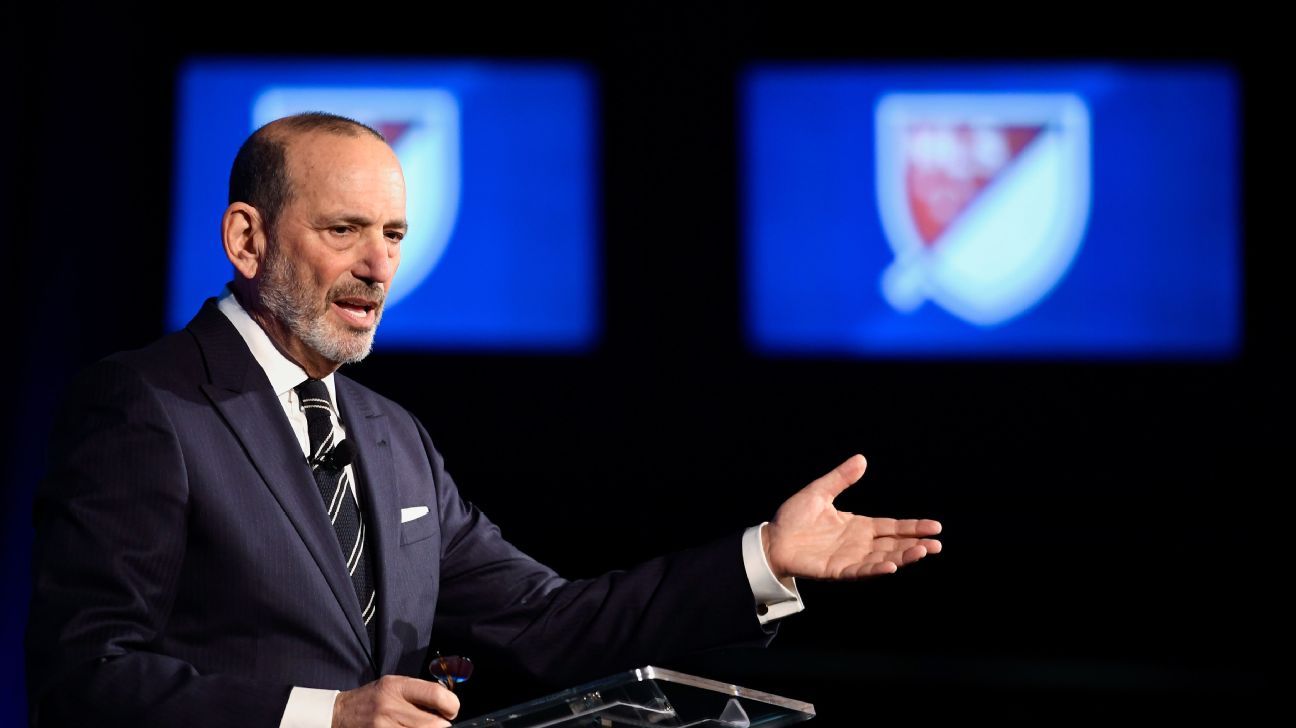
WASHINGTON — Major League Soccer Commissioner Don Garber, long a staunch opponent of promotion and relegation in the league, signaled a potential shift in his views during a news conference Thursday night at D.C. United's Audi Field. Speaking ahead of the World Cup draw, Garber acknowledged that while implementing a pro/rel system remains far off — possibly years or even decades away — he is no longer willing to dismiss the idea outright.
MLS, which launched in 1996 with just 10 teams, has grown into a 30-team league operating under a closed system where teams cannot be relegated to lower divisions based on performance. The most recent expansion, San Diego FC, secured its spot by paying a staggering $500 million fee and is set to begin play in 2025. Garber has consistently argued that the financial investments made by owners in stadiums, training facilities, and youth academies make pro/rel unfeasible for MLS, as it could jeopardize those assets.
"There's no real point of saying never because I don't know what the future would look like," Garber said. "I certainly never thought we would adapt to the international calendar." He added that the ongoing development of lower divisions might one day create a viable ecosystem for pro/rel, though he emphasized, "Frankly, I don't believe that ecosystem can exist today, but who knows? I've learned never say never. That doesn't mean we're having promotion relegation any time soon."
The commissioner's comments come as the United Soccer League (USL), MLS's primary rival in American professional soccer, pushes forward with ambitious plans to establish its own top-tier competition. The USL announced this year that it intends to launch a Division I league starting in the 2027-28 season, complete with a promotion and relegation system. Currently, the USL Championship operates as the sanctioned second-tier division since 2017, featuring 24 teams. Below that, USL League One began play in 2019 as the third tier, while USL League Two serves as a semipro level with 144 teams spread across 19 regional divisions and four conferences.
Garber, who celebrated his 68th birthday in October, has led MLS since August 1999 and recently extended his contract through the 2027 season. During the news conference, he addressed the league's future leadership, noting that MLS has functioned like a perpetual startup for nearly three decades. "MLS has almost been operating as a startup for 30 years, so we never gave any thought to succession planning, at all," he said. "High-performing companies need to do that. So the start of this process is to have a proper succession process not just for the next commissioner, but for the next leader of our commercial business or the next leader of our sporting business."
The commissioner indicated he has not contemplated extending his tenure beyond 2027. "Right now I'm focused on the next couple of years and I'll think about that and have a conversation with the MLS ownership at that right time," Garber stated. His remarks underscore a period of transition for the league, which last month approved a significant shift in its schedule. Starting with the 2027-28 season, MLS will adopt a summer-to-spring calendar, aligning more closely with major European leagues and moving away from its traditional February-to-December format.
Garber reflected on the calendar change, which was unexpected even during his contract renewal discussions. "Certainly I wasn't thinking about the renewal of my last contract with an eye towards the calendar change because we had no idea back then that we'd be doing it," he said. "But we'll figure it out." This adjustment aims to better integrate MLS with the global soccer landscape, potentially boosting international player recruitment and fan engagement ahead of the 2026 World Cup co-hosted by the United States, Canada, and Mexico.
While discussing broader league matters, Garber expressed frustration over stalled stadium developments for the Vancouver Whitecaps, who are set to host Inter Miami in the MLS Cup final on Saturday at B.C. Place. The Whitecaps currently play as tenants at the multi-purpose venue and have sought a dedicated soccer-specific stadium for years. "The MLS team, its owners, its fans, its players have done everything to earn the support that they're not getting today from the city and from the province and that's an untenable situation," Garber said. "What we have there has to change. And right now, we're not necessarily on a path to do that."
He noted recent efforts to improve the situation, including a positive meeting with Vancouver's mayor and negotiations for a better lease at B.C. Place. However, progress has been slow. "We're looking at getting a better lease at B.C. Place right now. There's been no movement on that and it's been a month," Garber added. The lack of advancement has raised concerns about the franchise's long-term stability in the city.
Vancouver's ownership woes add another layer of complexity. The club, which joined MLS in 2011, has been owned primarily by Greg Kerfoot since 2002, with Steve Luczo, Jeff Mallett, and former NBA star Steve Nash joining as partners in 2008. In December 2023, the group announced the team was up for sale, though Mallett suggested in August that their strategy might now involve bringing in a new partner rather than a full divestiture.
The intersection of these issues highlights the challenges MLS faces as it matures. On one hand, the league's closed system has enabled rapid expansion and financial security, attracting high-profile investors and global talent. On the other, critics, including fans and lower-division operators like the USL, argue that pro/rel would increase competition and excitement, mirroring successful European models. Garber's softened stance, while cautious, suggests that evolving dynamics — such as the growth of USL and MLS's own calendar alignment — could eventually pressure the league to reconsider its structure.
Looking ahead, MLS's focus on succession planning and infrastructure improvements will be crucial. With Garber's contract winding down and major events like the 2026 World Cup on the horizon, the league is at a pivotal moment. The commissioner's comments on pro/rel, though not an endorsement, open the door to discussions that could reshape American soccer's competitive landscape in the coming decades.
For now, the immediate priority remains the MLS Cup final in Vancouver, where the Whitecaps aim to capitalize on home-field advantage against Lionel Messi's Inter Miami. Yet, underlying tensions around stadiums and ownership could cast a shadow over the celebrations. As Garber put it, change is inevitable, even if the path forward remains uncertain.
The broader soccer ecosystem in the U.S. continues to expand, with USL's Division I ambitions potentially creating a more interconnected pyramid. Whether MLS engages with pro/rel or maintains its insulated model, Garber's evolving perspective signals adaptability in a sport that has transformed dramatically since his early days as commissioner.