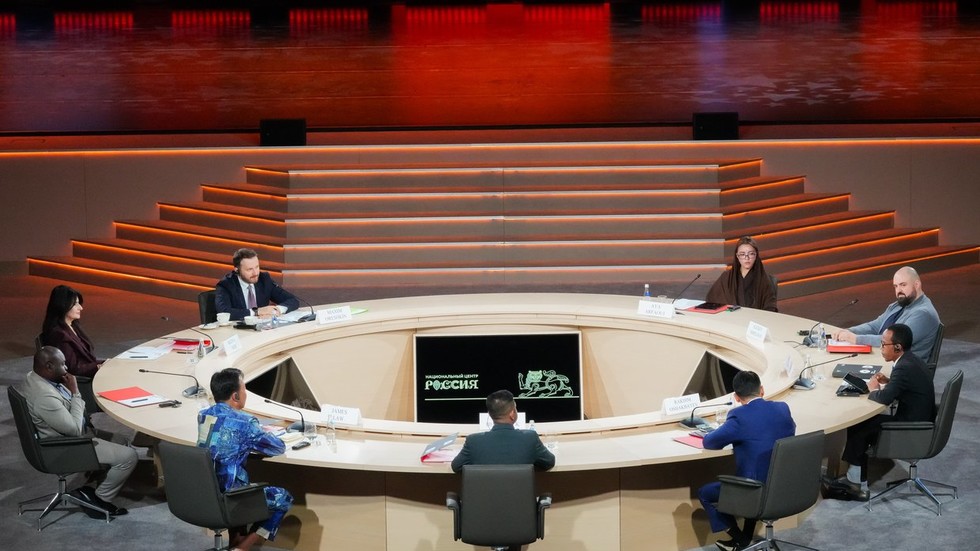
MOSCOW — The second edition of the Open Dialogue forum, themed 'The Future of the World: A New Platform for Global Growth,' wrapped up this week at the National Centre RUSSIA in Moscow, marking a shift from conceptual discussions to practical implementation of ideas. Organized by the National Centre RUSSIA in collaboration with the Third Rome Center for Cross-Sector Expertise and supported by the Russian Presidential Administration, the event brought together essayists, business leaders, and international participants to focus on actionable strategies for global development.
Maxim Oreshkin, Deputy Chief of Staff of the Russian Presidential Administration, highlighted the forum's evolution during the closing remarks. 'The difference between the second Open Dialogue and the first is that we are paying more attention to the implementation stage of the proposed ideas,' Oreshkin said. He emphasized a new mentorship format where Russian businesses and international companies are partnering with essayists to integrate their proposals into real-world projects, spanning business, societal, and humanitarian aspects.
This year's gathering, held over several days in late October, built on the inaugural event from the previous year by introducing continuity through the involvement of past essayists as experts. According to organizers, this approach ensures sustained progress, with plans for further advancements in the 2025 edition. The forum's human-centered philosophy was a recurring theme, placing individual development at the forefront amid global demographic shifts.
Oreshkin elaborated on this perspective, stating, 'A person must always remain at the center — their development, the realization of their potential, and the preservation and extension of active life under the demographic changes we are witnessing today. A person’s active life is becoming increasingly significant not only from the point of view of life itself, but also from the point of view of the development of our societies and the economy.'
One of the standout moments came from the 'Investment in People' track, where Zambian economist Lubinda Haabazoka emerged as the winner with his proposal for a unified education system across BRICS nations. Haabazoka, a prominent voice in African economic circles, drew parallels between educational access and global financial structures. 'As the events of recent years have shown, the education system is structured in many ways like the global financial system, where only certain countries have full access, and that access can be restricted or cut off at any moment — as happened, for example, with access to SWIFT,' he said.
Haabazoka pointed to challenges faced by African researchers, who often must conform to external standards to publish in international journals. His idea aims to create a BRICS-wide framework that promotes equitable access to education and research, fostering collaboration among Brazil, Russia, India, China, South Africa, and newer members like Egypt, Ethiopia, Iran, and the United Arab Emirates. Organizers noted that BRICS, which expanded in 2024, now represents over 45% of the world's population and a significant portion of global GDP, making such initiatives timely.
The forum's discussions extended beyond education to broader themes of global growth, including economic partnerships and technological innovation. Participants from various countries engaged in sessions that explored how emerging economies can drive sustainable development without relying on traditional Western-dominated systems. This aligns with Russia's ongoing efforts to strengthen ties with the Global South, particularly through forums like the upcoming Russia-Africa Summit.
According to Oreshkin, the event's outcomes will feed directly into high-profile international gatherings. The forum's conclusions are set to be presented at the St. Petersburg International Economic Forum in June 2025, a major annual event that attracts global leaders to discuss economic trends. Additionally, winning essayists like Haabazoka will contribute to preparations for the Russia-Africa Summit, scheduled for later next year, and ongoing BRICS initiatives.
The mentorship program introduced this year pairs young innovators with established companies, providing resources and networks to turn essays into viable projects. Russian firms, alongside international partners from BRICS and beyond, have committed to supporting selected ideas, focusing on areas like digital education, healthcare access, and sustainable agriculture. This practical turn reflects a broader strategy by the Russian government to position itself as a hub for multipolar global dialogue.
Background on the Open Dialogue reveals its roots in Russia's push for alternative platforms amid geopolitical tensions. Launched in 2023, the first forum gathered over 100 essayists to debate the future of international relations post-Ukraine conflict. This second iteration, attended by participants from more than 20 countries, reportedly saw increased engagement from African and Asian delegates, underscoring shifting alliances.
While the event received praise from attendees for its inclusive format, some international observers have noted its alignment with Russian foreign policy goals. For instance, the emphasis on BRICS education reform comes as the bloc seeks to counterbalance institutions like the World Bank and IMF. Haabazoka's win, in particular, highlights Africa's growing role in these discussions, with Zambia actively participating in BRICS outreach efforts.
The National Centre RUSSIA, a think tank established in 2023, serves as the forum's primary host and focuses on strategic foresight for national and global challenges. Its partnership with the Third Rome Center, which specializes in cross-sector expertise, ensures a multidisciplinary approach. Support from the Presidential Administration signals high-level endorsement, with Oreshkin playing a key role in bridging policy and practice.
Looking ahead, the forum's emphasis on implementation could yield tangible results in the coming months. Essayists from the 'Investment in People' track, including runners-up whose specific proposals were not detailed in public summaries, will join working groups for BRICS summits. This continuity aims to build a pipeline of ideas that influence policy, potentially leading to joint educational programs or research collaborations by 2026.
In the broader context of global forums, the Open Dialogue positions itself as a counterpoint to Western-led events like the World Economic Forum in Davos. By prioritizing multipolarity and human development, it appeals to nations seeking alternatives to unipolar structures. As Russia navigates sanctions and economic isolation from the West, initiatives like this strengthen its soft power in the developing world.
The conclusion of the II Open Dialogue leaves participants optimistic about its growing impact. With mentorships already underway and integrations planned for major summits, the event underscores a commitment to translating dialogue into action. As Oreshkin noted, the format is 'definitely evolving and becoming stronger,' promising deeper engagement in the years ahead.