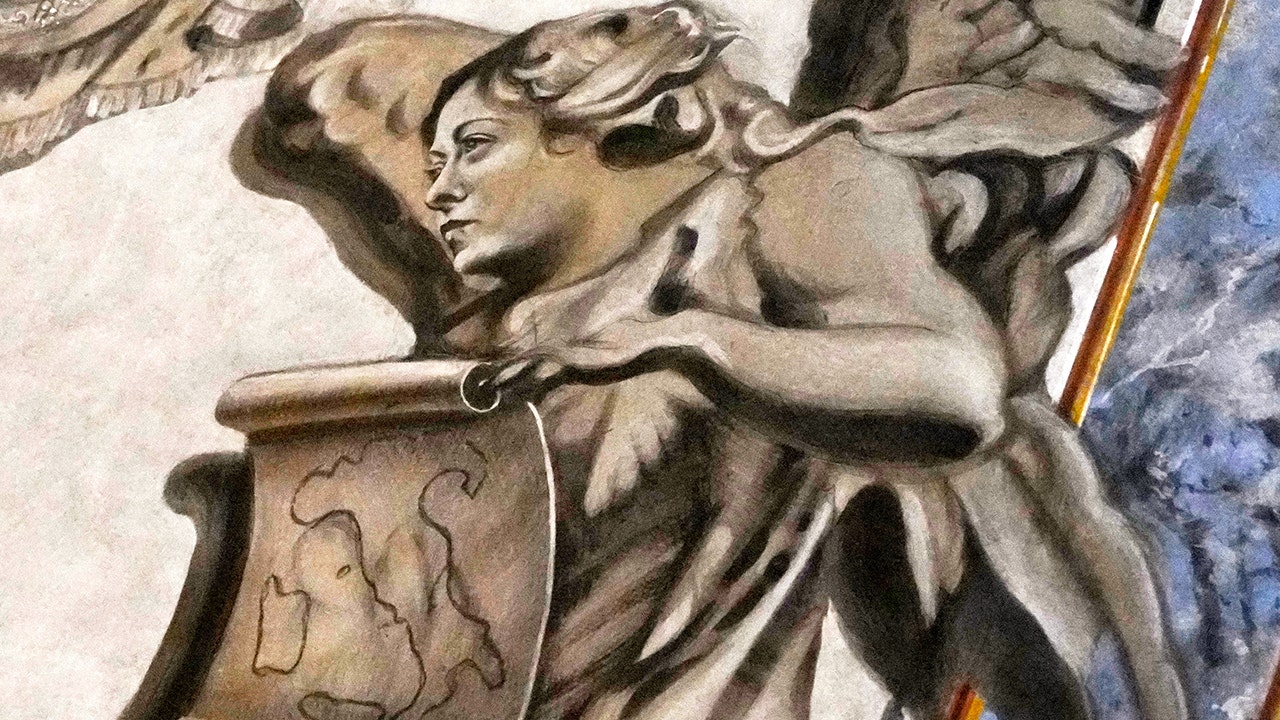
In the heart of Rome, near the bustling Spanish Steps, a peculiar discovery has stirred debate at one of the city's ancient basilicas. A restored fresco inside the Basilica of San Lorenzo in Lucina now features a cherub that bears a striking resemblance to Italian Prime Minister Giorgia Meloni, prompting church officials to launch an investigation into how the image appeared. The basilica, consecrated in the 5th century by Pope Sixtus III, has long been a sacred site for tourists and worshippers alike, but this unexpected addition to a memorial fresco honoring Italy's last king has ignited discussions about art, politics, and the boundaries of restoration.
The fresco in question, created around 2000 to commemorate King Umberto II, depicts a group of angels in deferential poses toward the monarch. According to reports from The Associated Press, the cherub's face closely mirrors Meloni's features, complete with her distinctive hairstyle and expression. This anomaly surfaced recently during ongoing restoration work, drawing attention from visitors and local media. The basilica, one of Rome's oldest churches, suffered significant damage during World War II, when Allied bombings destroyed parts of the structure and erased numerous frescoes, as noted by organizers of the upcoming Jubilee 2025 celebrations.
Church authorities moved quickly to address the controversy. The Diocese of Rome issued statements clarifying that they had been aware of a restoration project on the fresco since 2023, but emphasized that no modifications or additions were authorized. "The modification of the cherub's face was an initiative of the decorator not communicated to the competent bodies," one release stated, according to the Associated Press. The diocese reiterated its dedication to preserving Rome's artistic and spiritual heritage, adding in the statements: "The Diocese of Rome’s commitment to the preservation of its artistic and spiritual heritage, it is firmly reiterated that images of sacred art and Christian tradition cannot be misused or exploited, as they are intended exclusively to support liturgical life and personal and communal prayer."
Local reactions have varied, with some seeing deeper symbolism in the cherub's placement. Observers have interpreted the image as a subtle commentary on Italy's post-World War II history, particularly the rejection of the monarchy following its alignment with fascist dictator Benito Mussolini. The pose of the Meloni-like cherub, shown in a subservient manner toward King Umberto II, has fueled speculation that it alludes to the nation's shift away from royalist traditions after the war. Italy held a referendum in 1946 that abolished the monarchy, ending centuries of rule and ushering in the republic amid widespread disillusionment with the House of Savoy's wartime decisions.
Not everyone agrees on the resemblance, however. Bruno Valentinetti, a local craftsman and volunteer involved in restorations, told local press that he discerns no similarity between the painted face and the prime minister. "I see no resemblance between the painting and Meloni," Valentinetti said, dismissing the buzz as overblown. His perspective highlights the subjective nature of such interpretations, especially in a city rich with artistic history where faces in old works often evoke familiar figures.
Prime Minister Meloni herself weighed in with humor on social media. On Facebook, she shared a photo of the fresco and captioned it: "No, I definitely don’t look like an angel," accompanied by a laughing emoji. The post, which quickly garnered attention, underscores Meloni's lighthearted approach to the incident, contrasting with the more serious tones from ecclesiastical sources. Meloni, who leads Italy's right-wing Brothers of Italy party and has been prime minister since 2022, has navigated various controversies, but this artistic doppelgänger appears to be a whimsical footnote.
Rev. Daniele Micheletti, the basilica's priest, offered further insight to the Associated Press, explaining the complexities of church art. "Many artists have depicted real people in their paintings," he noted, suggesting that such inclusions are not unprecedented in religious iconography. Micheletti distanced himself from responsibility, stating: "The priest is not responsible for the decorations in the sense that the owner is someone else. So, what do they want from me? I did not do the painting." This comment points to the basilica's governance, where artistic decisions may involve private patrons or external decorators rather than direct clerical oversight.
The investigation, now underway, aims to determine the intent behind the alteration and whether it violates guidelines for sacred art. Officials from the Diocese of Rome have not specified a timeline for conclusions, but the probe is expected to review the restorer's credentials and the project's approvals. The fresco's restoration is part of broader efforts to prepare Rome's historic sites for Jubilee 2025, a major Catholic event anticipated to draw millions of pilgrims. These preparations include shoring up war-damaged structures like San Lorenzo in Lucina, which was first established in the 4th century and has endured invasions, renovations, and conflicts over 1,600 years.
Historical context adds layers to the story. King Umberto II, who reigned briefly in 1946, was the last monarch before the referendum ousted the Savoy family. His father's support for Mussolini during the fascist era tainted the monarchy, leading to exile for Umberto and his descendants. The fresco, originally painted in 2000, was meant as a tribute to this final king, but the recent tweak has reopened old wounds for some. Art historians note that frescoes in Roman churches often blend sacred themes with contemporary allusions, a tradition dating back to the Renaissance.
Visitors to the basilica, a quiet oasis amid Rome's tourist throngs, have mixed responses. One pilgrim, speaking anonymously to reporters, called the cherub "a cheeky nod to modern politics in a holy place," while another dismissed it as "just a bad restoration job." The site's proximity to the Spanish Steps—less than a 10-minute walk—means it attracts a global crowd, amplifying the story's reach. Social media has exploded with memes and analyses, turning a local curiosity into an international talking point.
As the investigation proceeds, questions linger about oversight in church restorations. The Diocese of Rome's statements suggest a gap in communication, with the decorator acting independently. This incident echoes past controversies, such as unauthorized changes to artworks in Vatican museums or debates over modern interpretations in medieval sites. Experts say such events underscore the need for stricter protocols, especially as Italy invests heavily in cultural preservation ahead of the Jubilee.
Beyond the immediate scandal, the episode highlights the enduring interplay between art and power in Italy. Meloni's government has championed national heritage, allocating funds for sites like Notre-Dame de Paris's restoration—though that's in France, it reflects broader European trends. Friends of Notre-Dame de Paris President Michel Picaud recently shared updates on that project's progress five years after the 2019 fire, drawing parallels to Rome's own safeguarding efforts. In Lucina, the focus remains on ensuring that sacred spaces remain untainted by political whims.
Looking ahead, the basilica's future role in Jubilee 2025 could be shaped by this resolution. Organizers plan enhanced security and guided tours to highlight its history, from early Christian martyrs to WWII survival. If the cherub is deemed inappropriate, removal or alteration might follow, but for now, it serves as a reminder of art's provocative power. As Rev. Micheletti implied, the line between inspiration and imposition is often blurred in places where heaven and earth meet.
The story continues to unfold, with officials promising transparency. Tourists snapping photos near the Spanish Steps may soon find this basilica topping their itineraries—not just for its antiquity, but for a cherub that captured a nation's imagination. In Rome, where history whispers from every stone, even angels can stir the pot.