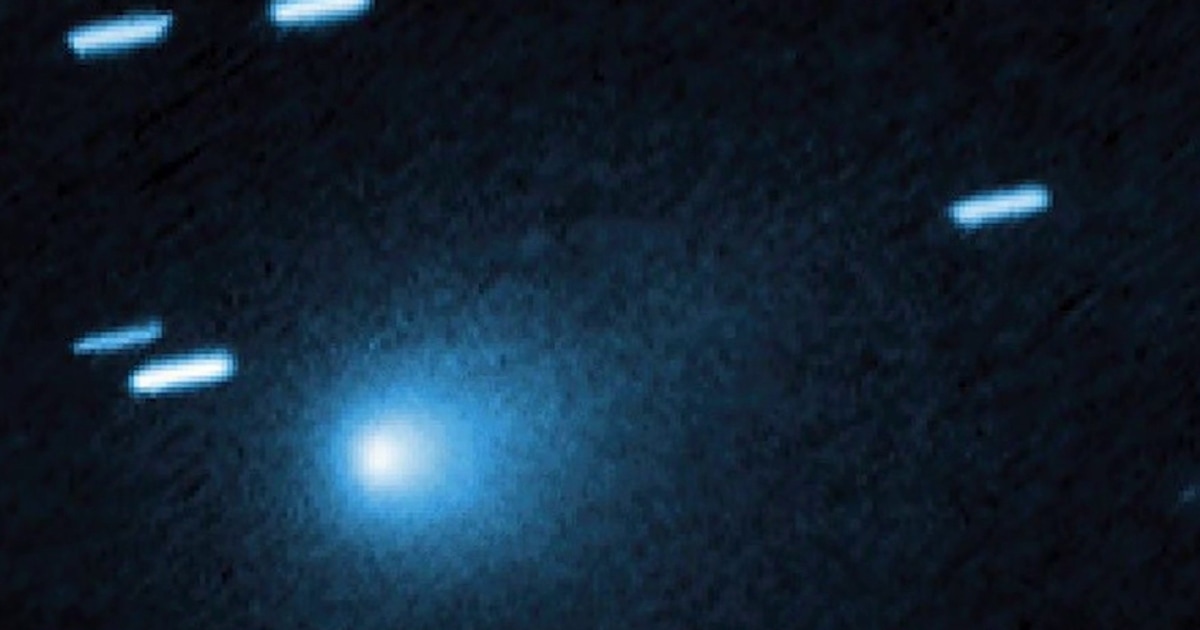
APPLETON, Wis. — A mysterious interstellar object dubbed 3I/ATLAS is hurtling through our solar system, reaching its closest point to Earth this week and captivating astronomers worldwide. Discovered by the Asteroid Terrestrial-impact Last Alert System (ATLAS), the object is believed to originate from another star system, marking it as only the third confirmed interstellar visitor to our cosmic neighborhood. According to reports from NBC News, the object's path brings it within about 1.4 astronomical units of Earth—roughly twice the distance from our planet to the sun—on Tuesday, October 10, 2023.
NBC News correspondent Gadi Schwartz, who covered the event in a recent broadcast, described the object as "a mysterious outer space object that is thought to be billions of years old." Schwartz's report highlighted the intrigue surrounding 3I/ATLAS, noting that its trajectory suggests it has been wandering the galaxy for eons before entering our solar system earlier this year. The discovery was first announced by the International Astronomical Union on July 15, 2023, after ATLAS telescopes in Chile and South Africa detected the faint, fast-moving dot against the starry backdrop.
Astronomers at the University of Hawaii, where the ATLAS system is partially based, confirmed the object's interstellar nature through its hyperbolic orbit—a path that indicates it's not bound by the sun's gravity and will eventually exit the solar system. "This is an extraordinary opportunity to study material from beyond our solar system," said Karen Meech, an astronomer at the Institute for Astronomy in Honolulu, in a statement released by the university. Meech, who led the team that studied the first interstellar object, 1I/'Oumuamua, in 2017, emphasized the rarity of such events. "3I/ATLAS gives us a chance to compare and contrast with previous visitors, potentially revealing more about the formation of planetary systems elsewhere."
The object's speed, clocking in at approximately 25 kilometers per second relative to the sun, further underscores its alien origins. Unlike asteroids or comets from our own solar system, which typically orbit in elliptical paths, 3I/ATLAS's velocity propels it on a one-way journey through our region of space. Observations from the Hubble Space Telescope, conducted in late September, revealed it to be roughly 200 meters in diameter, with a reddish hue similar to that of 'Oumuamua. However, unlike its predecessor, which sparked debates over possible artificial origins due to its unusual cigar shape, 3I/ATLAS appears more comet-like, with tentative signs of a dusty tail detected by ground-based telescopes in Mauna Kea, Hawaii.
Schwartz's NBC report delved into the historical context, reminding viewers of the two prior interstellar interlopers. The first, 'Oumuamua, discovered in October 2017, puzzled scientists with its non-gravitational acceleration, leading to theories ranging from outgassing to speculative extraterrestrial technology—though the latter was widely dismissed by experts. The second, 2I/Borisov, identified in August 2019, was a more traditional comet, complete with a visible coma and tail, allowing for detailed spectroscopic analysis that showed organic molecules akin to those in our solar system's comets.
"What makes 3I/ATLAS particularly exciting is its timing," Schwartz noted in the broadcast. "Just as we've refined our detection capabilities with networks like ATLAS and the upcoming Vera C. Rubin Observatory, another of these rare objects shows up." The ATLAS system, funded by NASA and operated in collaboration with universities, is designed primarily to spot near-Earth asteroids that could pose collision risks, but its wide-field surveys have proven invaluable for unexpected discoveries like this one.
Experts offered varied perspectives on the object's composition. A team from the European Southern Observatory (ESO) in Chile, using the Very Large Telescope, reported preliminary data suggesting the presence of water ice and silicates, common in comets. "It's a snapshot of a distant solar system's building blocks," said ESO astronomer Olivier Hainaut. In contrast, a separate analysis by researchers at the Jet Propulsion Laboratory (JPL) in Pasadena, California, cautioned that the object's surface might be heavily weathered from billions of years of exposure to cosmic radiation, potentially masking its true makeup. "We need more observations during closest approach to confirm these traits," JPL's Karen J. Abercromby said in an interview with NBC News.
The closest approach on October 10 occurs at around 2:47 a.m. EDT, when 3I/ATLAS will be visible to professional telescopes in the constellation of Pegasus, rising in the eastern sky before dawn. Amateur astronomers with large backyard scopes might catch a glimpse under dark skies, though it's too faint for naked-eye viewing—peaking at a magnitude of 18.5. The Virtual Telescope Project in Italy plans a live webcast of the event, hosted by astrophysicist Gianluca Masi, who remarked, "These objects are like cosmic messengers, carrying secrets from stars we'll never visit."
Public interest has surged, with social media buzzing about the object's potential implications. While scientists stress its natural origins, the discovery has reignited popular fascination with interstellar space. Educational outreach efforts, including a webinar series by the American Astronomical Society, aim to demystify the science. "It's not aliens, but it's still mind-blowing," said astrophysicist Neil deGrasse Tyson in a tweet responding to the news. "A relic from another star, right in our backyard."
Background on interstellar objects provides crucial context for understanding 3I/ATLAS's significance. Prior to 'Oumuamua, astronomers theorized that such visitors might pass through the solar system every few years, but detection was challenging due to their speed and faintness. The advent of survey telescopes like ATLAS and Pan-STARRS has changed that, with models now predicting up to 10 such objects per year once the Rubin Observatory comes online in 2025. This influx could revolutionize our knowledge of exoplanetary systems, as these wanderers offer unaltered samples from afar.
Comparisons to past events highlight consistencies and differences. 'Oumuamua's anomalous acceleration, explained by astronomers as hydrogen outgassing from irradiated ice, set a precedent for cautious interpretation. Borisov, on the other hand, behaved like a typical comet, fragmenting as it neared the sun and releasing gases. For 3I/ATLAS, early data from the Atacama Large Millimeter/submillimeter Array (ALMA) in Chile indicates possible cyanide emissions, a molecule also seen in Borisov, suggesting a cometary nature. "If confirmed, this would align it more closely with 2I than 1I," said ALMA project scientist Alvaro Gonzalez during a press briefing.
Broader implications extend to planetary defense and astrobiology. NASA's Planetary Defense Coordination Office, which monitors potential threats, has ruled out any collision risk for 3I/ATLAS, as its path keeps it safely outside Earth's orbit. Yet, the event underscores the need for enhanced surveillance. "Interstellar objects could one day carry prebiotic materials," speculated astrobiologist Sara Seager of MIT in a related commentary. "Studying them helps us ponder life's origins across the cosmos."
Challenges in observation persist, as the object's rapid motion limits exposure times for telescopes. Ground-based efforts are hampered by moonlight this week, pushing more reliance on space assets like Hubble and the James Webb Space Telescope, which is scheduled for a deep-field observation on October 12. "We're racing against the clock," Schwartz reported, quoting astronomers who fear the object will soon fade into the outer solar system, heading toward the constellation of Telescopium.
Looking ahead, the discovery of 3I/ATLAS may spur international collaborations. The United Nations Office for Outer Space Affairs has called for standardized protocols for interstellar object studies, emphasizing data sharing. Meanwhile, funding for survey programs could see a boost, with Congress considering allocations in the next NASA budget cycle. As the object recedes, its legacy will likely endure in scientific literature and public imagination, reminding us of the vast, interconnected universe.
In Appleton, local stargazers gathered at the Fox Cities Planetarium on Monday evening for a viewing party, where director Mark Retzlaff explained the object's journey. "It's a reminder that we're part of something much larger," Retzlaff said. "Events like this bring the stars a little closer to home." As 3I/ATLAS makes its fleeting pass, it leaves behind a trail of wonder and unanswered questions, fueling the endless quest to understand our place in the galaxy.