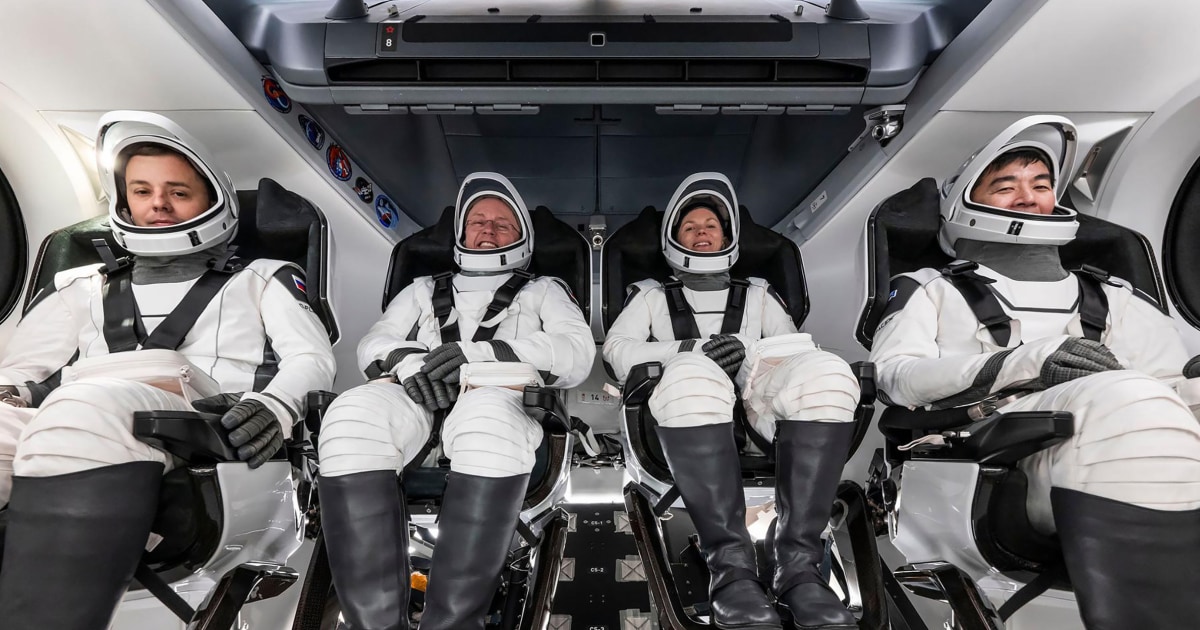
WASHINGTON — NASA plans to bring four astronauts back to Earth ahead of schedule from the International Space Station after one crew member encountered a medical issue in orbit, marking a historic first for the orbiting laboratory's 25-year operations.
The agency announced late Friday that the Crew-11 mission, which launched in early August, will undock from the ISS no earlier than 5 p.m. ET on Wednesday, weather permitting at the splashdown site off California's coast. If the timeline holds, the astronauts are expected to return via a SpaceX Dragon capsule, splashing down in the Pacific Ocean approximately 11 hours later, around 3:40 a.m. ET on Thursday. NASA and SpaceX will provide more precise details on landing time and location closer to the event.
Officials emphasized that the early return is precautionary rather than an emergency. In a Thursday news briefing, NASA Administrator Jared Isaacman explained the decision, stating, “After discussions with chief health and medical officer Dr. JD Polk and leadership across the agency, I’ve come to the decision that it’s in the best interest of our astronauts to return Crew-11 ahead of their planned departure.” The crew had originally been slated to remain on the station until late February, conducting a range of scientific experiments and maintenance tasks.
The affected astronaut's identity and the specifics of the medical issue remain undisclosed, in line with NASA's commitment to medical privacy. Agency representatives described the situation as stable during the briefing, noting that the crew member received appropriate care aboard the ISS. This incident underscores the challenges of long-duration spaceflight, where even minor health concerns can prompt swift action to ensure safety.
The returning crew includes NASA astronauts Zena Cardman and Mike Fincke, Japanese astronaut Kimiya Yui, and Russian cosmonaut Oleg Platonov. Cardman, a geobiologist selected in NASA's 2017 astronaut class, and Fincke, a veteran of multiple spaceflights including a previous ISS stint, represent the U.S. segment of the team. Yui, from the Japan Aerospace Exploration Agency, brings expertise in robotics and engineering, while Platonov, a Roscosmos cosmonaut, contributes to international collaboration efforts on the station.
Crew-11's arrival in early August extended the multinational partnership that has sustained the ISS since its assembly began in 1998. The station, a collaborative project involving NASA, Roscosmos, the European Space Agency, JAXA, and Canada's space agency, orbits about 250 miles above Earth, serving as a platform for microgravity research in fields like biology, physics, and human health. This mission was part of NASA's Commercial Crew Program, which relies on private companies like SpaceX to ferry astronauts, reducing costs and increasing flight frequency compared to the retired Space Shuttle era.
The Dragon capsule, the same one that carried the crew to the station, has proven reliable in previous missions, with splashdowns typically occurring in the Gulf of Mexico or off Florida's coast. However, for this return, NASA selected a Pacific site to align with weather forecasts and recovery logistics. Post-splashdown, the astronauts will undergo medical evaluations and a period of readjustment to Earth's gravity, a standard procedure after extended stays in space.
Following Crew-11's departure, the ISS will operate with a reduced U.S. presence for several weeks. NASA flight engineer Chris Williams, who arrived via a Russian Soyuz spacecraft on November 27, will remain to oversee American science experiments and station operations. He will be joined by Russian cosmonauts Sergey Kud-Sverchkov and Sergei Mikaev, ensuring continuity in the station's daily activities, including life support systems and research payloads.
This temporary skeleton crew highlights the interdependent nature of ISS operations, where U.S. and Russian segments work in tandem despite geopolitical tensions. Williams' Soyuz launch was part of ongoing agreements to maintain balanced crews, with Russia providing seats on its vehicles in exchange for NASA support on the station's power and propulsion modules.
The medical incident prompting the early return is unprecedented in the ISS's history. While astronauts have faced health challenges before—such as vision impairments from fluid shifts in microgravity or injuries during spacewalks—no previous mission has been abbreviated solely due to an in-orbit medical event. NASA has long prepared for such scenarios through rigorous pre-flight screening, onboard medical kits, and telemedicine consultations with ground-based physicians.
Broader context reveals NASA's evolving approach to crew health amid plans for deeper space exploration. The agency is investing in advanced monitoring technologies for future Artemis lunar missions and Mars voyages, where medical evacuations would be impossible. Incidents like this one provide valuable data for refining protocols, even as officials stress that the current case does not indicate systemic flaws in astronaut preparation.
Looking ahead, the next rotation, Crew-12, is scheduled for launch in mid-February aboard another SpaceX Dragon. Isaacman indicated during the briefing that NASA is assessing whether to accelerate this mission to restore full staffing levels sooner. “We will evaluate the timeline for Crew-12 based on operational needs and crew readiness,” he said, without committing to changes.
The decision to expedite Crew-11's return also reflects NASA's priority on astronaut welfare over mission duration. With the ISS certified for operations through at least 2030, the agency can afford such adjustments without disrupting long-term research goals. Scientists aboard the station have already completed key experiments during Crew-11's tenure, including studies on plant growth in space and combustion behavior in microgravity, results of which will bolster future missions.
As the undocking approaches, NASA teams on the ground are coordinating with SpaceX for a smooth separation and reentry. Live coverage of the event is expected on NASA Television and the agency's website, allowing the public to follow the historic early return. For the astronauts, the abrupt end to their mission means forgoing planned activities, but it ensures their safe homecoming after months in orbit.
This event serves as a reminder of the human element in space exploration, where health considerations can override scientific timelines. As NASA pushes boundaries toward the Moon and beyond, such precautionary measures will likely become more routine, balancing ambition with the fragility of life in extreme environments.