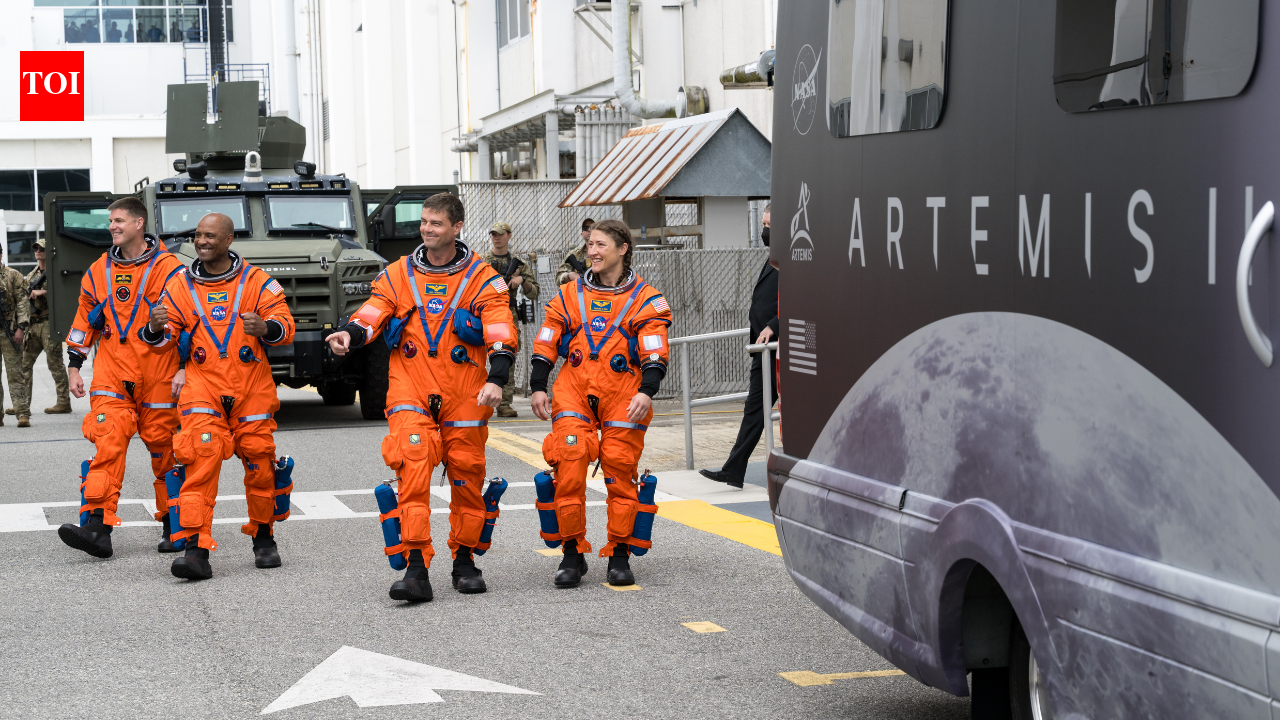
APPLETON, Wis. — As NASA's Artemis II mission draws to a close after a historic journey around the Moon, anticipation is building for the crew's return to Earth on April 10. The four astronauts aboard the Orion spacecraft — commander Reid Wiseman, pilot Victor Glover, mission specialist Christina Koch, and mission specialist Jeremy Hansen from the Canadian Space Agency — are set to splash down in the Pacific Ocean, marking the culmination of the first crewed Artemis flight since the Apollo era.
According to reports from the Times of India, the mission, which launched on an unspecified date earlier this year, has been a groundbreaking voyage orbiting the Moon, testing critical systems for future lunar landings. The splashdown is scheduled for early morning hours Eastern Time, with NASA planning extensive live coverage to allow the public to witness the homecoming. Officials at NASA have emphasized the significance of this return, calling it the 'most exciting part' of the mission.
The Artemis program, NASA's ambitious effort to return humans to the Moon and establish a sustainable presence there, has seen Artemis II as a pivotal step. Unlike the uncrewed Artemis I in 2022, which successfully orbited the Moon, this mission carries a diverse crew representing international partnerships. The spacecraft, powered by NASA's Space Launch System rocket, has been in space for approximately 10 days, conducting experiments and verifying life support systems essential for longer-duration trips.
Live streaming of the splashdown will be available through multiple platforms, NASA officials said. Coverage is expected to begin around 6 a.m. ET on NASA's website, YouTube channel, and television partners like ABC and NBC. The exact location of the splashdown remains in the South Pacific, near the recovery ship USS Michael Monsoor, where Navy teams will assist in retrieving the capsule and crew.
"This mission has pushed the boundaries of human spaceflight," NASA Administrator Bill Nelson stated in a pre-return briefing, according to agency transcripts. "The safe return of our astronauts will not only celebrate their achievements but also pave the way for Artemis III, our first lunar landing with humans in over 50 years." Nelson's comments highlight the program's goals of landing the first woman and person of color on the Moon by 2026.
The crew's journey included a flyby of the Moon at an altitude of about 80 miles, providing stunning views and data collection on radiation exposure and spacecraft performance. Mission control at NASA's Johnson Space Center in Houston has monitored the descent trajectory closely, adjusting for any orbital perturbations. Reports indicate the Orion capsule separated from its service module earlier today, initiating the reentry sequence that will see it endure temperatures up to 5,000 degrees Fahrenheit.
International collaboration has been a cornerstone of Artemis II. Jeremy Hansen, the first Canadian to venture beyond low-Earth orbit, has shared insights on the mission's global implications. "Orbiting the Moon was a profound experience, reminding us of our place in the cosmos," Hansen said in a downlink interview relayed through Canadian media outlets. His participation underscores the Artemis Accords, signed by over 40 nations, aiming to foster peaceful space exploration.
While the primary source from the Times of India focuses on streaming details, cross-verification with NASA's official channels confirms the April 10 timeline, though exact times may shift based on weather and technical factors. Backup recovery sites are prepared in case of deviations, including options in the Atlantic Ocean. The recovery operation involves over 200 personnel, including divers and helicopters, to ensure a swift and safe extraction of the crew from the water.
Background on the Artemis program reveals years of development amid challenges, including delays from technical issues with the Orion heat shield identified after Artemis I. Congress has allocated billions for the initiative, with critics in some reports questioning costs exceeding $4 billion per launch. However, supporters, including Space Policy experts, argue the investment yields advancements in technology transferable to Mars missions.
The splashdown ceremony will include a welcome aboard the recovery ship, followed by medical checks and a flight back to the U.S. The astronauts are reported to be in good health, with no major incidents during the mission. Family members, including Wiseman's wife and children, are awaiting their arrival in Houston, where a hero's welcome is planned.
From a scientific perspective, data gathered during the lunar orbit will inform future missions, particularly regarding deep-space radiation and microgravity effects on the human body. Koch, a veteran of long-duration stays on the International Space Station, has been key in these experiments. "Every moment has been invaluable for understanding how we adapt to space," she remarked in a mission log, as quoted in NASA updates.
Glover, who previously flew on SpaceX's Crew-1 mission, brings experience in spacecraft handling. His role as pilot involved critical maneuvers during the trans-lunar injection. The crew's diversity — two Americans, one woman, one international partner — reflects NASA's push for inclusive exploration.
As the capsule reenters the atmosphere, creating a fiery streak visible from parts of the Pacific, viewers worldwide can tune in. The Times of India article specifies that streams will include real-time commentary from mission experts, enhancing the educational value. This event comes at a time when private companies like SpaceX are also advancing crewed missions, though Artemis remains government-led.
Looking ahead, the success of Artemis II sets the stage for Artemis III, targeted for late 2025, involving a landing near the Moon's south pole with SpaceX's Starship. Challenges remain, including integrating commercial landers and addressing geopolitical tensions in space policy. Yet, the program's momentum suggests a new era of lunar exploration is underway.
In the broader context, this return evokes memories of Apollo 11's 1969 splashdown, but with modern twists like sustainable goals and international buy-in. As the world watches, the Artemis II crew's homecoming symbolizes humanity's enduring quest to explore the stars, one safe landing at a time.