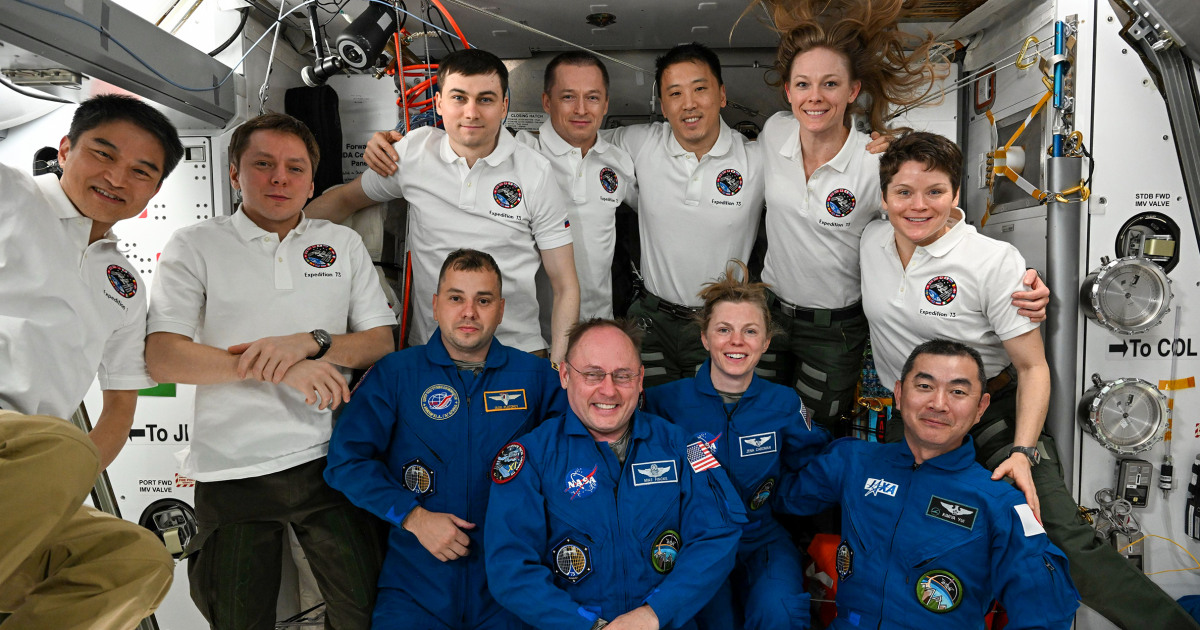
In a historic and precautionary move, four astronauts departed the International Space Station on Wednesday evening, weeks ahead of schedule, due to a medical issue affecting one of the crew members. The crew, consisting of NASA astronauts Zena Cardman and Mike Fincke, Japanese astronaut Kimiya Yui, and Russian cosmonaut Oleg Platonov, undocked from the orbiting laboratory at 5:20 p.m. ET aboard their SpaceX Dragon capsule, named Endeavour. Their return journey is set to conclude with a splashdown in the Pacific Ocean off the coast of California at approximately 3:41 a.m. ET on Thursday, marking the first time in the space station's 25-year history that a mission has been abbreviated because of an in-orbit medical problem.
The decision to bring the Crew-11 astronauts home early underscores NASA's commitment to crew safety, even as officials emphasized that the situation is stable and not an emergency. NASA has withheld specifics about the affected crew member or the nature of the medical issue, citing privacy concerns. According to agency statements, the move allows for comprehensive medical evaluations on Earth, where advanced diagnostic tools are available. The astronauts, who launched to the station in August, were originally slated to remain until late February, conducting a range of scientific experiments and maintenance tasks.
As the Dragon capsule separated from the station, SpaceX mission controllers radioed a farewell: “Endeavour Crew, enjoy the ride home.” The nearly 11-hour trip back to Earth will involve a deorbit burn to slow the spacecraft, followed by its descent through the atmosphere and a parachute-assisted landing in the ocean. On Tuesday, the crew spent their final full day in orbit packing cargo into the capsule and reviewing procedures, though the Dragon is engineered for autonomous flight during undocking and reentry.
Mike Fincke, the mission commander, addressed the situation in a LinkedIn post over the weekend, reassuring the public about the crew's well-being. “First and foremost, we are all OK,” Fincke wrote. “Everyone on board is stable, safe, and well cared for. This was a deliberate decision to allow the right medical evaluations to happen on the ground, where the full range of diagnostic capability exists. It’s the right call, even if it’s a bit bittersweet.” His words highlighted the measured approach taken by NASA, balancing operational needs with health priorities.
The medical incident came to light last week when NASA announced the cancellation of a planned spacewalk. Cardman and Fincke were scheduled to perform upgrades to the station's exterior, but the agency opted to prioritize the crew member's health instead. Days later, officials confirmed the early return as a precautionary step. NASA Administrator Jared Isaacman explained the rationale in a statement on Thursday: “After discussions with chief health and medical officer Dr. JD Polk and leadership across the agency, I’ve come to the decision that it’s in the best interest of our astronauts to return Crew-11 ahead of their planned departure.”
This unprecedented departure leaves the International Space Station with a reduced crew for the immediate future. NASA flight engineer Chris Williams and two Russian cosmonauts, including newly appointed commander Sergey Kud-Sverchkov, will remain onboard to continue operations. In a change-of-command ceremony on Monday, Fincke formally handed over leadership to Kud-Sverchkov. “Sergey, it’s an honor and a pleasure to be a commander, and I cannot imagine being happier than to hand over command to you,” Fincke said during the event. He described the early end to the mission as “interesting times” but reflected positively on the collaborative spirit aboard the station.
“We’re from all over the planet, and we’re working together,” Fincke added. “It’s a great symbol of what human beings can do.” The ceremony served as a poignant transition, emphasizing the international partnerships that have sustained the space station since its assembly began in 1998. The outpost, a collaborative effort involving NASA, Roscosmos, JAXA, the European Space Agency, and Canada, has hosted continuous human presence for over two decades, hosting more than 260 people from 20 countries.
The early return of Crew-11 means Williams will be the sole NASA representative overseeing U.S. science experiments and station maintenance for several weeks. NASA officials are now evaluating ways to accelerate the launch of the next rotation, Crew-12, currently targeted no earlier than February 15. That mission, also aboard a SpaceX Dragon, will bring three new astronauts to the station, helping to restore full staffing levels. In the interim, the reduced crew will focus on essential tasks, including ongoing research in microgravity that benefits fields from medicine to materials science.
The Dragon capsule's reliability has been a key factor in this scenario. SpaceX has flown 13 crewed missions to the station since 2020, providing NASA with a dependable alternative to the retired Space Shuttle program. The vehicle's autonomous capabilities allowed the Crew-11 astronauts to prepare for departure with relative ease, even under shortened timelines. Recovery teams from NASA and SpaceX will be on hand for the splashdown, ready to extract the crew from the capsule and begin post-flight medical checks.
Background on the astronauts reveals a diverse team with extensive experience. Zena Cardman, a geologist selected in NASA's 2017 astronaut class, was on her first spaceflight, eager to contribute to geological studies from orbit. Mike Fincke, a veteran of three previous long-duration missions, brought leadership honed from over 370 days in space. Kimiya Yui, representing JAXA, has prior station experience from 2015, while Oleg Platonov, from Roscosmos, added expertise in Russian segment operations. Their synergy was evident in the mission's achievements before the medical hiccup, including experiments on plant growth and fluid dynamics.
The incident also prompts questions about medical preparedness in space. While NASA has advanced telemedicine capabilities, including ultrasound devices and remote consultations with ground-based physicians, the limitations of orbit are clear. Officials have long planned for such contingencies, with protocols for everything from minor ailments to more serious conditions. This event, though not an emergency, tests those systems and may inform future missions, including NASA's Artemis program aiming for lunar returns.
Broader implications extend to international cooperation. The space station's multinational crew exemplifies diplomacy in low Earth orbit, even amid geopolitical tensions. Russia's continued participation, despite conflicts on Earth, highlights the station's role as a diplomatic outlier. With Crew-11's departure, the remaining team must navigate solo shifts, but NASA expressed confidence in their abilities.
Looking ahead, the splashdown will cap a mission that, despite its abrupt end, advanced NASA's goals. Recovery operations will include helicopter transport to shore, followed by quarantine and debriefing at Johnson Space Center in Houston. The astronauts' experiences, including the medical decision, will likely shape training for future crews. As the Dragon hurtles toward Earth, it carries not just four spacefarers, but lessons for humanity's next steps beyond our planet.
In the end, this story of prudence over peril reaffirms the human element in space exploration. Fincke's bittersweet reflection captures the essence: a mission cut short, yet rich in accomplishment and unity. As Crew-11 approaches home, the space station endures, a beacon of what's possible when nations look skyward together.