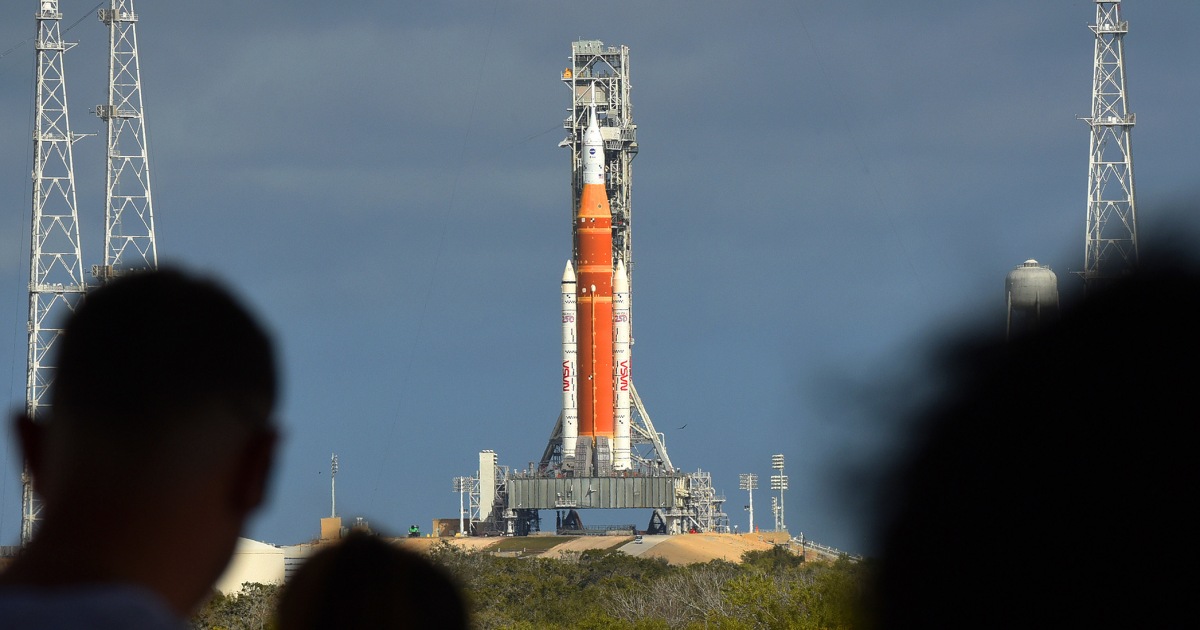
CAPE CANAVERAL, Fla. — As NASA edges closer to its ambitious return to the moon, the space agency is gearing up for a pivotal test that could determine the fate of its next crewed lunar mission. On Monday evening, engineers at the Kennedy Space Center will conduct a "wet dress rehearsal" for the Artemis II rocket, loading more than 700,000 gallons of cryogenic propellant into the massive Space Launch System (SLS) booster in a full-scale simulation of launch day procedures.
The rehearsal, set to culminate in a simulated countdown to 9 p.m. ET, represents the final major hurdle before NASA commits to a liftoff date for Artemis II, which is targeted no earlier than Sunday. This 10-day mission will carry four astronauts — NASA’s Reid Wiseman, Christina Koch, and Victor Glover, along with Canadian Space Agency astronaut Jeremy Hansen — on a historic trajectory around the moon, venturing farther from Earth than any humans have traveled since the Apollo era.
"We’ll take some time after wet dress, we’ll review the data, and then we’ll set up for our launch attempt," Artemis launch director Charlie Blackwell-Thompson said during a news briefing last month. Her comments underscore the high stakes: a smooth test could pave the way for a launch announcement in the coming days, while any glitches might push the mission into March or April.
The wet dress rehearsal is no mere formality. It involves fueling the SLS rocket — standing taller than the Statue of Liberty — with super-chilled liquid hydrogen and oxygen, then running through the countdown sequence up to about 30 seconds before ignition. Mission managers plan to pause and resume the clock multiple times in the final 10 minutes, allowing teams to scrutinize the rocket’s automated systems designed to assume control during the critical pre-launch phase.
This practice run comes after NASA rolled the fully stacked SLS rocket, topped with the Orion crew capsule, to Launch Pad 39B on Jan. 17. The agency had initially scheduled the rehearsal for Saturday but delayed it due to a brutal cold snap that gripped the Southeast and mid-Atlantic regions over the weekend. Frigid temperatures, dipping well below normal for Florida, prompted officials to scrub the first two launch opportunities in January’s window, which runs through Feb. 11.
The crew, meanwhile, has been in quarantine at NASA’s Johnson Space Center in Houston for the past week and a half to safeguard their health. Wiseman, the mission commander, Koch, the pilot, Glover, the mission specialist, and Hansen will not only orbit the moon but also test Orion’s life support and communication systems in deep space — a crucial validation for future lunar landings.
Artemis II marks the first human flight for both the SLS rocket and Orion capsule, building on the success of the uncrewed Artemis I mission in late 2022. That test flight looped around the moon and splashed down in the Pacific Ocean after 25 days, demonstrating the hardware’s endurance but also highlighting potential pitfalls. During Artemis I’s own wet dress rehearsal, hydrogen leaks forced a six-month delay and a rollback of the rocket to the Vehicle Assembly Building for repairs.
Engineers are acutely aware of those past issues. If Monday’s test reveals similar problems, NASA may have no choice but to repeat the process, potentially derailing the January timeline. "The results will allow engineers and mission managers to assess the performance and readiness of the booster," according to NASA officials, emphasizing the test’s role in ironing out any unforeseen anomalies.
The broader Artemis program aims to establish a sustainable human presence on the moon by the end of the decade, with Artemis III slated to land the first woman and person of color on the lunar surface as early as 2026. Artemis II serves as the critical bridge, proving that the SLS-Orion stack can safely transport astronauts beyond low-Earth orbit for the first time in over 50 years.
Weather remains a wildcard. The cold front that postponed the rehearsal has largely passed, but NASA meteorologists will monitor conditions closely. Launch windows are constrained by orbital mechanics and safety protocols, leaving little room for error if additional delays arise.
For the astronauts, the anticipation is palpable. The crew has undergone rigorous training, including simulations of lunar flybys and emergency scenarios. Hansen, representing international partners in the Artemis Accords, brings a unique perspective as the first non-American to venture so far from home on a NASA-led mission.
At the Kennedy Space Center, teams of technicians have been working around the clock. The SLS, powered by four RS-25 engines and two solid rocket boosters, generates more thrust than the Saturn V that carried Apollo astronauts. Yet, its complexity demands precision; even minor propellant flow irregularities could scrub the launch.
If the rehearsal succeeds, NASA could target a Feb. 2 liftoff, aligning with the current window. Officials have contingency plans extending into spring, but the agency is eager to maintain momentum. The Artemis program’s budget has ballooned to billions, with congressional oversight ensuring every milestone counts.
Looking ahead, a successful Artemis II would not only boost morale but also validate partnerships with private companies like Boeing and Lockheed Martin, which built key components. It sets the stage for deeper space exploration, including eventual Mars missions. As Blackwell-Thompson noted, the data from this test will be scrutinized meticulously to ensure the crew’s safety.
In the end, Monday’s wet dress rehearsal stands as a testament to NASA’s methodical approach. With the world watching, the outcome could accelerate humanity’s return to the moon or serve as a sobering reminder of the challenges in conquering space.