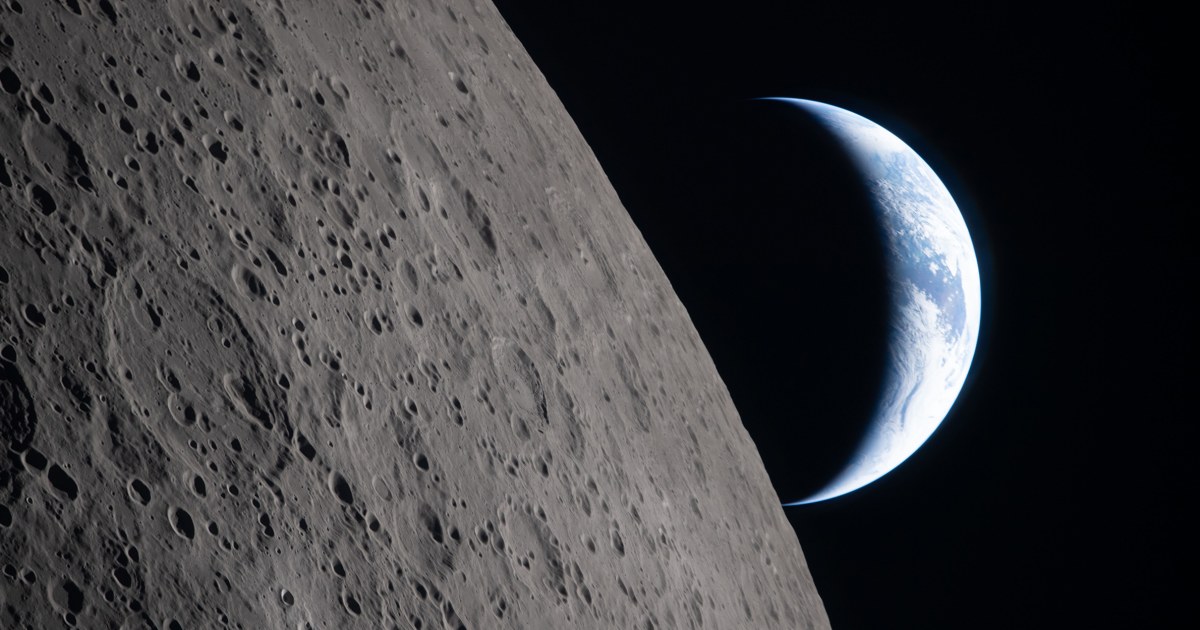
In a stunning release that has captivated space enthusiasts worldwide, NASA unveiled thousands of new photographs from the recent Artemis II mission over the weekend, offering unprecedented glimpses of the moon's far side and Earth's distant silhouette. The agency shared more than 12,000 images captured during the 10-day journey, which marked humanity's return to lunar exploration after more than five decades. Among the highlights are dramatic close-ups of the moon's cratered surface and ethereal views of a solar eclipse observed from lunar orbit, providing scientists with fresh data on the celestial body's ancient geology.
The Artemis II crew, consisting of NASA astronauts Reid Wiseman, Christina Koch, and Victor Glover, along with Canadian Space Agency astronaut Jeremy Hansen, lifted off on April 1 aboard NASA's powerful Space Launch System rocket and Orion spacecraft. This mission was the first crewed flight for both the SLS and Orion, designed primarily to test their capabilities in deep space ahead of future lunar landings. Launched from Kennedy Space Center in Florida, the astronauts embarked on a trajectory that took them farther from Earth than any humans before, looping around the moon in a flyby that pushed the boundaries of human exploration.
According to NASA officials, the mission's success paves the way for the more ambitious Artemis III, slated for launch next year. That follow-on effort will incorporate additional technologies, including new vehicles essential for achieving a crewed landing on the lunar surface by 2028. The long-term vision, as outlined by the agency, involves establishing a sustainable human presence on the moon, potentially including a surface base to support ongoing scientific research and preparation for Mars missions.
During the pivotal lunar flyby on April 6, the crew ventured to the moon's far side, a region perpetually hidden from Earth due to tidal locking. For roughly seven hours, Wiseman, Koch, Glover, and Hansen documented features never before witnessed by human eyes, including the rugged topography along the moon's terminator—the boundary between its sunlit and shadowed hemispheres. They focused on jagged ridges, ancient lava flows, and massive craters formed by asteroid impacts billions of years ago, capturing images that reveal the moon's violent formative history.
"The Artemis II images of craters, ridges and ancient lava flows on the moon’s surface could help scientists better understand its topography and how it formed," NASA has said in a statement accompanying the photo release. These visuals, sharper and more detailed than those from previous robotic probes, are expected to aid in modeling the moon's geological evolution and identifying potential resources for future habitats.
One of the mission's most remarkable moments came when the astronauts witnessed and photographed a solar eclipse from the lunar vantage point. As the sun aligned behind the moon from their perspective, the photos depict a darkened lunar disk encircled by the sun's glowing corona, the outer atmosphere visible in fiery tendrils. This event, the first of its kind observed by humans from space near another world, added a poetic dimension to the scientific endeavor, blending awe with data collection.
The crew's observations extended beyond photography to hands-on experiments, including detailed studies of the moon's surface features during the flyby. Hansen, representing international collaboration through the Artemis Accords, contributed to assessments of the far side's potential for future landings. Meanwhile, Wiseman, as mission commander, coordinated the team's efforts to ensure all objectives were met within the tight timeframe of their orbital pass.
After completing their lunar loop, the Orion capsule began its return journey, re-entering Earth's atmosphere and splashing down in the Pacific Ocean off the coast of San Diego on April 10. Recovery teams from NASA and the U.S. Navy swiftly retrieved the astronauts and spacecraft, confirming the mission's safe conclusion. Post-flight analyses have already begun, with engineers poring over telemetry data to refine designs for upcoming flights.
The release of these 12,000-plus images builds on an initial batch shared shortly after the mission, but the new trove includes enhanced views and previously unseen angles. Dramatic perspectives of the moon's pockmarked terrain dominate the collection, showcasing countless craters that tell stories of cosmic collisions eons ago. Earth appears as a fragile blue marble winking in the void, a reminder of the mission's achievement in venturing 240,000 miles from home.
Experts in planetary science have praised the quality of the photographs, noting their value for ongoing research. While robotic missions like China's Chang'e series have imaged the far side, the human perspective from Artemis II offers unique insights, combining real-time annotations from the crew with high-resolution visuals. This blend could accelerate discoveries about the moon's subsurface ice deposits and volcanic history.
The Artemis program's momentum comes at a time of renewed global interest in space, with competitors like SpaceX and international partners vying for lunar footholds. NASA's collaboration with Canada, Europe, and Japan underscores a multilateral approach, contrasting with more unilateral efforts elsewhere. Yet, challenges remain, including budget constraints and technical hurdles for the 2028 landing goal.
Looking ahead, the photos serve not just as scientific assets but as inspirational tools. Public reaction has been overwhelmingly positive, with social media buzzing about the eclipse images and far-side vistas. Educators are already incorporating the material into curricula, fostering the next generation of explorers.
As NASA processes the full dataset, anticipation builds for Artemis III's preparations. With the SLS rocket proving reliable and Orion's life-support systems performing flawlessly, the path to the lunar surface seems clearer. The agency's ultimate aim—a permanent lunar outpost—could transform humanity's relationship with our nearest neighbor, enabling leaps toward deeper space travel.
In reflecting on the mission, the crew's journey from launch to splashdown encapsulates decades of innovation. From the roar of liftoff to the quiet splendor of lunar shadows, Artemis II has reignited wonder about the cosmos. These newly released images ensure that the adventure continues to unfold, inviting the world to gaze upon the moon anew.