By Michael Thompson, The Appleton Times
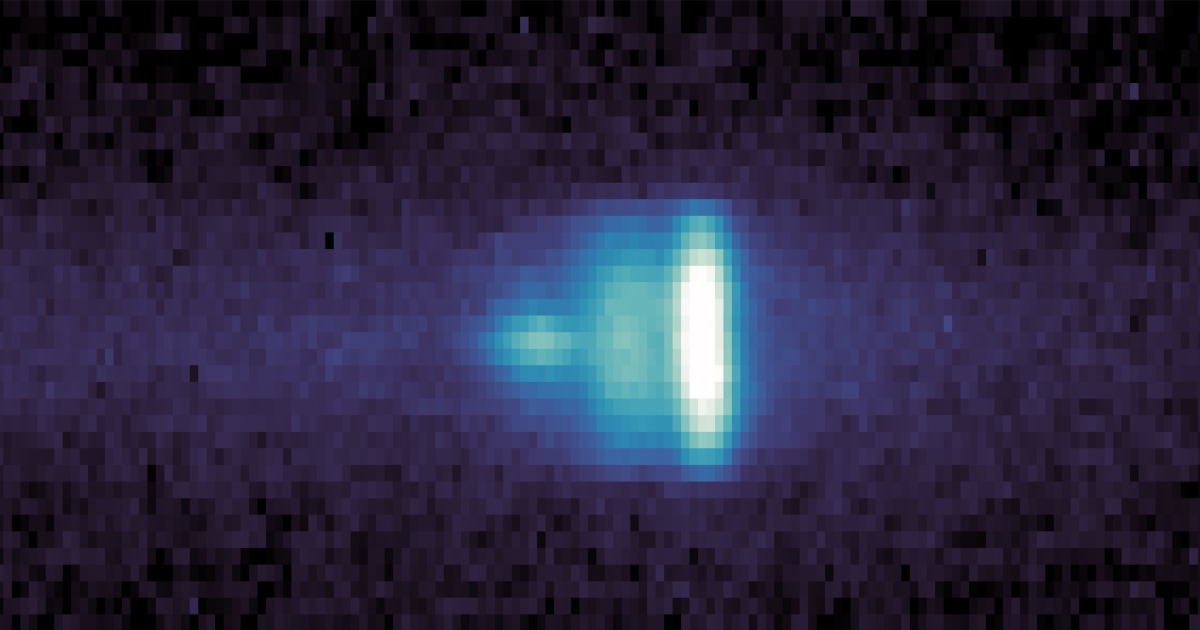
WASHINGTON — NASA unveiled a series of striking new images on Wednesday of the interstellar comet 3I/ATLAS, marking the third confirmed visitor from beyond our solar system to grace the inner reaches of our cosmic neighborhood. Captured by a fleet of NASA spacecraft as the comet made its closest approach to the sun in late October, the photos depict the object as a brilliant point of light enveloped in a hazy coma of gas and dust, with some shots revealing a faint, trailing tail that stretches like a ghostly smudge across the void.
The release of these long-anticipated images comes after a delay caused by the recent federal government shutdown, which halted operations at NASA and other agencies. According to NASA officials, the comet was first spotted in July by the ATLAS survey telescope in Chile, igniting excitement among astronomers worldwide due to its rare interstellar origins. Unlike the countless comets born within our solar system, 3I/ATLAS hails from another star system, offering a unique glimpse into the building blocks of distant worlds.
The images were gathered between late September and mid-October by several NASA missions, including the sun-observing PUNCH satellites, the Solar and Heliospheric Observatory (SOHO), the Mars Atmosphere and Volatile EvolutioN (MAVEN) orbiter, and even the Perseverance rover on the Martian surface. These vantage points, spanning from near-Earth orbit to the red planet, provide a multifaceted view of the comet's journey through the inner solar system. In one particularly evocative shot from SOHO, the comet appears as a luminous dot against the sun's corona, its tail faintly visible as it hurtles past at speeds exceeding 100,000 miles per hour.
Prior to 3I/ATLAS, only two other interstellar objects had been confirmed in our solar system: the enigmatic, cigar-shaped 'Oumuamua in 2017 and the comet 2I/Borisov in 2019. Both sparked intense scientific scrutiny and public fascination, with 'Oumuamua even fueling speculation about potential artificial origins due to its unusual shape and acceleration. 3I/ATLAS, however, has followed a more predictable path so far, behaving much like a typical comet as it sheds material while approaching the sun.
Despite the object's otherworldly provenance, NASA officials were quick to dismiss any notions of extraterrestrial technology during a briefing on Wednesday. "We certainly haven’t seen any techno signatures or anything from it that would lead us to believe it was anything other than a comet," said Nicky Fox, associate administrator of NASA’s Science Mission Directorate. Fox emphasized that all observations to date align with known comet dynamics, though the comet's unique composition could still reveal secrets about its home star system.
The intrigue surrounding 3I/ATLAS lies in its potential to bridge gaps in our understanding of planetary formation elsewhere in the galaxy. "It’s the differences that are so tantalizing for us," Fox added. "It could be from something that existed before our own solar system. That is so cool." Scientists hope to analyze the comet's chemical makeup — including isotopes of water, carbon, and other volatiles — to infer conditions in its natal environment, possibly billions of years old and light-years away.
Tom Statler, NASA’s lead scientist for solar system small bodies, echoed this sentiment, describing the comet as a "new scientific opportunity" and a "new window into the makeups and histories of other solar systems." He noted that researchers are still in the early stages of studying these rare intruders, grappling with fundamental questions about their trajectories and compositions. Tracing 3I/ATLAS's exact origin remains challenging, Statler said, as its hyperbolic orbit suggests it was ejected from another star system eons ago, wandering the interstellar medium before entering ours.
The comet reached perihelion — its closest point to the sun — at the end of October, passing within about 130 million miles of the star. This proximity caused it to brighten dramatically but also rendered it invisible from Earth-based telescopes due to the sun's glare. NASA expects 3I/ATLAS to reemerge into view by early December as it swings around the sun, heading outward on its outbound leg.
A notable milestone awaits on December 19, when the comet will make its closest approach to Earth at a distance of roughly 170 million miles — far too distant to pose any threat, according to agency calculations. This flyby will offer prime observing windows for telescopes around the world. The James Webb Space Telescope, with its infrared capabilities, is slated to turn its gaze toward the comet in December, potentially capturing detailed spectra of its gaseous emissions. Ground-based facilities, including the W.M. Keck Observatory in Hawaii, are also lining up observations to complement NASA's data.
International collaboration has already enriched the dataset. In early October, the European Space Agency released images from its ExoMars Trace Gas Orbiter, which orbits Mars. The probe, a joint project between ESA and Russia's Roscosmos, captured 3I/ATLAS as a bright white dot against the starry backdrop, at a separation of about 18.6 million miles. Those photos, taken as the comet buzzed past the red planet, highlighted its rapid motion and increasing activity as it warmed in the sunlight.
Amateur astronomers and citizen scientists have played a role too, with backyard telescopes contributing to the global monitoring effort since the comet's discovery. The initial detection by the Asteroid Terrestrial-impact Last Alert System (ATLAS) in July prompted a worldwide alert, leading to follow-up observations that confirmed its interstellar trajectory. Its path, inclined at about 30 degrees to the ecliptic plane, underscores its foreign nature, as solar system comets typically follow more aligned orbits.
While the government shutdown delayed the public release of NASA's images, it did not halt all data collection. Spacecraft like MAVEN and Perseverance continued autonomous operations, beaming back raw imagery and spectral data through NASA's Deep Space Network. "There will be more to come," Statler assured during the briefing. "Not all of the data have been downlinked yet through NASA’s Deep Space Network, and there are more observations still in works." Processing this influx will keep scientists busy for months, refining models of the comet's size — estimated at 1 to 2 miles across — and its outgassing behavior.
Beyond the immediate science, 3I/ATLAS's passage highlights the growing capability of space agencies to detect and study fleeting interstellar visitors. With surveys like ATLAS and the upcoming Vera C. Rubin Observatory set to scan the skies more comprehensively, experts anticipate discovering more such objects in the coming years. This could transform our view of the galaxy's dynamic exchanges, revealing how materials are shared between stars.
As 3I/ATLAS continues its outbound journey, fading from view by mid-2025, it leaves behind a treasure trove of data poised to answer long-standing questions about cosmic origins. For now, the images serve as a reminder of the universe's vast interconnectedness, where a single comet can connect Earth to the stars. NASA encourages public engagement through its website, where the new photos are available for download and exploration.
In the broader context of space exploration, this event coincides with renewed interest in comet missions, such as the European Space Agency's upcoming Comet Interceptor probe, designed specifically to rendezvous with future interstellar wanderers. While 3I/ATLAS slips away, its legacy may inspire the next generation of discoveries, underscoring humanity's enduring quest to understand our place in the cosmos.