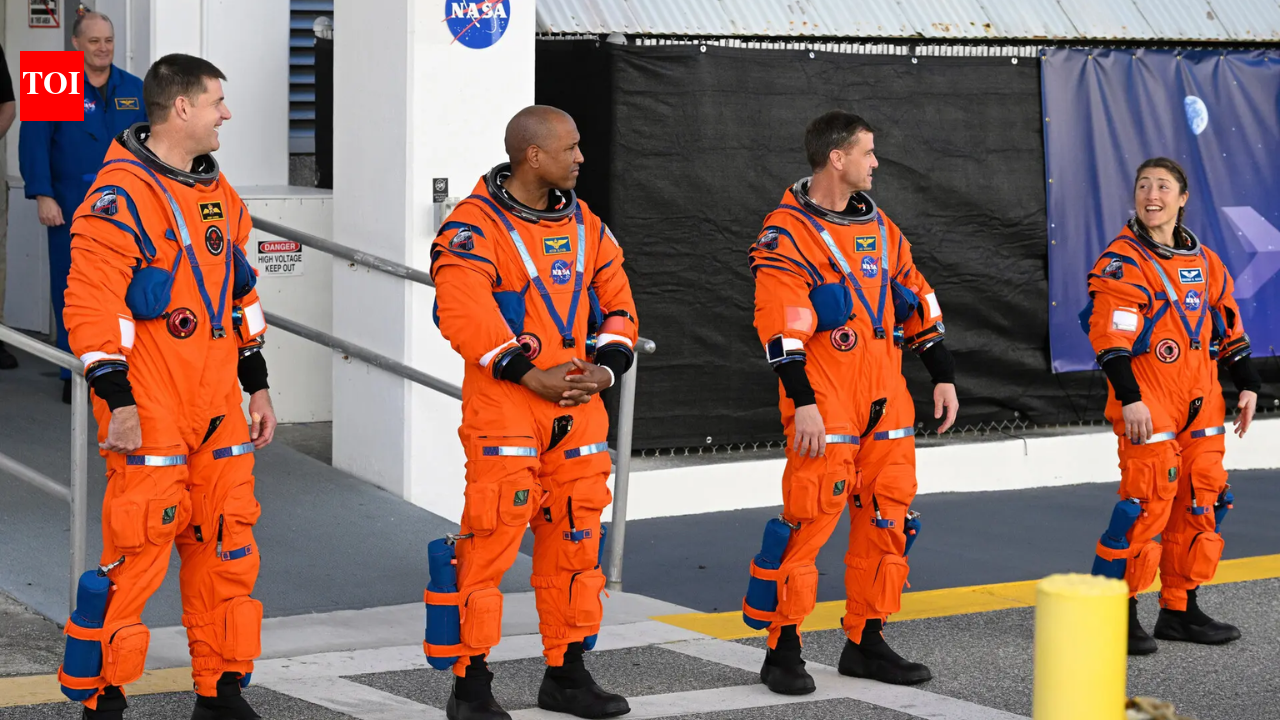
APPLETON, Wis. — The crew of NASA's Artemis II mission has achieved a significant milestone, entering the moon's gravitational sphere of influence early Monday morning and approaching what could be the farthest distance from Earth ever traveled by humans. The four astronauts aboard the Orion spacecraft — commander Reid Wiseman, pilot Victor Glover, mission specialist Christina Koch, and mission specialist Jeremy Hansen from the Canadian Space Agency — are on a 10-day journey that marks the first crewed flight test of NASA's next-generation deep space exploration program.
According to NASA officials, the spacecraft crossed into the moon's sphere of influence around 2 a.m. Eastern Time, a critical phase that allows the gravitational pull of the moon to assist in steering the vehicle along its trajectory. This maneuver positions the crew for a lunar flyby, where they will come within about 80 miles of the moon's surface before slingshotting back toward Earth. The mission, which launched on September 29 from Kennedy Space Center in Florida, is designed to test the Orion capsule's systems in deep space without landing on the lunar surface.
The Artemis II flight represents a pivotal step in NASA's ambitions to return humans to the moon for the first time since the Apollo 17 mission in 1972. Unlike the uncrewed Artemis I test flight in 2022, which successfully orbited the moon, this mission carries a diverse crew that includes the first woman, first person of color, and first international partner to venture beyond low Earth orbit. NASA Administrator Bill Nelson highlighted the historic nature of the journey in a pre-launch statement, saying, "Artemis II will send four brave astronauts — including the first woman and the first person of color — on a mission to the Moon. This flight will pave the way for Artemis III, which will see astronauts step foot on the lunar surface near the moon's South Pole."
As the spacecraft nears its farthest point, projected to be approximately 250,000 miles from Earth — surpassing the Apollo 13 record of 248,655 miles set in 1970 — the crew is conducting a series of scientific experiments and system checks. Mission Control at NASA's Johnson Space Center in Houston is monitoring the spacecraft's performance, with live updates streamed to the public via NASA's website. The crew has been communicating regularly with ground teams, providing insights into the experience of deep space travel.
Commander Reid Wiseman, a U.S. Navy test pilot with experience on the International Space Station, described the transition into lunar influence as "smooth and exhilarating" during a brief audio update broadcast Monday afternoon. "We're feeling the pull now, and it's a reminder of how vast and powerful our solar system is," Wiseman said. His words underscore the blend of routine operations and awe-inspiring exploration that defines the mission.
Pilot Victor Glover, who previously flew on SpaceX's Crew-1 mission to the ISS, emphasized the team's preparation. "We've trained for every scenario, from nominal flight to potential anomalies, and so far, everything is performing as expected," Glover reported from orbit. The crew's diversity is seen as a reflection of NASA's push for inclusive space exploration, with Glover noting in pre-mission interviews that his role inspires underrepresented communities back on Earth.
Mission specialist Christina Koch, who holds the record for the longest single spaceflight by a woman at 328 days on the ISS, brings expertise in human health research. During the flyby, she and her crewmates will observe Earth and the moon from a unique vantage point, capturing high-resolution images and conducting outreach events. Koch shared in a NASA blog post prior to launch, "This mission is about pushing boundaries, not just for us, but for future generations who will live and work in space."
Jeremy Hansen, the first Canadian to fly on a NASA-led deep space mission, represents international collaboration under the Artemis Accords, a framework signed by over 40 countries to promote peaceful lunar exploration. Hansen, a Royal Canadian Air Force colonel, has been involved in mission planning for years. In a statement from the Canadian Space Agency, he said, "Entering the moon's gravity is a moment we've all been waiting for — it's the gateway to new discoveries and partnerships in space."
The technical achievements of Artemis II build on lessons from Artemis I, where the Orion spacecraft demonstrated its heat shield and life support systems during a 25-day uncrewed trip. Engineers at Lockheed Martin, the prime contractor for Orion, reported no major issues during the crewed launch, though minor adjustments were made to the trajectory en route. "The spacecraft is handling the deep space environment beautifully," said a Lockheed Martin spokesperson in a press release Monday.
Background on the Artemis program reveals its roots in the Obama-era Constellation cancellation and the Trump administration's renewed focus on lunar return. Congress has allocated billions for the initiative, with Artemis II's budget exceeding $4 billion when combined with prior tests. Critics, including some space policy experts, have questioned the program's cost and timeline delays — Artemis II was originally slated for 2024 but slipped due to technical hurdles with the Space Launch System rocket.
Despite these challenges, supporters point to the mission's role in preparing for Artemis III, planned for 2026, which will attempt the first lunar landing since Apollo. That mission will include the first woman and person of color on the moon's surface, landing near the South Pole to explore water ice resources crucial for future Mars missions. NASA's partner SpaceX is developing the Starship Human Landing System for this purpose, though integration testing remains ongoing.
From a scientific standpoint, the flyby offers opportunities to study the moon's far side and radiation environment, data vital for long-duration spaceflight. The crew is deploying small instruments, including a solar wind monitor, to gather real-time information. Astrophysicist Dr. Sarah Noble, a NASA program scientist, explained in an interview, "This close pass will give us unprecedented views and measurements that inform not just lunar science, but our understanding of the entire heliosphere."
Public interest in Artemis II has been high, with millions tuning into the launch and ongoing coverage. Educational outreach includes virtual reality experiences and classroom resources distributed by NASA. In Appleton, local astronomy clubs hosted watch parties, drawing families eager to follow the mission's progress. "It's inspiring to see Wisconsin's own contributions through partnerships like the Universities Space Research Association," said local educator Maria Thompson, whose students tracked the spacecraft's path using online simulators.
Looking ahead, the crew is scheduled to perform a manual docking simulation and engine burns to refine re-entry procedures. The mission is set to conclude with a splashdown in the Pacific Ocean off the California coast on October 9, where recovery teams from the U.S. Navy and NASA will retrieve the capsule. If successful, Artemis II will validate the pathway to sustainable lunar presence, including the Gateway space station orbiting the moon, construction of which begins with future flights.
The broader implications of this mission extend to global space competition, as China advances its own lunar program with the Chang'e missions, aiming for a crewed landing by 2030. NASA's international partnerships aim to counterbalance such efforts through shared technology and exploration goals. As the Artemis II crew hurtles toward their historic distance, they embody humanity's enduring quest to explore the cosmos, one gravitational milestone at a time.