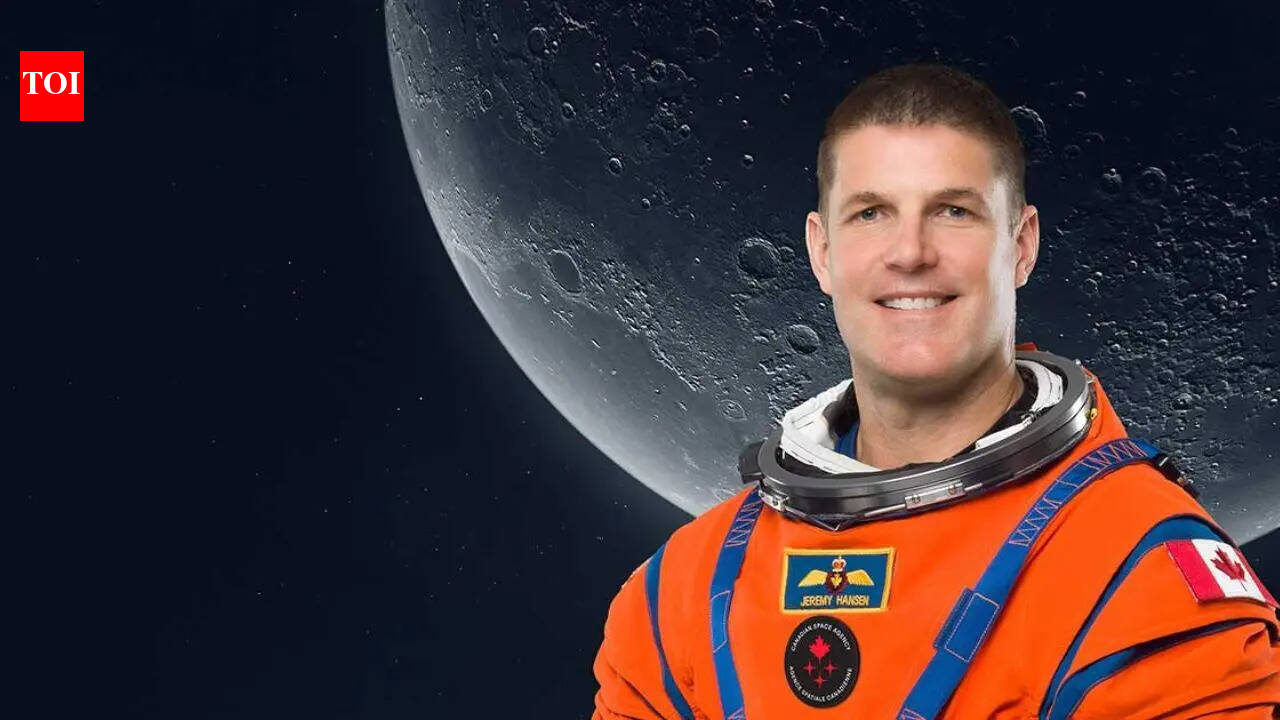
In a ceremony rich with tradition and anticipation, the crew of NASA's upcoming Artemis II mission has honored Canadian astronaut Jeremy Hansen with the prestigious 'astronaut gold pin,' a symbol of elite achievement in spaceflight. The event, held at NASA's Johnson Space Center in Houston, Texas, on October 15, 2024, marks a significant milestone not only for Hansen but also for international collaboration in space exploration. According to reports from the Times of India, this presentation underscores the historic role Canada is playing in the Artemis program, which aims to return humans to the Moon and pave the way for Mars missions.
The Artemis II mission, scheduled for launch no earlier than September 2025 aboard the Space Launch System rocket and Orion spacecraft, will be the first crewed flight test of NASA's deep space exploration vehicle. The four-person crew consists of NASA astronauts Reid Wiseman as commander, Victor Glover as pilot, and Christina Koch as mission specialist, alongside Hansen, who represents the Canadian Space Agency (CSA). This mission will orbit the Moon without landing, testing systems critical for future lunar explorations. Officials from NASA described the pin presentation as a moment of camaraderie and recognition ahead of the high-stakes journey.
Jeremy Hansen, a 47-year-old colonel in the Royal Canadian Air Force with a background in physics and operational research, was selected for the Artemis II crew in April 2020. His inclusion makes him the first Canadian to venture beyond low-Earth orbit, a point of national pride in Canada. 'This honor from my crewmates is deeply meaningful,' Hansen said in a statement released by the CSA following the ceremony. 'It reminds us of the shared legacy of spaceflight and the bonds that unite us in pushing the boundaries of human exploration.'
The 'astronaut gold pin' is a revered NASA tradition, awarded to astronauts who have completed spaceflight training and are on the cusp of their missions. Crafted from 14-karat gold and featuring the NASA insignia, the pin has been presented since the agency's early days, symbolizing the transition from preparation to execution. According to NASA historian Jennifer Ross-Nazzal, 'The gold pin is more than an award; it's a rite of passage that connects current astronauts to legends like Neil Armstrong and Sally Ride.' In Hansen's case, the crew presented the pin during a private gathering at the Johnson Space Center's Neutral Buoyancy Laboratory, where the team conducts underwater simulations of spacewalks.
The Times of India article highlights how this event heralds 'a new epoch' for the Artemis program and serves as 'a mark of tradition and accomplishment for Canada.' Canadian Prime Minister Justin Trudeau congratulated Hansen via social media, stating, 'Jeremy's journey to the Moon inspires all Canadians and strengthens our partnership with NASA. This is a proud moment for our nation.' The CSA echoed this sentiment, noting that Hansen's participation fulfills commitments under the Artemis Accords, an international agreement signed by 43 countries to promote peaceful space exploration.
Background on the Artemis program reveals its ambitious scope. Following the retirement of the Space Shuttle in 2011, NASA has been developing the SLS and Orion to enable sustainable lunar presence. Artemis I, the uncrewed test flight, successfully launched in November 2022, splashing down in the Pacific Ocean after 25 days in space. Artemis II builds on that success, with the crew expected to spend about 10 days in space, including a flyby of the Moon at an altitude of approximately 80 miles. NASA Administrator Bill Nelson emphasized the mission's importance in a recent briefing: 'Artemis II will be humanity's return to the Moon's vicinity, with a diverse crew ready to make history.'
While the ceremony was a highlight, it also comes amid ongoing preparations and challenges. The Orion spacecraft's heat shield, which endured extreme temperatures during Artemis I, is undergoing modifications based on post-flight analysis. Engineers at Kennedy Space Center in Florida are integrating the European Space Agency's service module, which provides propulsion and life support. According to a NASA update, these efforts are on track, though weather and technical reviews could adjust the launch date. The Times of India summary points to the mission as achieving 'an historic milestone,' aligning with NASA's narrative of progress.
Hansen's path to this honor is one of perseverance. A native of London, Ontario, he joined the CSA in 2009 after serving as a CF-18 fighter pilot. He has logged over 2,000 flight hours and contributed to international space station missions through simulations. His selection for Artemis II was announced during a White House ceremony, where then-President Donald Trump praised the international aspect. 'Canada's expertise in robotics and science is invaluable,' a CSA spokesperson said at the time. Hansen has since undergone rigorous training, including survival exercises in Russia's Star City and centrifuge simulations to prepare for launch forces up to 4Gs.
The crew's dynamics were evident during the pin presentation. Wiseman, who commanded the 2022 Crew-4 mission to the International Space Station, handed Hansen the pin, saying, 'Jeremy, you've earned this with your dedication and skill. We're all in this together.' Glover, a veteran of the 2020 SpaceX Crew-1 mission, added, 'This pin represents the trust we have in each other for the long haul to the Moon.' Koch, who holds the record for the longest single spaceflight by a woman at 328 days on the ISS, represented the growing role of women in deep space. Their comments, reported by NASA, reflect the team's cohesion forged through months of joint training.
Broader context includes the geopolitical landscape of space. The U.S.-led Artemis program contrasts with China's lunar ambitions, including its planned crewed landing by 2030. Russia, amid tensions with the West, has partnered with China on the International Lunar Research Station. However, the Artemis Accords emphasize transparency and interoperability, with Canada playing a key role through contributions like the Canadarm3 robotic system for the Gateway lunar station. Experts say Hansen's mission could inspire STEM education in Canada, where space funding has increased by 20% since 2019.
Looking ahead, Artemis II's success will inform Artemis III, targeted for 2026, which aims to land the first woman and person of color on the Moon near the lunar south pole. The mission's trajectory will include high-resolution photography of the Moon's far side and tests of communication systems for deep space. If delays occur, as with previous NASA timelines, backup dates extend into 2026. 'We're preparing for every contingency,' said Mission Operations Director Cliff Lanham in a Johnson Space Center press conference.
The honoring of Hansen also spotlights diversity in spaceflight. As the first non-U.S. citizen on an Artemis crewed mission, his role challenges the historically American-dominated narrative. Indigenous leaders in Canada have noted the symbolic timing, aligning with reconciliation efforts. 'Jeremy carries the spirit of exploration that resonates with our First Nations' stories of the stars,' said a representative from the Assembly of First Nations.
In summary, the astronaut gold pin presentation is a poignant prelude to Artemis II's bold objectives. As the crew continues simulations and final integrations at Kennedy Space Center, the world watches closely. This event not only celebrates Hansen's achievement but also reinforces the global partnership essential for humanity's next giant leap. With the Moon in sight, NASA's Artemis era is truly underway, promising discoveries that could reshape our understanding of the solar system.
The implications extend to commercial space, with companies like SpaceX and Blue Origin vying for lunar lander contracts. NASA's budget for Artemis, at $4.1 billion for fiscal year 2024, supports thousands of jobs across 50 states and international partners. For Canada, the mission boosts its space industry, valued at $5 billion annually. As Hansen prepares, his words encapsulate the mission's ethos: 'We're not just going to the Moon; we're going there to stay and explore further.'