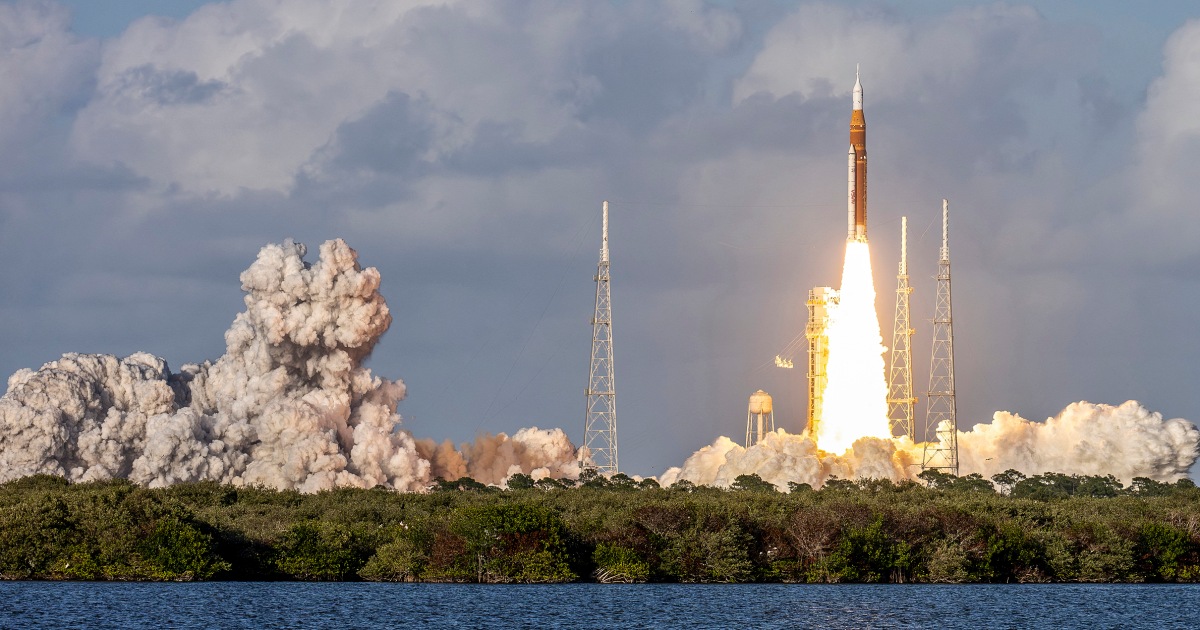
CAPE CANAVERAL, Fla. — NASA's Artemis II mission, the agency's first crewed voyage to the moon in more than half a century, lifted off successfully on Wednesday evening, marking a triumphant return to deep space exploration. The spacecraft, carrying astronauts Reid Wiseman, Christina Koch, and Victor Glover from NASA, along with Canadian Space Agency astronaut Jeremy Hansen, soared into the Florida sky aboard the massive Space Launch System rocket and Orion capsule. An estimated 250,000 spectators gathered along central Florida's coastlines and beaches to witness the historic launch, which proceeded smoothly despite a few minor technical hiccups during the countdown that were quickly resolved.
The mission represents a pivotal step in NASA's ambitious Artemis program, aimed at reestablishing a human presence on the lunar surface and paving the way for future Mars expeditions. After a 54-year hiatus since the Apollo 17 mission in 1972, this flight circles the moon without landing, serving as a critical test for the Orion spacecraft's systems under crewed conditions. "After a brief, 54-year intermission, NASA is back in the business of sending astronauts to the moon," said NASA Administrator Jared Isaacman during a post-launch briefing at Kennedy Space Center.
The crew's journey began with a flawless ascent through clear skies, the rocket's four core boosters and solid rocket boosters igniting in a spectacular display of power. This was the first time the Space Launch System, NASA's most powerful rocket ever built, carried human passengers. The Orion capsule separated from the rocket's upper stage about 90 minutes after liftoff, placing the astronauts into a stable orbit around Earth. From there, the team wasted no time diving into their extensive checklist of tasks designed to verify the spacecraft's readiness for longer deep-space missions.
For the initial 8½ hours in orbit, Wiseman, Koch, Glover, and Hansen focused on activating and testing essential onboard systems. This included the potable water dispenser, the spacecraft's toilet, and the air quality control mechanisms—mundane yet vital components that must perform flawlessly in the isolation of space. According to mission controllers, these early checks are foundational to ensuring crew safety during the mission's more demanding phases.
A key highlight of the early flight was a simulated docking procedure, where the crew practiced maneuvering the Orion capsule toward the Space Launch System's upper stage, now serving as a stand-in target. This exercise is particularly important for upcoming Artemis missions, which will require precise docking with commercial lunar landers developed by companies like SpaceX and Blue Origin. Those landers will ferry astronauts from lunar orbit to the moon's surface and back, a capability that Artemis II helps validate through demonstration.
Looking ahead, the mission's next major event is the trans-lunar injection burn, or TLI, scheduled for roughly 24 hours after launch—expected on Thursday. This engine firing will propel Orion out of Earth's gravity and onto a trajectory around the moon, committing the crew to a path from which there's no turning back without additional maneuvers. Flight operations teams convened earlier in the day to review spacecraft health data before greenlighting the burn. "We’re looking to make sure that the life-support systems work, the vehicle’s healthy," said Norm Knight, director of NASA’s Flight Operations Directorate, in remarks following the launch. "Once we commit to TLI, they have to function."
If the TLI proceeds as planned, the astronauts will spend the subsequent three days cruising toward the moon at speeds approaching 24,000 miles per hour. The spacecraft's trajectory will take it into a distant retrograde orbit, looping around the moon in the opposite direction of its travel relative to Earth. This path allows for efficient fuel use and maximizes time in deep space for testing.
The crew's most exhilarating milestone arrives on Monday, when Orion is set to perform a close flyby of the moon, passing within 4,000 to 6,000 miles of its cratered surface. At that distance, according to NASA, the moon will appear roughly the size of a basketball held at arm's length from the astronauts' vantage point inside the capsule. This approach will not only test the spacecraft's navigation and communication systems but also push the boundaries of human exploration.
During the flyby, the Artemis II team could shatter the record for the farthest distance traveled from Earth by humans, exceeding the 248,655 miles reached by the Apollo 13 crew in 1970 during their ill-fated mission. More remarkably, as Orion swings around the moon's far side—the hemisphere perpetually hidden from Earth—the astronauts will become the first people to lay eyes on those uncharted lunar terrains with the naked eye, free from the distortions of telescopes or robotic probes.
The far side of the moon, often called the dark side despite receiving equal sunlight, features a rugged landscape of impact basins and highlands untouched by direct Earth observation. NASA engineers designed the mission's orbit to provide optimal views, with the crew capturing high-resolution photographs and video to aid future landing site selections. These images will complement data from previous uncrewed missions like Artemis I, which orbited the moon in late 2022 and confirmed Orion's structural integrity.
Following the lunar flyby, the spacecraft will begin its return journey, slingshotting back toward Earth using the moon's gravity. The final days of the 10-day mission will involve additional system checks, scientific observations, and preparations for reentry. Orion is slated to splash down in the Pacific Ocean off the coast of San Diego on April 10, where recovery teams from the U.S. Navy and NASA will retrieve the capsule and crew.
Artemis II builds directly on the successes and lessons of Artemis I, the uncrewed test flight that launched in November 2022. That mission validated the Space Launch System and Orion through a 25-day journey, including two lunar flybys, but encountered issues like unexpected vibrations during ascent and heat shield wear upon reentry. NASA addressed these concerns in the lead-up to the crewed flight, incorporating modifications to enhance reliability.
The inclusion of international partner Jeremy Hansen underscores the collaborative nature of the Artemis program. As the first non-American to venture beyond low-Earth orbit since the Apollo era, Hansen represents Canada's contributions through the Gateway lunar space station project, a key element of NASA's long-term lunar architecture. The station, set to orbit the moon, will serve as a staging point for surface missions and deep-space research.
Beyond immediate tests, Artemis II holds profound implications for NASA's vision of sustainable lunar exploration. The agency plans to launch Artemis III next year, focusing on technology demonstrations in low-Earth orbit with the commercial moon landers from SpaceX's Starship and Blue Origin's Blue Moon. This mission could involve uncrewed or partially crewed tests of descent and ascent capabilities, setting the stage for the program's crown jewel: a human landing on the moon during Artemis IV, targeted for sometime in 2028.
That landing would mark the first woman and first person of color on the lunar surface, fulfilling NASA's diversity goals while advancing scientific objectives like resource utilization for in-situ resource utilization—extracting water ice for fuel and life support. Ultimately, these missions aim to establish a permanent base on the moon, fostering international partnerships and commercial opportunities in space. As the Artemis II crew hurtles toward the moon, they carry not just the weight of history but the promise of a new era in human spaceflight.