By Michael Thompson, The Appleton Times
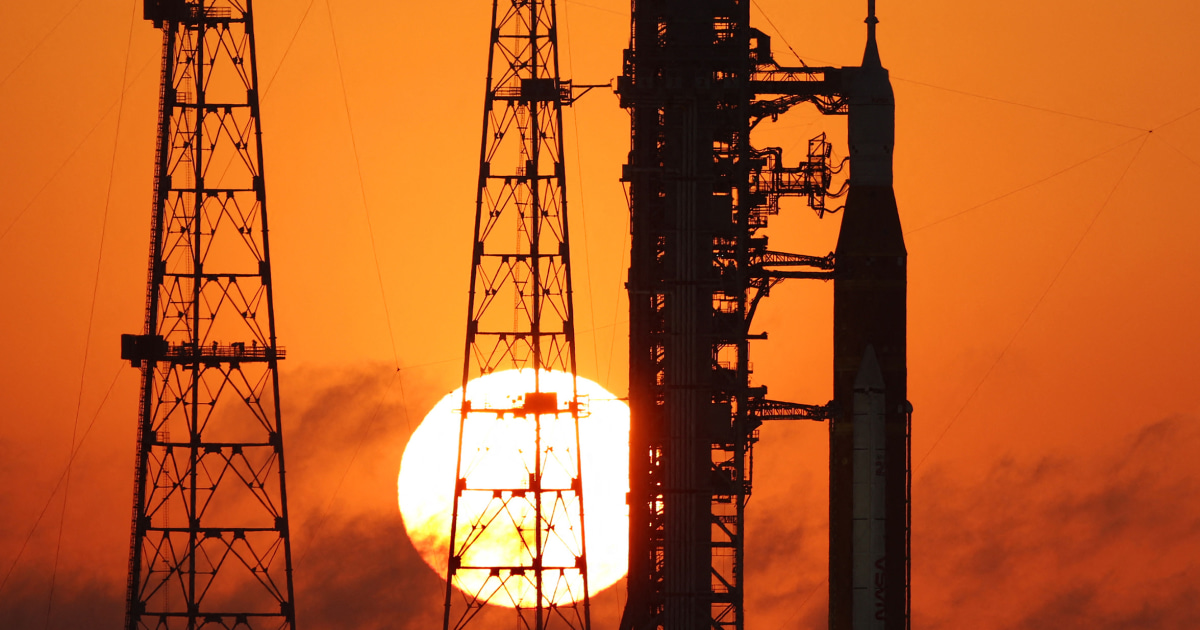
CAPE CANAVERAL, Fla. — The 322-foot-tall Space Launch System rocket looms on the launch pad at NASA's Kennedy Space Center, its fueling tests complete and its four-astronaut crew in quarantine. As early as Wednesday, the Artemis II mission could blast off, marking the first crewed launch toward the moon in more than 50 years and potentially sending humans farther from Earth than ever before. This long-awaited flight comes after over a decade of development and tens of billions of dollars in spending, but it arrives amid persistent questions about costs, delays and safety.
The mission's crew — NASA astronauts Reid Wiseman, Christina Koch and Victor Glover, along with Canadian Space Agency astronaut Jeremy Hansen — will spend 10 days in space aboard the Orion capsule, orbiting the moon without landing. According to NASA officials, the journey will test the spacecraft's systems in deep space for the first time with humans on board. The launch, originally slated for much earlier, has been pushed back repeatedly, with the most recent delay in early 2024 due to hydrogen leaks in the rocket's systems.
"This rocket was originally supposed to launch in 2016 and cost $5 billion," said Casey Dreier, chief of space policy for The Planetary Society, a nonprofit focused on space exploration advocacy. "It costs something like $20 billion now, 10 years after that." Dreier's comments highlight the ballooning expenses of the Space Launch System (SLS) rocket and Orion spacecraft, which together have exceeded $44 billion in development costs since the program's inception.
The Artemis program's challenges have drawn sharp criticism from skeptics who question its value in an era of advancing private spaceflight and international competition. Some experts and former astronauts point to the years of delays, now totaling nearly a decade beyond initial timelines, as evidence of inefficiency. Others express concerns over the Orion capsule's heat shield, which showed unexpected damage during the uncrewed Artemis I test flight in November 2022 — nearly four years ago.
During that test, an investigation by NASA revealed that a critical layer of the heat shield cracked, causing charred material to break off in several locations. The agency attributed the issue to gases building up in the shield's outer material without proper venting, leading to pressure accumulation. For Artemis II, NASA has opted not to modify the heat shield but instead to adjust the re-entry trajectory. The capsule will skip the usual "skip re-entry" maneuver — where it dips into the atmosphere and bounces back out to reduce heat and G-forces — and instead descend at a steeper angle to limit exposure to extreme temperatures.
"If we stick to the new re-entry path that NASA has planned, then this heat shield will be safe to fly," Wiseman said at a media event in July. NASA Administrator Jared Isaacman echoed this confidence in January, stating he had "full confidence" in the heat shield after extensive testing. Despite these assurances, the decision to fly with the existing shield has fueled debates among space policy watchers about risk management.
The roots of the Artemis program trace back to political decisions made over a decade ago, as NASA wound down its space shuttle program in 2010 and 2011. Congress authorized the SLS rocket to preserve jobs and expertise in states like Florida, Alabama and Utah, where longtime NASA contractors operate. "It was birthed by Congress itself," Dreier noted, emphasizing how the design incorporated upgraded space shuttle main engines, known as RS-25s, built by the same workforce dating back to the 1970s.
"If you think about it, this is not a 15-year-old program. This is a 50-year-old program," Dreier added. "This is the same workforce and same contractors going back to the '70s." This heritage has provided the SLS with strong bipartisan support in Congress, even as costs soared. From its start through the Artemis I flight in 2022, the rocket's development alone cost nearly $24 billion, while the Orion spacecraft, initiated in 2006, tallied more than $20 billion by the same year, according to figures from The Planetary Society.
A 2021 audit by NASA's Office of Inspector General projected the full Artemis program would cost $93 billion through fiscal year 2025, with each SLS and Orion launch estimated at $4.1 billion. Two years later, the Government Accountability Office reported that senior NASA officials viewed the SLS as unsustainable at current cost levels. Technical issues, such as the hydrogen leaks that plagued both Artemis I and II preparations, stem from the rocket's design choices, including the use of liquid hydrogen — a clean-burning fuel inherited from the shuttle era but notoriously difficult to contain due to its tiny molecules.
"The rocket was mandated to use the same components and reuse the hardware," Dreier explained. "Congress locked in this design decision made for a completely different spacecraft in a completely different era, and that's why we face these challenges today." These delays contrast sharply with the rapid iteration seen in commercial space ventures, like SpaceX's frequent Falcon 9 launches.
Beyond budget woes, the program's pace has drawn fire. Nearly four years elapsed between Artemis I and the upcoming II, and until recent changes, Artemis III was slated for 2026 — another two-year gap. Critics argue such intervals hinder safety improvements by limiting opportunities to learn from flights. "The fact that the Space Launch System cannot launch very frequently was a huge structural and safety risk that has been known for a long time," Dreier said. "You only have so many chances to learn about what your failure modes are."
In response, Isaacman announced a revamp of the Artemis timeline less than three months into his tenure as administrator. Artemis III, originally planned as the first lunar landing in 2028, will now launch to low-Earth orbit in mid-2027 for technology demonstrations, including docking with a commercial lander from SpaceX or Blue Origin. A NASA Office of Inspector General report this month indicated SpaceX's Starship lander is at least two years behind schedule, with further delays anticipated. Under the new plan, the first moon landing shifts to Artemis IV in 2028, with SLS launches targeted every 10 months instead of every three years.
The broader goals of Artemis extend far beyond a simple return to the moon. Unlike the brief Apollo missions of the 1960s and 1970s, Artemis aims to establish a sustainable lunar presence, including an outpost at the south pole for scientific exploration and resource mining. Isaacman said Tuesday that NASA plans to invest $20 billion in building this lunar base, which could harvest water ice to produce rocket fuel for future Mars missions.
Pamela Melroy, a retired NASA astronaut and former deputy administrator from 2021 to 2025, defended the program's value. "I’ve always thought it was not a race for boots on the moon, because we won that race more than 50 years ago," she said. "It was actually going to be a race for values as we humans go out in the solar system." Melroy highlighted opportunities for a lunar economy, long-term science and setting international norms for transparent space operations that benefit humanity.
Yet not everyone agrees on the priorities. Some lawmakers, former NASA officials and members of the public advocate redirecting human spaceflight efforts toward Mars or deeper solar system exploration, viewing a moon return as redundant. "Some have argued that rather than repeat accomplishments notched half a century ago, NASA should focus its human spaceflight efforts on pushing deeper into the solar system, such as to Mars," according to reports from space policy analysts.
A growing geopolitical dimension adds urgency. As China's human spaceflight program advances rapidly, including plans for its own lunar missions, the U.S. sees Artemis as part of a new space race. "The clock is running in this great-power competition, and success or failure will be measured in months, not years," Isaacman said Tuesday at a NASA event outlining national space policy goals. This competitive edge, combined with domestic job preservation, has sustained political backing despite the controversies.
A successful Artemis II could provide a pivotal morale boost for NASA and reignite public enthusiasm for space exploration. "Whenever the White House really needs a good news story, they come to NASA," Melroy observed. With the mission's outcome hanging in the balance, it represents not just a technical milestone but a test of whether the program can overcome its hurdles to deliver on promises of lunar sustainability and beyond.
Looking ahead, the mission's success will inform the accelerated timeline, including the commercial partnerships critical to lunar landings. As teams finalize preparations at Kennedy Space Center, the eyes of the world — and a new generation — turn to the moon once more.