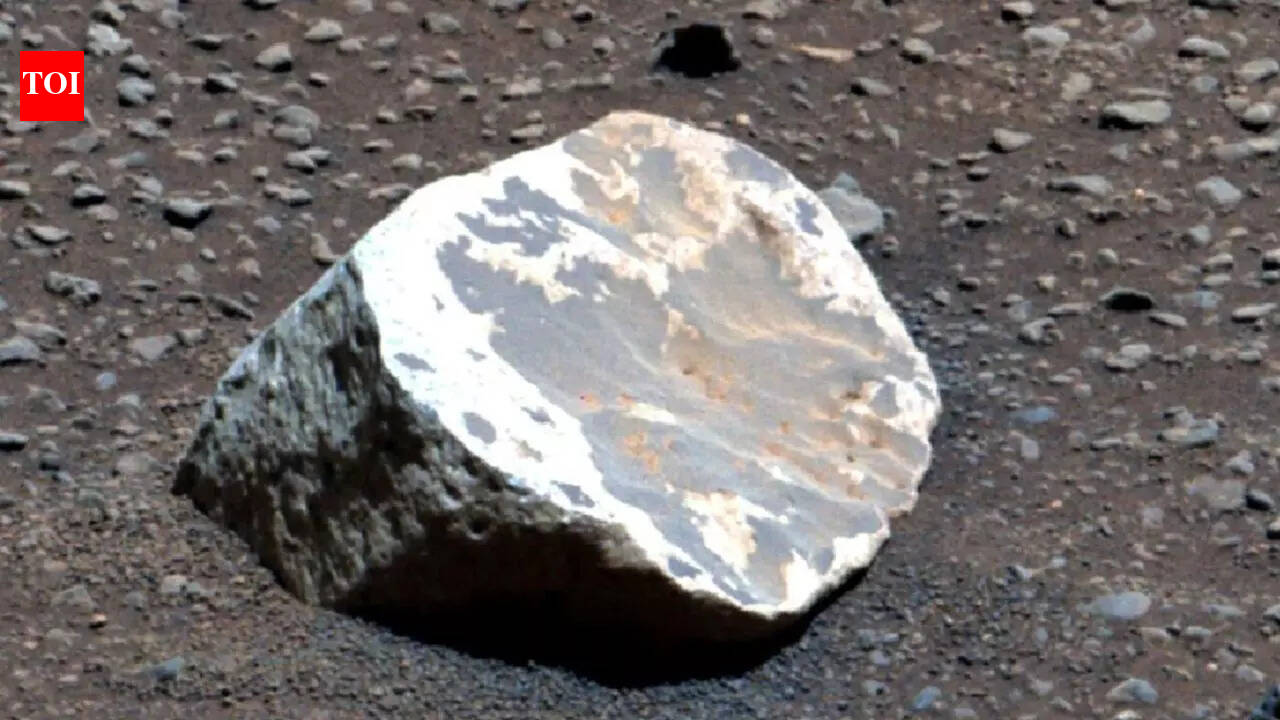
APPLETON, Wis. — NASA's Perseverance rover has uncovered a striking discovery on the surface of Mars: bright white rocks composed of kaolinite, a mineral typically formed in the presence of water. Scattered across the rusty red plains of Jezero Crater, these pale formations stand out against the planet's familiar iron-rich terrain, hinting at a wetter, more Earth-like past for the Red Planet. According to reports from NASA's Jet Propulsion Laboratory, the finding suggests that Mars experienced millions of years of rainfall and sustained moist conditions billions of years ago.
The Perseverance rover, which touched down in Jezero Crater on February 18, 2021, has been methodically exploring the 28-mile-wide ancient lakebed as part of its mission to seek signs of past microbial life. Jezero Crater, located in Mars' northern hemisphere, was selected for its geological history, including a delta formed by a long-vanished river that once fed into a lake. Scientists had long suspected the area held clues to the planet's watery history, but the detection of kaolinite— a clay mineral that forms through chemical weathering in aqueous environments— marks a significant milestone.
"These white rocks are unlike anything we've seen before in this region," said Ken Farley, project scientist for the Mars 2020 mission at the California Institute of Technology, in a statement released by NASA. The rover's instruments, including its SuperCam laser and the PIXL X-ray spectrometer, analyzed the rocks during a recent traverse near the crater's western edge. The data revealed high concentrations of kaolinite, which on Earth is often associated with tropical or subtropical climates where prolonged exposure to water breaks down feldspar into clay.
According to the Times of India, which first reported on the discovery, the kaolinite deposits indicate that Jezero Crater was once a lush environment with steady rainfall over an extended period, potentially lasting for tens of millions of years during the Noachian period, around 3.5 to 4 billion years ago. This era is believed to be when Mars had a thicker atmosphere and liquid water flowing across its surface, before the planet lost much of its magnetic field and atmosphere to solar wind, leading to the arid conditions we see today.
The rover spotted the white rocks during its exploration of a feature called the 'Curiosity Delta,' a layered outcrop that preserves sediments from the ancient lake. Perseverance's mast-mounted cameras captured images of the rocks protruding from the soil, their ghostly pallor contrasting sharply with the surrounding basaltic plains. Initial spectroscopic analysis confirmed the presence of kaolinite, along with traces of other hydrated minerals like smectite, further supporting the idea of a hydrated past.
Experts caution that while the discovery is exciting, it doesn't directly prove the existence of life on Mars. "Kaolinite formation requires water, but it can occur through non-biological processes," noted Abigail Fraeman, deputy project scientist for Perseverance, in an interview with NASA's media team. The mineral's presence, however, bolsters the case for habitability, as water is a key ingredient for life as we know it. The team plans to collect core samples from nearby rocks for the Mars Sample Return mission, a joint NASA-ESA effort slated to bring Martian material back to Earth by the early 2030s for detailed laboratory analysis.
This isn't the first time Perseverance has found evidence of water-related geology in Jezero. Earlier in the mission, the rover examined igneous rocks and sedimentary layers that suggested episodic flooding. But the kaolinite stands out for its implications of sustained wetness. On Earth, similar clays are found in ancient riverbeds and lake shores, providing a window into prehistoric climates. Mars scientists hope these rocks will do the same for the planet's lost epoch.
The discovery comes amid a flurry of activity for the Perseverance mission. Just last month, the rover successfully deployed its Ingenuity helicopter for a series of flights, scouting ahead for potential sample sites. Ingenuity, which made history as the first powered flight on another planet, has now completed 72 flights since April 2021, though its mission was recently extended. The helicopter's aerial imagery has helped map the crater floor, revealing more white outcrops that the rover team now prioritizes for closer inspection.
Broadening the context, Mars' watery past has been pieced together from decades of missions, starting with the Viking landers in the 1970s and continuing through orbiters like Mars Reconnaissance Orbiter. Previous findings, such as hematite 'blueberries' in Meridiani Planum by Opportunity in 2004, indicated acidic water flows. Curiosity, Perseverance's predecessor in Gale Crater, detected mudstones and sulfates pointing to habitable lakes. The kaolinite in Jezero adds another layer, suggesting neutral to alkaline waters that could have supported microbial ecosystems.
Not all scientists agree on the exact timeline or extent of Mars' wet period. Some researchers, citing orbital data from the Compact Reconnaissance Imaging Spectrometer for Mars (CRISM), argue that kaolinite might have formed during brief hydrothermal events rather than prolonged rainfall. "The spectrum matches kaolinite, but the distribution suggests localized formation," said a geologist from the European Space Agency's Mars Express team, who reviewed preliminary data. NASA officials maintain that ground-truthing by Perseverance provides the most reliable evidence, with the rover's SHERLOC instrument detecting organic molecules in similar rocks last year.
The implications of this find extend beyond Mars science. Understanding how a planet like Mars transitioned from wet to dry could inform models for exoplanets in habitable zones around other stars. NASA's astrobiology program views Jezero as a prime analog for early Earth, where similar clays might have cradled the first life forms. As Perseverance continues its trek toward the crater rim, expected to take another year, the team anticipates more surprises. The rover has already cached 24 sample tubes, with plans to collect dozens more before the sample return launch window in 2028.
Back on Earth, the discovery has sparked public interest and educational outreach. NASA's social media channels lit up with images of the white rocks, drawing comparisons to snowy landscapes on Mars. Educators at the Smithsonian Institution plan to incorporate the finding into virtual reality tours of Jezero Crater, aimed at middle school students. Meanwhile, international partners like the Canadian Space Agency, which contributed the rover's weather station, hailed the result as a testament to global collaboration in space exploration.
Looking ahead, the Perseverance team is preparing for the mission's next phase, including ascents up the delta front where more kaolinite-bearing layers may lie. Engineers at JPL report the rover is in excellent health, with solar panels generating ample power despite the thin Martian atmosphere. The kaolinite discovery underscores the rover's primary goal: to answer whether Mars ever hosted life. As data streams back to Earth at 2,000 bits per second, scientists eagerly await the next transmission from 225 million miles away.
In the broader narrative of solar system exploration, this finding reinforces Mars as a key destination for future human missions. NASA's Artemis program, which aims to return astronauts to the Moon by 2026, includes technology tests applicable to Mars. Private ventures like SpaceX's Starship are also eyeing the Red Planet, with Elon Musk tweeting last week about potential landing sites in Jezero. Yet, for now, Perseverance remains the vanguard, quietly unearthing secrets from a world that once knew rain.