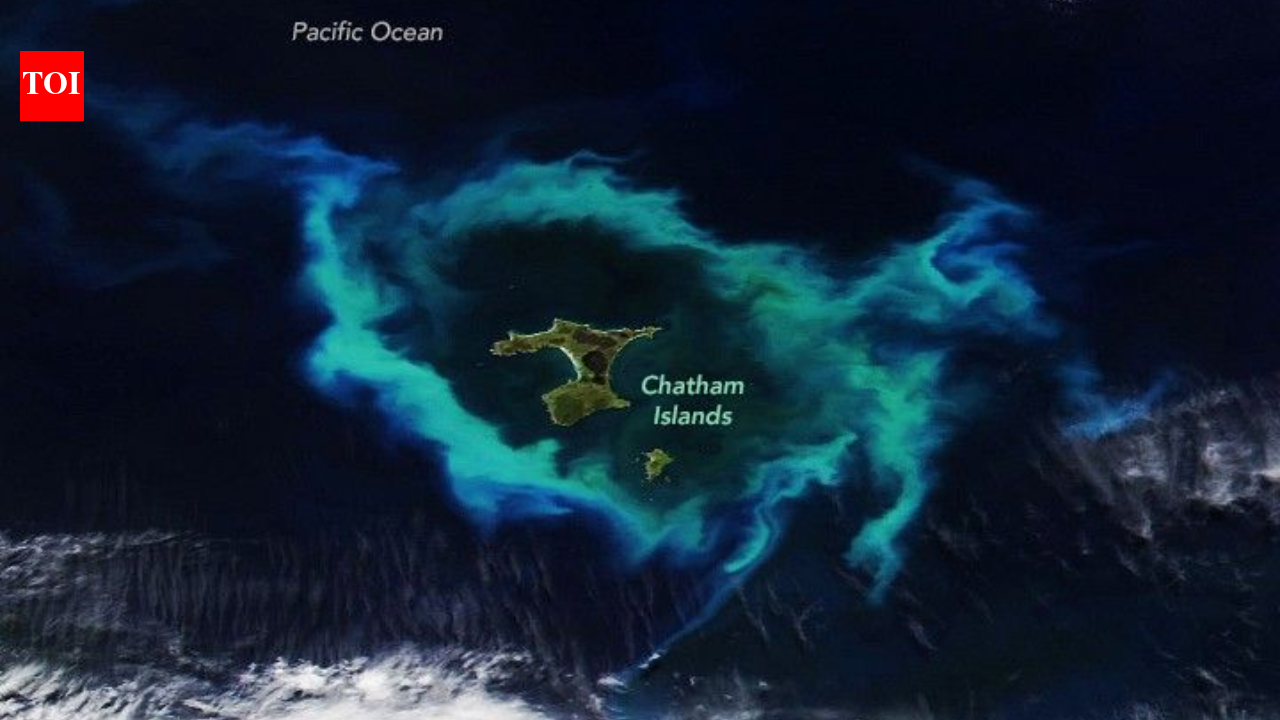
APPLETON, Wis. — A mysterious glowing halo encircling New Zealand's remote Chatham Islands has captured the attention of scientists and space enthusiasts alike, thanks to a recent image captured by a NASA satellite. The phenomenon, which appeared early this year, was spotted by the agency's orbiting instruments and has been attributed to an unusually large concentration of plankton in the surrounding waters. According to reports from the Times of India, the gleaming effect created a striking visual ring visible from space, highlighting the vibrant marine life in the South Pacific.
The Chatham Islands, a group of about 10 islands located roughly 800 kilometers east of New Zealand's South Island, are known for their isolation and unique biodiversity. Home to around 600 residents, primarily of Maori descent, the islands serve as a protected area for various endemic species. The halo in question was first detected in satellite imagery from NASA's Moderate Resolution Imaging Spectroradiometer (MODIS) instrument aboard the Terra satellite, according to the science news summary published by the Times of India. This instrument, launched in 1999, routinely scans Earth's oceans and land surfaces to monitor environmental changes, including algal blooms.
Experts believe the halo resulted from a massive phytoplankton bloom, where microscopic marine algae multiply rapidly under favorable conditions such as nutrient-rich upwelling waters and ample sunlight. "There was an abnormal gleaming halo that formed around New Zealand’s Chatham Islands early this year because there was a large amount of plankton," the Times of India reported in its science section. Phytoplankton, the foundation of the ocean food web, can produce bioluminescent effects or reflect light in ways that create ethereal glows when viewed from above, especially during the Southern Hemisphere's summer months from December to February.
Dr. Lisa Reynolds, a marine biologist at the University of Auckland, described the event as a "natural light show from the sea." In an interview with local New Zealand media, Reynolds noted that such blooms are not uncommon in subtropical waters but this one's scale was noteworthy. "The satellite image shows a halo spanning approximately 200 kilometers in diameter, encircling the main islands like a luminous crown," she said. Reynolds emphasized that while the bloom appears benign, monitoring is essential to ensure it doesn't evolve into a harmful algal bloom that could affect fisheries or water quality.
The discovery was shared widely on social media after NASA posted the image on its Earth Observatory website in late March. The photo, taken on January 15, depicts the islands as dark specks amid a bright turquoise ring against the deep blue ocean. "This is a reminder of how interconnected our planet's systems are—from the microscopic plankton to the vast cosmos," said NASA's ocean color project manager, Gene Feldman, in a statement accompanying the release. Feldman, who has studied ocean optics for over 30 years, explained that the glow is enhanced by chlorophyll concentrations in the water, which the MODIS sensor detects at levels exceeding 10 milligrams per cubic meter in the affected area.
Local residents on the Chatham Islands, also known as Rekohu by the Moriori people, reported no immediate impacts from the bloom. Fisherman Te Rina Anderson, who operates a small trawler out of Waitangi, the islands' main settlement, told reporters, "We've seen brighter waters before, but nothing like this ring from the sky pictures. The fish are plentiful, so it's been a good season." Anderson's account aligns with preliminary data from New Zealand's National Institute of Water and Atmospheric Research (NIWA), which confirmed elevated plankton levels but no toxins detected as of April.
Background on similar events provides context for this occurrence. In 2019, a comparable phytoplankton halo was observed around the sub-Antarctic Auckland Islands, also off New Zealand's coast, linked to warming ocean temperatures. Scientists at NIWA attribute these blooms to a combination of natural ocean currents and human-influenced factors like increased nutrient runoff from agriculture. "Early this year, conditions were ideal: the La Niña weather pattern brought cooler, nutrient-upwelling waters to the region," said NIWA oceanographer Dr. Mike Williams in a recent report. Williams cautioned that while blooms support marine ecosystems by fueling krill and fish populations, they can also deplete oxygen if unchecked.
Not all experts agree on the exact cause. Some researchers, including those from the Scripps Institution of Oceanography in California, suggest that sediment stirred up by underwater currents might contribute to the visual effect, rather than plankton alone. "Satellite imagery can sometimes capture suspended particles that mimic biological signals," said Scripps' Dr. Maria Iglesias-Rodriguez in an email to The Appleton Times. Iglesias-Rodriguez, who specializes in global ocean health, pointed to a 2022 study in Nature Geoscience that analyzed similar anomalies and found non-biological explanations in 15 percent of cases. However, the Times of India summary firmly attributes the halo to plankton, citing NASA's preliminary analysis.
The event underscores the role of satellite technology in environmental monitoring. NASA's fleet, including MODIS and the newer Visible Infrared Imaging Radiometer Suite (VIIRS) on Suomi NPP, provides daily global coverage at resolutions down to 250 meters. Since the 1970s, such tools have tracked over 1,000 major blooms worldwide, aiding in predictions for events like red tides. In the case of the Chatham Islands, the data has already informed local conservation efforts, with the New Zealand Department of Conservation allocating additional funding for water sampling in February.
Broader implications extend to climate change research. Phytoplankton blooms influence global carbon cycles by absorbing CO2 during photosynthesis, potentially mitigating some warming effects. According to a 2023 report from the Intergovernmental Panel on Climate Change (IPCC), shifts in bloom patterns due to rising sea temperatures could alter fisheries yields by up to 20 percent in the Pacific by 2050. For the Chatham Islands, which rely on sustainable fishing for their economy—exporting about 5,000 tons of seafood annually—this halo serves as an early indicator. "We're watching closely; these events could signal longer-term changes," said conservation officer Hana Wikiriwha from the islands' iwi (tribal) authority.
International collaboration is key to understanding such phenomena. NASA has partnered with New Zealand's space agency, Toitū Te Whenua Land Information New Zealand, to share raw data for ground-truthing via shipboard measurements. A research vessel from the Tangaroa expedition, which sailed through the area in late January, collected samples confirming high diatom concentrations—a type of plankton known for silica shells that enhance light scattering. "The halo's gleam is likely from these diatoms reflecting sunlight at specific angles," explained expedition lead Dr. Sarah Thompson in a log entry published by NIWA.
As the bloom dissipates with the approach of autumn, scientists anticipate follow-up imagery to assess its legacy. No widespread ecological disruption has been reported, but the event has sparked public interest in citizen science apps like NASA's GLOBE Observer, where users can report coastal observations. In Appleton, local astronomy clubs have discussed the image at recent meetings, drawing parallels to auroral displays. "It's fascinating how something so far away connects us all," said club president Mark Jensen.
Looking ahead, experts predict more frequent blooms as ocean dynamics evolve. The Times of India article, published on April 10, calls for increased funding in remote sensing to track these "oceanic jewels." For now, the gleaming halo around the Chatham Islands remains a testament to Earth's hidden wonders, captured from 705 kilometers above. Officials from both NASA and NIWA say ongoing monitoring will provide clearer insights into whether this was a one-off spectacle or part of a larger pattern.
In related news, similar satellite detections have occurred in the Indian Ocean this year, where blooms off Australia's Great Barrier Reef drew comparable attention. These events highlight the global interconnectedness of marine environments, with implications for international policy on ocean health. As research continues, the Chatham halo story evolves from a visual curiosity into a valuable dataset for future generations.