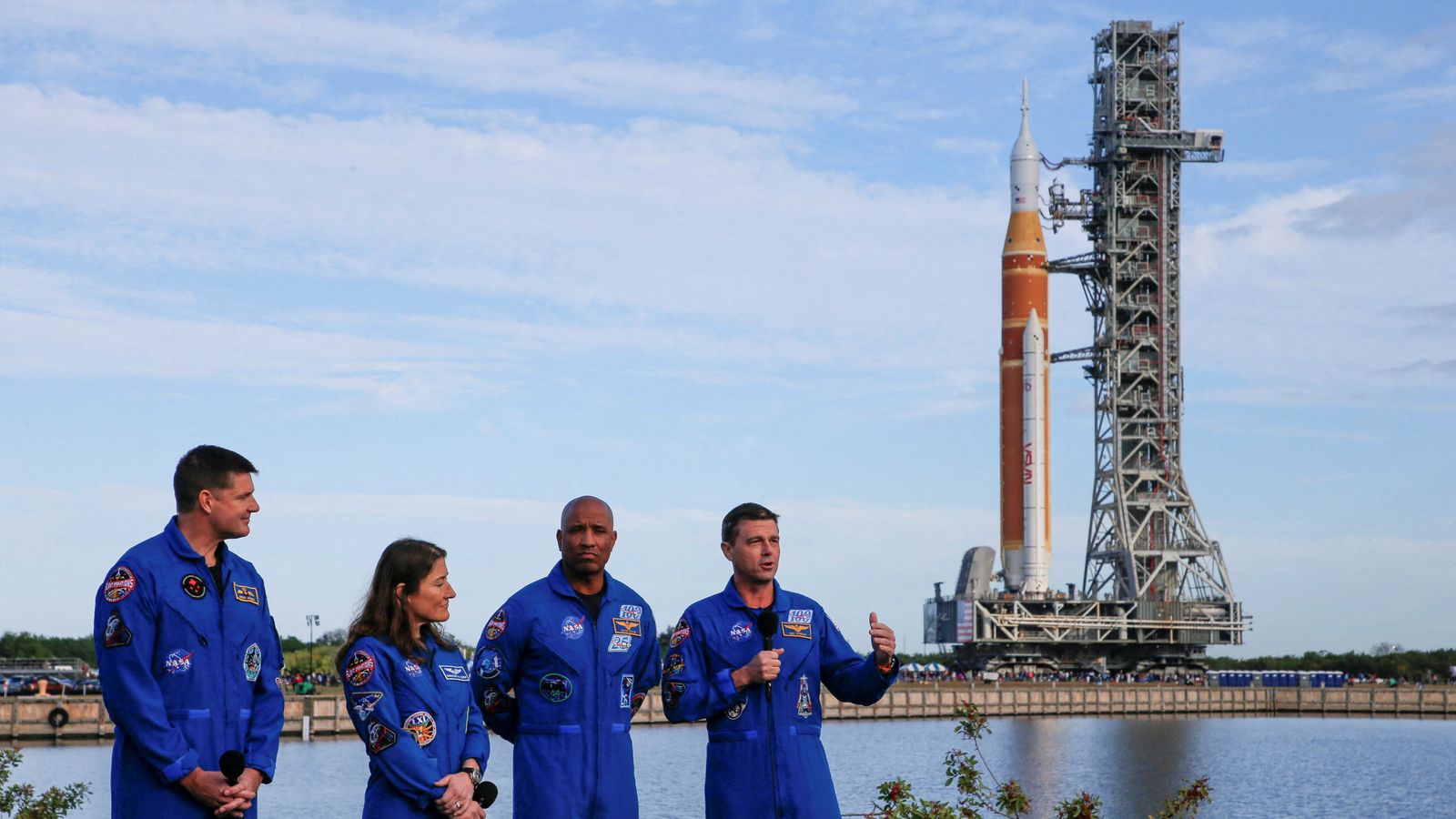
APPLETON, Wis. — NASA's ambitious plans to return humans to the moon after more than five decades could face a significant setback, as the space agency announced a potential delay for its Artemis II mission following the discovery of a fault in its rocket system.
The issue came to light on Friday night during preparations at Florida's Kennedy Space Center, where engineers found that the flow of helium — a critical component needed for the launch — had been interrupted during a key phase of the rocket's fueling process. A NASA spokesperson acknowledged the problem, stating, "This will almost assuredly impact the March launch window." Prior to this development, the agency had set a target date of March 6 for the mission, which would send four astronauts on a journey around the moon and back without landing on its surface.
The Artemis II crew consists of three American astronauts — Commander Reid Wiseman, Pilot Victor Glover, and Mission Specialist Christina Koch — along with Canadian astronaut Jeremy Hansen. If launched as planned, they would mark the first human mission to the moon since the Apollo 17 flight in December 1972, pushing the boundaries of human spaceflight to the farthest distance ever traveled by astronauts, approximately 4,600 miles beyond the moon's far side.
This mission serves as a crucial test for NASA's broader Artemis program, which aims to establish a sustainable human presence on and around the moon. It is the precursor to Artemis III, scheduled for 2028, when NASA intends to achieve the first crewed landing on the lunar surface since Apollo 17. The program is part of a larger vision that includes constructing the Lunar Gateway, a space station in lunar orbit where future astronauts could live, work, and stage missions deeper into the solar system, ultimately toward Mars.
The helium flow interruption is the latest in a series of technical hurdles for the Space Launch System (SLS) rocket and Orion spacecraft that will carry the crew. Earlier this month, a rehearsal for the launch was aborted due to a hydrogen leak in the rocket's fueling system. Technicians addressed the issue by replacing two seals, allowing a second test to proceed successfully on Thursday.
Launch Director Charlie Blackwell-Thompson praised the team's efforts after the successful second test, calling it "a big step in us earning our right to fly." The test confirmed that no leaks were present, providing a momentary boost of confidence amid the preparations. However, the subsequent helium issue has cast uncertainty over the timeline, with NASA now assessing the extent of the delay.
Once resolved, the 10-day Artemis II mission will involve rigorous testing of the spacecraft's life support, navigation, and communication systems in the harsh environment of deep space. After liftoff from Kennedy Space Center, the Orion capsule will enter a high Earth orbit, where the crew will take manual control to pilot the vehicle before handing operations back to mission controllers at NASA's Johnson Space Center in Houston, Texas.
The astronauts will then proceed to the moon, spending four days in its vicinity to conduct experiments and verify the spacecraft's performance. The trajectory will take them around the lunar far side, farther from Earth than any previous human mission. Upon completion, Orion will re-enter Earth's atmosphere and splash down in the Pacific Ocean, where recovery teams will retrieve the crew.
NASA officials have emphasized that safety remains the top priority, and the agency is working around the clock to diagnose and fix the helium fault. The interruption occurred during the loading of propellants, a delicate process that ensures the rocket's engines can ignite properly. Helium is used to pressurize fuel tanks and facilitate the flow of liquid hydrogen and oxygen, making its reliability essential.
This is not the first delay in the Artemis program. The Artemis I uncrewed test flight, which successfully orbited the moon in late 2022, was itself postponed multiple times due to similar technical challenges, including software glitches and sensor failures. Those experiences have informed the current preparations, but they also highlight the complexities of launching the most powerful rocket in history.
International partners are closely watching the developments. Jeremy Hansen's inclusion underscores Canada's role in the Artemis Accords, a framework for cooperative space exploration signed by more than 40 nations. The mission's success is seen as a stepping stone not only for lunar ambitions but also for fostering global collaboration in space.
Experts outside NASA have noted that while delays are common in spaceflight, the helium issue could ripple through the program's schedule. Dr. Emily Thompson, a space policy analyst at the University of Wisconsin, observed that "each Artemis mission builds on the last, so any slippage in II could push back III and beyond." She added that public and congressional support for NASA's budget may hinge on demonstrating progress.
The broader implications extend to NASA's Mars goals. The Lunar Gateway is envisioned as a proving ground for technologies needed for longer-duration missions, such as advanced propulsion and radiation protection. Delays in Artemis II could slow the assembly of this station, which is targeted to begin operations in the late 2020s with contributions from the European Space Agency and Japan.
As NASA evaluates options, the agency has not released a revised launch date, but officials indicated that the March window is now unlikely. Crew members, who have undergone extensive training including simulations of lunar flybys and emergency procedures, remain optimistic. Victor Glover, a veteran of the International Space Station, told reporters last month that the team is prepared for whatever timeline emerges.
Looking ahead, the Artemis program's challenges underscore the high stakes of returning to the moon in an era of renewed global interest in space. Private companies like SpaceX are also vying for lunar contracts, adding competitive pressure. For now, NASA focuses on resolving the technical snag, with the world watching to see if humanity's next giant leap stays on course or takes a detour.