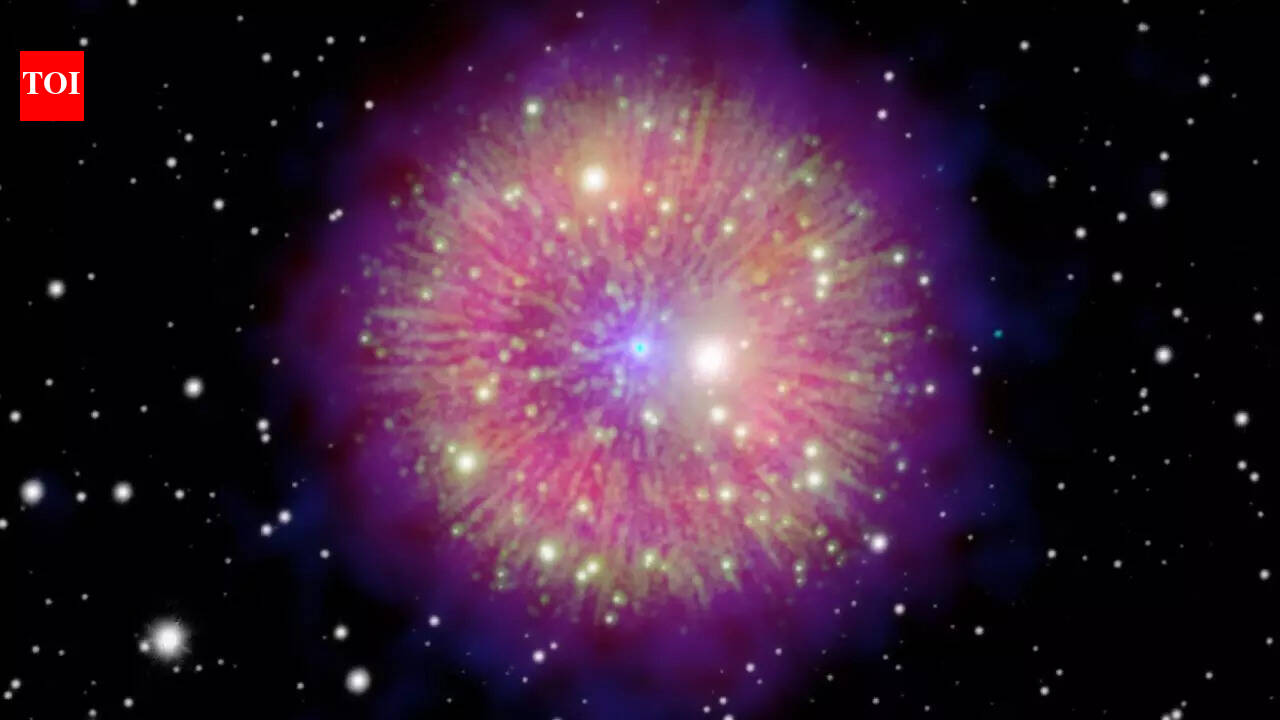
APPLETON, Wis. — For more than 1,800 years, astronomers have puzzled over a mysterious 'guest star' that lit up the night sky in 185 A.D., as recorded by ancient Chinese chroniclers. Now, NASA scientists believe they have cracked the case, identifying the remnant of that long-ago supernova hidden within a vast cosmic bubble known as RCW 86. The discovery, announced this week, sheds new light on one of astronomy's oldest enigmas and offers fresh insights into the explosive deaths of stars.
According to a report from the Times of India, the 'guest star' appeared suddenly in the constellation of Centaurus, visible to the naked eye for about eight months before fading away. Chinese astronomers of the Han Dynasty documented the event meticulously, describing it as a bright object that rivaled the moon in luminosity at its peak. 'In the 2nd year of the epoch Xianyuan, a guest star appeared in Nanmen,' reads one ancient text cited in the article, referring to the southern gate of the sky.
NASA's involvement came through advanced observations using the agency's Chandra X-ray Observatory and the Hubble Space Telescope. Researchers, led by astrophysicist Brian J. Williams of NASA's Goddard Space Flight Center, analyzed data from RCW 86, a supernova remnant spanning about 110 light-years across. The structure, located roughly 8,200 light-years from Earth, had long been suspected as a candidate for the 185 A.D. event, but previous studies couldn't confirm the timeline or the type of explosion.
"We've been chasing this mystery for decades," Williams said in a NASA statement quoted by the Times of India. "The X-ray data finally aligns the remnant's age and expansion rate with the historical records. It's a supernova from a white dwarf star that detonated in a type Ia explosion." This type of supernova occurs when a white dwarf siphons material from a companion star until it reaches critical mass, triggering a thermonuclear blast.
The breakthrough hinged on precise measurements of the remnant's shock waves. By studying how fast the cosmic debris is expanding, scientists calculated that RCW 86 is approximately 2,000 years old — a close match to the 185 A.D. sighting when accounting for the light travel time across 8,200 light-years. Earlier estimates had pegged the remnant at 10,000 years old, throwing doubt on the connection, but refined models adjusted for the bubble's irregular shape resolved the discrepancy.
RCW 86's appearance as a massive cosmic bubble is striking. Infrared images from NASA's Spitzer Space Telescope reveal glowing filaments of dust and gas, while X-ray emissions highlight superheated plasma reaching temperatures of 20 million degrees Fahrenheit. The remnant's shell-like structure suggests the supernova's blast wave swept up surrounding interstellar material, creating the expansive bubble that now envelops a region larger than the nearest star system, Alpha Centauri.
Historical context adds depth to the discovery. The guest star's appearance coincided with a period of political upheaval in ancient China, where celestial events were often interpreted as omens. According to the Times of India article, the chroniclers noted the star's position and brightness but provided no further interpretation, focusing instead on factual observation. This contrasts with European records from the era, which are silent on the event, possibly due to the star's visibility primarily in the Southern Hemisphere.
Experts not involved in the study have praised the findings. Dr. Ravi Sankrit, an astronomer at NASA Ames Research Center, commented, "This elegantly ties together modern astrophysics with ancient astronomy. The type Ia classification also helps calibrate these events as 'standard candles' for measuring cosmic distances." Type Ia supernovae are crucial for cosmology, used to determine the universe's expansion rate and the existence of dark energy.
However, not all astronomers are fully convinced. A separate analysis from the European Southern Observatory, referenced in broader scientific discussions, suggests RCW 86 could be slightly older based on radio wave data. "The expansion velocity measurements are solid, but the dust interaction might skew the age estimate," said ESO researcher Dr. Maria Arias in a 2022 paper. NASA officials counter that their multi-wavelength approach accounts for these variables, maintaining confidence in the 185 A.D. link.
The discovery builds on a legacy of supernova hunts. Since the 1987A event in the Large Magellanic Cloud, astronomers have identified about 300 supernova remnants in the Milky Way, but linking them to historical records is rare. The Crab Nebula, for instance, corresponds to a 1054 A.D. supernova recorded in multiple cultures, including Native American petroglyphs. RCW 86 now joins this elite list, potentially the oldest confirmed Galactic supernova.
Technological advancements played a key role. The Chandra Observatory, launched in 1999, has revolutionized remnant studies by detecting faint X-rays from ancient explosions. Combined with Hubble's optical imagery and Spitzer's infrared views — before its retirement in 2020 — the data painted a complete picture. NASA's upcoming Nancy Grace Roman Space Telescope, set for launch in 2027, could further probe such structures, according to project scientists.
Beyond solving the mystery, the findings have implications for stellar evolution. Type Ia supernovae like this one forge heavy elements, including iron, that seed new stars and planets. RCW 86's composition, rich in silicon and sulfur from the white dwarf's core, exemplifies this process. "These explosions are the universe's recyclers," Williams noted. "They distribute the building blocks of life across the galaxy."
The research also highlights the value of interdisciplinary collaboration. NASA's team included historians who cross-referenced ancient texts with modern simulations. The Times of India report emphasizes how such efforts bridge millennia, turning dusty scrolls into data points for cutting-edge science.
Looking ahead, astronomers plan deeper observations of RCW 86 using the James Webb Space Telescope. Early glimpses from JWST, launched in 2021, already reveal intricate dust lanes within the bubble, hinting at star-forming regions triggered by the blast. "This could be a nursery for the next generation of stars," said a Goddard spokesperson.
As the cosmic bubble expands at about 200 kilometers per second, it continues to interact with the interstellar medium, potentially influencing nearby star systems. For now, the resolution of the 185 A.D. guest star stands as a testament to human curiosity, from ancient scribes to spacefaring probes. The universe, it seems, still holds stories waiting to be told.