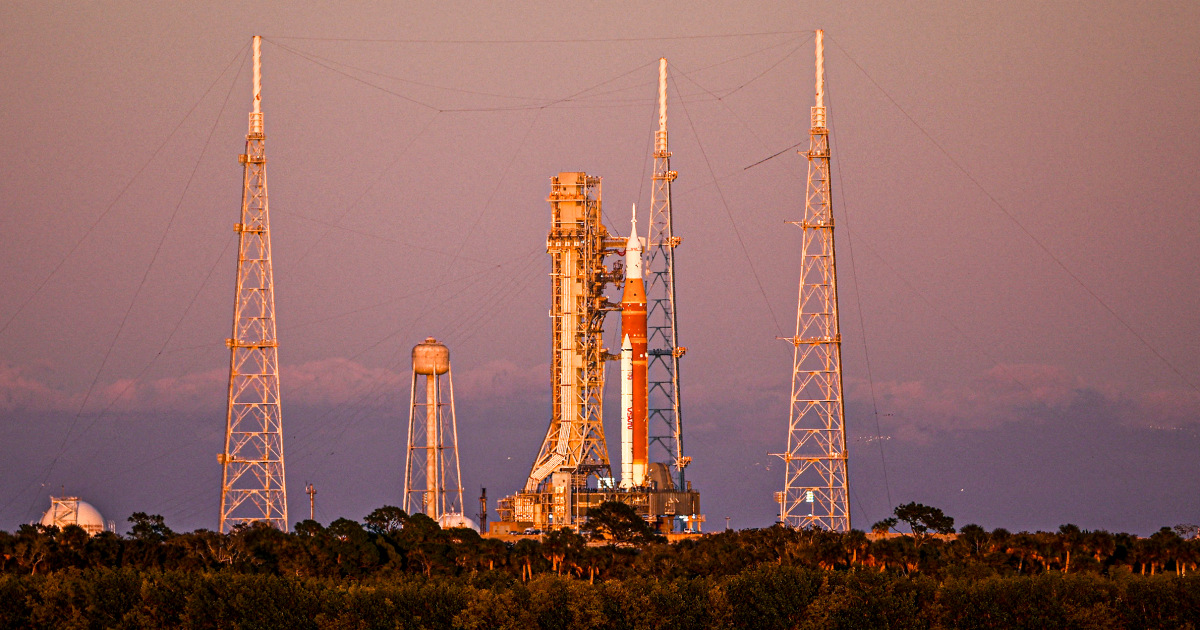
CAPE CANAVERAL, Fla. — NASA officials announced Friday that they are targeting March 6 for the launch of four astronauts on the Artemis II mission, a long-awaited voyage that will send humans around the moon for the first time in more than half a century.
The announcement came after the space agency successfully completed a critical fueling test and launch simulation on Thursday at the Kennedy Space Center. During the hours-long exercise, known as a wet dress rehearsal, teams loaded the Space Launch System (SLS) rocket with over 700,000 gallons of cryogenic propellant, mimicking the full countdown process leading to liftoff.
This milestone paves the way for the crewed flight, which will mark the debut of the SLS rocket and the Orion spacecraft carrying humans. The 10-day mission is expected to take the astronauts farther from Earth than any previous human expedition, circling the moon without landing.
The path to this point hasn't been smooth. An earlier attempt at the wet dress rehearsal on February 2 was aborted due to hydrogen fuel leaks near the rocket's tail section, scuttling all potential launch dates for that month. Engineers spent the intervening weeks addressing the issues, replacing two seals on fueling lines and performing additional repairs and tests at the launch pad.
"Getting through this wet dress was an important milestone for us," said Charlie Blackwell-Thompson, the Artemis launch director, during a briefing. She noted that the repaired seals held firm throughout Thursday's test, describing them as "rock solid."
Lori Glaze, acting associate administrator of NASA's Exploration Systems Development Mission Directorate, emphasized that while the March 6 target is promising, it remains contingent on several factors. These include final preparations at the launch pad and a comprehensive review of Thursday's data.
"Those things are all in front of us," Glaze said in the Friday news briefing. "We need to successfully navigate all of those. But assuming that happens, it puts us in a very good position to target March 6."
A flight readiness review is slated for late next week, where mission managers and senior NASA officials will formally approve the rocket and spacecraft for flight. Only after that certification can the launch proceed as planned.
The Artemis II crew consists of NASA astronauts Reid Wiseman, Christina Koch, and Victor Glover, along with Jeremy Hansen from the Canadian Space Agency. Although the astronauts did not take part in the wet dress rehearsal, several were present at Kennedy Space Center to observe the proceedings.
Glaze shared that she spoke with Wiseman, Koch, and Hansen during their visit. "They're all very, very excited," she said. "I was glad they could be here for the wet dress. They are really getting a lot of anticipation for a potential launch in March."
As preparations advance, the crew entered quarantine Friday afternoon in Houston to reduce the risk of illness before the mission. About five days prior to launch, they will travel to Florida to continue isolation at Kennedy Space Center.
The Artemis program represents NASA's renewed push to return humans to the moon, building on the successes of the Apollo era that last sent astronauts there in 1972. Artemis II serves as the first crewed test of the SLS and Orion systems, following uncrewed demonstrations like the 2022 Artemis I flight, which successfully orbited the moon and splashed down in the Pacific Ocean.
Unlike Apollo missions, which aimed for lunar landings, Artemis II will focus on orbital maneuvers around the moon, testing the spacecraft's life support, navigation, and reentry capabilities with a human crew aboard. The mission's trajectory will take the astronauts to a maximum distance of about 250,000 miles from Earth, surpassing the Apollo 13 record set in 1970.
International collaboration is a key aspect of Artemis. Hansen's inclusion highlights Canada's contributions through the Gateway lunar space station program, for which the country is providing robotics technology. The mission also underscores NASA's partnerships with private companies like Boeing, which built the SLS core stage, and Lockheed Martin, responsible for the Orion capsule.
Thursday's test was the second attempt at the wet dress rehearsal, a complex procedure that involves chilling propellants to extremely low temperatures—liquid hydrogen at minus 423 degrees Fahrenheit and liquid oxygen at minus 297 degrees. The process ensures the rocket's systems can handle the fuels without mishaps during the actual launch.
Blackwell-Thompson praised the ground teams for their diligence in resolving the February leaks. "The work appeared to pay off," she said, noting that no similar issues arose during the latest run. This success alleviates concerns that had delayed the program, which has faced scrutiny over its $4.1 billion annual budget and timelines stretching back to the Obama administration.
Looking ahead, a successful Artemis II could accelerate subsequent missions, including Artemis III, planned for a lunar landing as early as 2026. That flight would aim to put the first woman and person of color on the moon's surface, fulfilling long-standing diversity goals within NASA.
The broader implications of Artemis extend to deep space exploration. Data from Orion's systems will inform future Mars missions, where similar propulsion and habitat technologies will be essential. NASA officials have stressed that the program's investments in sustainable lunar presence could enable a permanent human outpost on the moon by the end of the decade.
While excitement builds around the March 6 target, NASA remains cautious. Weather, technical glitches, or unforeseen data from the rehearsal could push the date back. Historical precedents, like the multiple delays in the Space Shuttle program, remind observers that spaceflight timelines are fluid.
For the astronauts, the mission caps years of rigorous training, including simulations of zero-gravity conditions and emergency scenarios. Wiseman, the mission commander, has flown in space before aboard the International Space Station, while Koch holds the record for the longest single spaceflight by a woman at 328 days. Glover and Hansen bring their own expertise in engineering and science operations.
As the countdown begins in earnest, the eyes of the world will turn to Kennedy Space Center. If all goes according to plan, the roar of the SLS engines on March 6 will echo the triumphs of Apollo, heralding a new chapter in humanity's lunar legacy.
The Artemis II launch, if it proceeds, will be broadcast live from NASA's facilities, allowing global audiences to witness this historic moment. For now, teams at the spaceport continue final checks, ensuring every detail is perfected for the crew's safe journey.