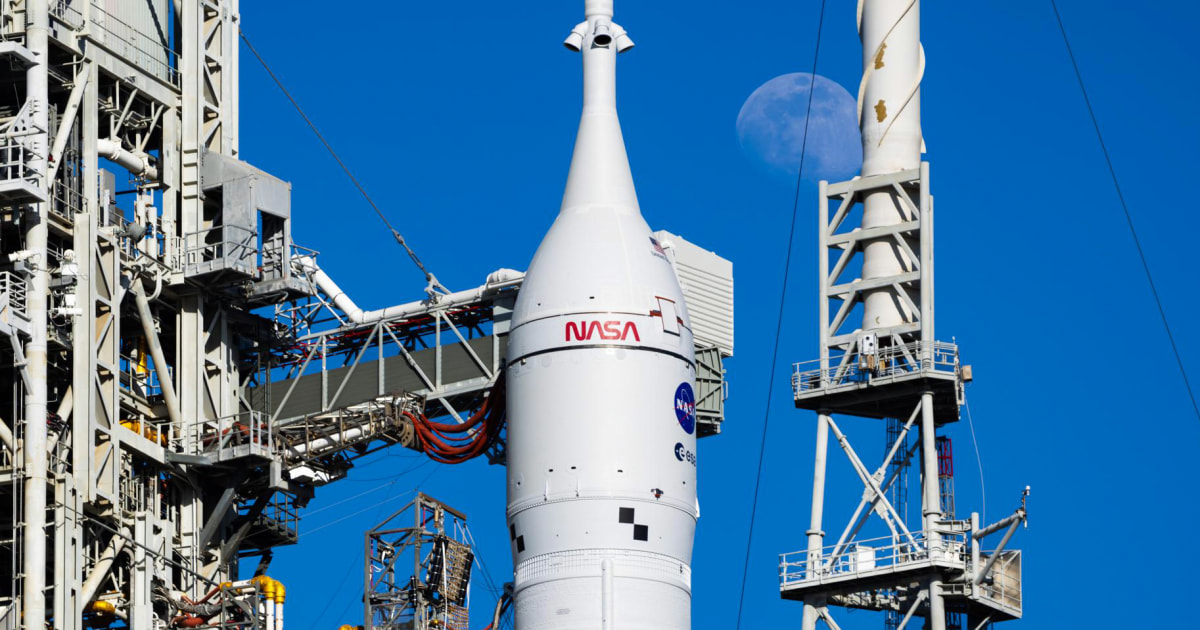
CAPE CANAVERAL, Fla. — NASA is set to conduct a critical dress rehearsal for its upcoming moon mission on Thursday, aiming to fuel its massive Space Launch System rocket and simulate launch procedures after recent repairs addressed a hydrogen leak that derailed an earlier attempt.
The test, dubbed a "wet dress rehearsal," represents a pivotal milestone in preparations for Artemis II, NASA's first crewed flight to the moon in more than half a century. Scheduled at the agency's Kennedy Space Center here, the hours-long exercise will evaluate the rocket's readiness and could pave the way for a launch as early as March 6. That date marks the beginning of a potential 10-day journey where four astronauts would orbit Earth before tracing a figure-eight path around the moon, venturing farther from our planet than any humans have before.
This mission will be the inaugural human flight for both the Space Launch System, or SLS, rocket and the Orion spacecraft, building on the uncrewed Artemis I test flight that successfully looped the moon in 2022. According to NASA officials, the rehearsal is essential before setting a firm launch target, with opportunities available from March 6 through 9, and again on March 11, if everything proceeds smoothly.
The rehearsal kicked off informally on Wednesday evening, with teams powering up rocket components, charging flight batteries, and preparing the spacecraft. The core fueling phase, however, awaits approval from mission managers and is slated to begin once the green light is given. Engineers will then load the SLS core stage with over 700,000 gallons of cryogenic propellant, including super-chilled liquid hydrogen and oxygen, to mimic the real launch conditions.
During the test, controllers will run through a simulated countdown to a planned liftoff time of 8:30 p.m. ET. NASA plans to execute two full walkthroughs of the final 10 minutes, incorporating deliberate pauses: one at T-minus 1 minute and 30 seconds, and another reset at T-minus 33 seconds back to T-minus 10 minutes. These interruptions, officials explained, allow teams to verify that the rocket's automated systems respond correctly during the critical endgame of a launch, when human intervention gives way to computer control.
"These stops and starts are designed to demonstrate that the rocket’s systems are performing as expected during the final part of the countdown," NASA stated in a mission update. The practice also equips managers to handle contingencies, such as troubleshooting unexpected problems, aborting due to technical glitches, or delaying for inclement weather—scenarios that could arise on launch day.
The Artemis II crew—NASA astronauts Reid Wiseman, Christina Koch, and Victor Glover, alongside Canadian Space Agency astronaut Jeremy Hansen—will not be present for the rehearsal. Instead, ground teams will simulate pre-flight routines, including sealing the Orion capsule's hatches and conducting other checkout procedures, to ensure seamless coordination.
This second attempt comes after a snag during the initial wet dress rehearsal on February 2, when a hydrogen leak at the rocket's base prompted an early halt. That issue scuttled all launch windows for February, forcing NASA to drain the propellants and tow the 322-foot-tall rocket back to the Vehicle Assembly Building for fixes. Engineers identified faulty seals on the fueling lines and replaced two of them, followed by a partial fueling test that revealed flow restrictions in ground support equipment.
To address the latter, NASA swapped out a clogged filter in the liquid hydrogen delivery system earlier this week, according to agency reports. "NASA said earlier this week that it had replaced a filter in the affected equipment," confirming the tweaks aimed at restoring optimal propellant flow. These repairs echo challenges from the Artemis I preparations, where similar hydrogen leaks during a 2021 rehearsal delayed that mission by six months, ultimately pushing it to November 2022.
If Thursday's test unfolds without hitches, the astronauts could enter a two-week quarantine in Houston as soon as Friday, a standard protocol to safeguard crew health before flight. However, NASA has emphasized caution: "NASA has said it ‘will not set a formal launch date until after a successful rehearsal and data reviews.’" Mission managers will pore over telemetry and performance data post-test to certify the SLS and Orion's airworthiness for human spaceflight.
The Artemis program, NASA's flagship effort to reestablish a human presence on the moon, draws parallels to the Apollo era of the 1960s and 1970s. Just as Apollo conducted circumlunar flights before landings, Artemis II serves as a crewed shakedown cruise to validate systems ahead of Artemis III, targeted for 2028. That future mission aims to touch down astronauts on the lunar south pole, a region rich in water ice that could support long-term exploration and serve as a stepping stone to Mars.
Artemis II's crew brings a mix of experience and historic firsts. Wiseman, the mission commander, Koch, the pilot, and Glover, the mission specialist, are all NASA veterans with International Space Station stints under their belts. Hansen, meanwhile, will become the first Canadian to venture beyond low-Earth orbit, underscoring international partnerships in the program, including contributions from the European Space Agency and Japan Aerospace Exploration Agency for Orion components.
The SLS rocket, standing taller than the Statue of Liberty, packs four RS-25 engines derived from the space shuttle fleet, augmented by two solid rocket boosters for a total thrust exceeding 8.8 million pounds—enough to hurl the 95,000-pound Orion capsule toward the moon at speeds topping 24,000 mph. Once in lunar orbit, the crew will spend about six days circling the moon, conducting experiments and testing life-support systems, before splashing down in the Pacific Ocean off California's coast.
While excitement builds for this revival of lunar ambitions, the program has faced scrutiny over its $4.1 billion-per-launch cost and delays. Critics, including some in Congress, have questioned the SLS's reusability compared to private alternatives like SpaceX's Starship, selected for Artemis III's lander role. NASA counters that the SLS provides unmatched reliability for deep-space crewed missions, with Artemis II proving the hardware's human-rating.
Looking ahead, a successful rehearsal could accelerate NASA's timeline, injecting momentum into the broader goal of sustainable lunar exploration. By 2030, the agency envisions a lunar Gateway station in orbit and regular crew rotations to the surface, fostering technologies for eventual Mars voyages. For now, all eyes are on Kennedy Space Center, where Thursday's test could light the fuse for humanity's return to the moon.
As teams finalize preparations, the stakes are high—not just for the four astronauts, but for NASA's vision of a multi-planetary future. With repairs in place and procedures refined, the agency stands on the cusp of history, ready to script the next chapter in space exploration.