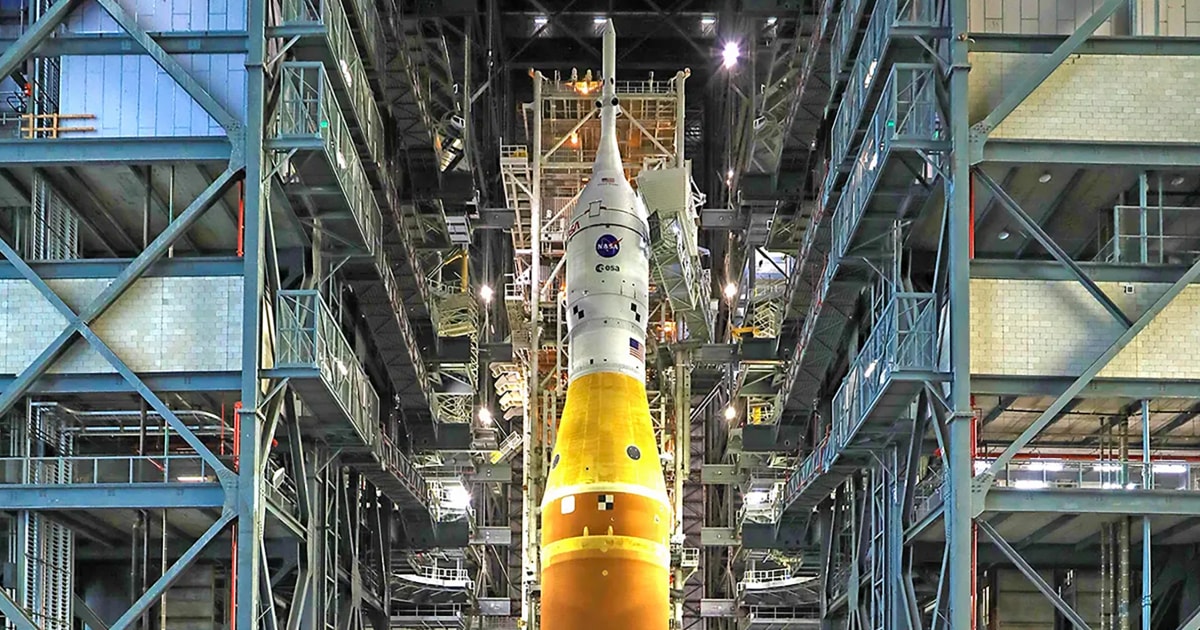
CAPE CANAVERAL, Fla. — In a milestone that evokes the grandeur of America's early space age, NASA on Saturday rolled out its massive Space Launch System rocket to the launchpad at Kennedy Space Center, marking a crucial step toward sending four astronauts on a historic journey around the moon.
The 322-foot-tall behemoth, weighing a staggering 11 million pounds and topped with the Orion spacecraft capsule, completed a deliberate four-mile trek from the agency's Vehicle Assembly Building to Launch Pad 39B. The journey began at 7 a.m. ET and concluded nearly 12 hours later at 6:42 p.m. ET, crawling along at about one mile per hour on a massive crawler-transporter platform that has been a fixture of NASA's operations since the Apollo era.
This rollout is part of the preparations for Artemis II, NASA's first crewed mission to the moon in more than 50 years. The flight is targeted for sometime between February 6 and 11, with additional launch windows available in March and April, according to agency officials. If all goes according to plan, the mission will pave the way for future lunar landings and deeper exploration of the solar system.
"These are the kind of days we live for," said John Honeycutt, chair of the Artemis II mission management team, during a news briefing on Friday ahead of the rollout. His enthusiasm captured the sense of anticipation among the hundreds of engineers and technicians who have poured years into assembling the rocket's components in the cavernous Vehicle Assembly Building.
The crew for Artemis II includes NASA astronauts Reid Wiseman, Victor Glover, and Christina Koch, along with Canadian Space Agency astronaut Jeremy Hansen. The four will spend about 10 days in space, first orbiting Earth before slinging into a lunar trajectory. While the mission won't land on the moon, it will test the Orion capsule's life-support systems, docking mechanisms, and overall performance with humans aboard for the first time.
Launch Pad 39B holds a storied place in space history. It was from here that the Apollo missions lifted off, carrying astronauts like Neil Armstrong and Buzz Aldrin to the lunar surface in the late 1960s and early 1970s. The pad also served as the departure point for dozens of space shuttle flights until that program's retirement in 2011. Now, it's being repurposed for the SLS rocket, which NASA describes as the most powerful launch vehicle ever built.
With the rocket now secured at the pad, the next phase involves a series of rigorous tests, including the highly anticipated wet dress rehearsal. This exercise will simulate launch day procedures, loading the rocket with cryogenic fuels and counting down to T-minus 29 seconds, just shy of ignition. "Launch day will be pretty similar to wet dress," explained Artemis launch director Charlie Blackwell-Thompson. "There'll be two big differences: One is that we're going to send the crew to the pad, and the other one is we're not going to stop at 29 seconds."
The wet dress rehearsal is designed to uncover any potential issues, such as fuel leaks or system malfunctions, in a controlled environment. If problems arise, the rocket could be rolled back to the Vehicle Assembly Building for repairs, potentially delaying the timeline. However, mission managers expressed confidence Friday that the rollout itself proceeded without major hitches, providing valuable data on the booster's integrity.
Artemis II represents a pivotal test for both the SLS rocket and the Orion spacecraft, which have undergone uncrewed flights before but never carried humans on this scale. During the mission, the astronauts will perform a variety of experiments, including checks on the spacecraft's ability to dock with future modules and maintain habitable conditions during the roughly 1.3 million-mile round trip to the moon and back.
The broader Artemis program aims to establish a sustainable human presence on the moon, with Artemis III slated for as early as 2027. That follow-on mission plans to land astronauts near the moon's south pole, a region rich in water ice that could support future bases or fuel production for Mars voyages. NASA has partnered with private companies like SpaceX to develop the human landing system for that flight.
Returning to the moon has been a key priority for U.S. space policy, particularly under former President Donald Trump, who accelerated the Artemis initiative amid a renewed space race with China. Chinese officials have announced plans to land their own astronauts on the lunar surface by 2030, prompting U.S. leaders to emphasize the need for American leadership in deep space exploration.
The rollout comes at a time when NASA's budget and timelines have faced scrutiny. Delays in previous Artemis preparations, including technical glitches with the Orion heat shield and hydrogen tank issues, have pushed back schedules. Yet, Saturday's event was a visible sign of progress, drawing crowds of onlookers and live coverage from space enthusiasts worldwide.
For the astronauts involved, the mission carries personal weight. Reid Wiseman, the mission commander, has flown to the International Space Station before and spoke last year about the thrill of pushing boundaries. Victor Glover, a Navy test pilot, will serve as pilot, while Christina Koch, who holds the record for the longest single spaceflight by a woman, and Jeremy Hansen, Canada's first astronaut to venture beyond low-Earth orbit, round out the diverse crew.
As preparations continue, NASA officials stressed the importance of safety above all. The wet dress rehearsal, expected to begin in the coming weeks, will be a dress rehearsal in every sense, ensuring that when the crew straps in, everything is primed for a flawless ascent. If successful, an official launch date could be announced soon after, bringing the dream of lunar flyby one step closer to reality.
Looking ahead, a triumphant Artemis II could reignite public interest in space exploration, much like the Apollo missions did decades ago. With international partners like the Canadian Space Agency involved and eyes on Mars as the ultimate goal, Saturday's slow procession to the pad symbolizes not just technical achievement, but a renewed commitment to humanity's place among the stars.